About Octopus tetricus Gould, 1852
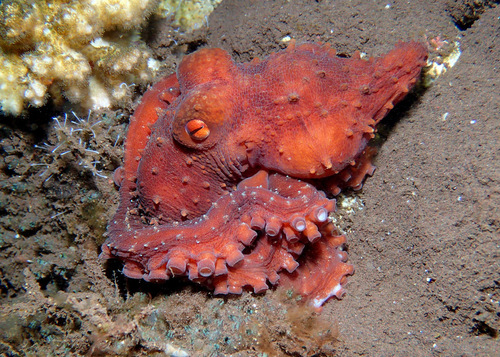
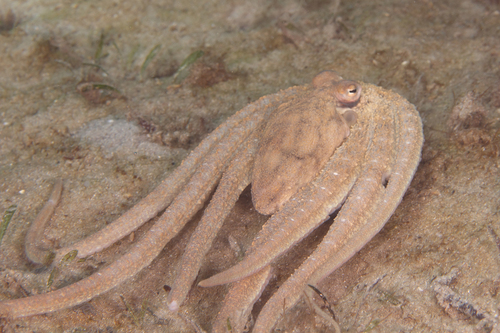
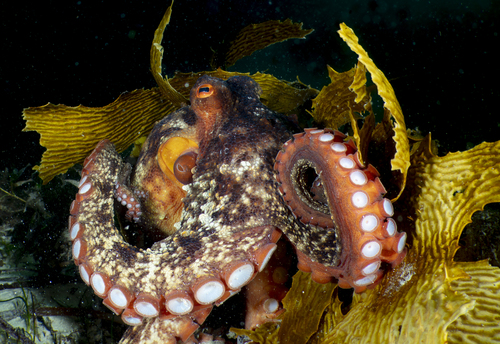
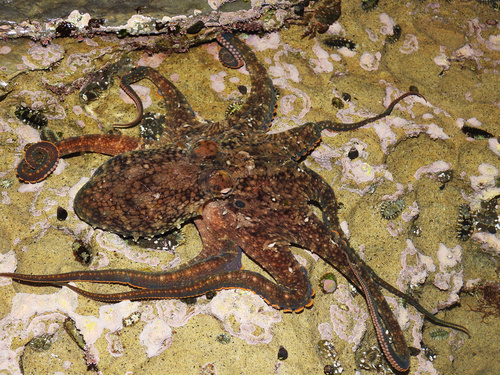
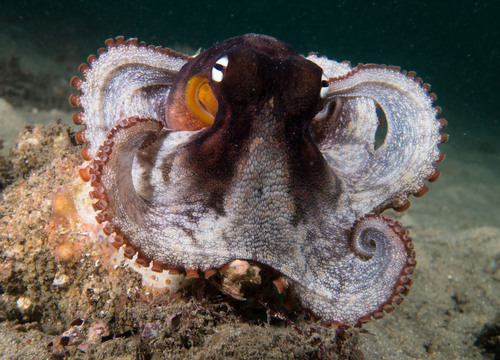
Anatomy and morphology of Octopus tetricus: this species is typically grey to mottled brown, with rufous arm faces that taper toward the tip. The arms, funnel, and mantle opening are coloured orange, and its eyes are usually white. Its skin has a granular texture, with many small irregularly shaped patches and large warty structures that make the octopus look spiky when it camouflages itself as seaweed. Adult individuals usually have an arm span of 2 metres (6.6 ft), a mantle length of up to 20 cm (7.9 in), and the maximum recorded weight for this species is 2.6 kg (5.7 lb). Like all species in the Octopoda order, its second and third arms are longer than the first and fourth arms. The main components of its nervous system are the brain, the optic lobes, and the highly developed arm nervous system. Each arm is capable of independent processing, motor control, and sensory exploration, leading to the common idea that octopuses have many brains. The arm nervous system holds three-fifths of the octopus's total 350 million neurons, which are evenly distributed across all eight arms. Distribution: O. tetricus was originally discovered in New South Wales, and is found along Australia's eastern coastline, occurring from Lakes Entrance in Victoria to Moreton Bay in southern Queensland. It lives in the subtropical seas of eastern Australia and northern New Zealand, including Lord Howe Island. A close relative, Octopus djinda, which occupies similar latitudes in Western Australia from Shark Bay to Cape Le Grand, was considered the same species as O. tetricus until 2021. The first recorded sighting of O. tetricus in New Zealand was in 1997, and it has since become one of the most common octopus species in New Zealand alongside Pinnoctopus cordiformis and Macroctopus maorum. In New Zealand, O. tetricus populations live along the northeast coast of the North Island, between the Bay of Plenty and Northland. Gene sequencing confirms that Australian and New Zealand O. tetricus originate from the same original population. It is proposed that gene flow across the Tasman Sea occurs via planktonic larvae and/or adult octopuses using floating wood or algae for transport. It is hypothesised that warming waters spreading south of Australia are driving O. tetricus populations to disperse further south in response to climate change. Habitat: O. tetricus occurs in the intertidal zone along rocky shores and seagrass beds, and can be found out to depths of 70 m (230 ft). While individuals often occupy soft-sediment seabed areas for most of their lives, the species is more commonly associated with rocky reefs during the breeding season. O. tetricus modifies its habitat by digging out dens, and uses prey remains including shells to build up these sites. Scallop beds are very commonly found close to these excavated dens; scallops act as a food source for the octopus, and their shells are incorporated into the shell beds built around dens. One O. tetricus den in Sydney has been recorded as being continuously used by different individuals since at least 2009. O. tetricus has been observed shifting and transporting sediment and shells to maintain its dens, and tends to prefer materials that are free from barnacles and encrustations. The extent of this preference depends on the octopus's foraging success. This species can be found in a range of coastal environments year-round, but adult individuals have been observed aggregating inshore to breed during spring and summer. Most individuals have high site fidelity, remaining in the same location for an average of 3 months. Movements between coastal areas and deeper ocean depths may correlate with the individual's current life cycle stage. Life cycle stage also affects where an individual sits inside its den: brooding females sit near the den entrance to protect their eggs, while non-brooding females stay near the back of the den. Females must defend their eggs from conspecific males and other marine organisms such as eels. O. tetricus is classified as an ecosystem engineer, because the habitat modification it carries out shapes and builds an ecosystem around its dens. The octopus carries prey, often shellfish, on its back, and discards empty shells at its den after feeding. The shell beds that form around excavated dens provide hiding places that attract hermit crabs and fish; these small fish and small prey species in turn attract larger species, and this cycle builds into a full established ecosystem. A solid object can act as a suitable den and become the starting point of a new O. tetricus settlement. Studies show that O. tetricus has larger populations in patch reef habitats than in broken reef habitats, and is rarely found on flat reefs. Adult O. tetricus occupy coastal reefs in summer, then disappear around the second week of April, which is the second week of autumn in Australia. Shelters play a critical role in the ecology of this octopus. When resources such as food and dens are scarce, octopuses will often attempt to exclude and displace other individuals. Reproduction and growth: The female reproductive cycle is linked to seasonal changes, similar to many other species. Females reach maturity around Australia's spring and summer to mate and lay eggs. During mating, the male O. tetricus transfers spermatophores to the female in one of two ways: the male either wraps his arms and web around the female's mantle, or reaches his mating arm from a distance to insert it into the female's mantle. The male's third right arm is the specialized mating arm; sperm travels down a groove on this arm, which has a sucker-less tip. Spermatophores are released from the male's terminal organ, moved by the male's oral suckers, then inserted into the female's oviduct. O. tetricus begins life as eggs laid in large clutches in the female's nest, with approximately 270,000 eggs laid per female. The eggs are normally glued to rock or substrate at the top of the den dug by the female. The female typically lays eggs over several nights, arranged in string formations. The size and number of egg strings depends on the size of the female, and can range between 60 and 200 egg strings. The female then guards the eggs until they hatch. Female O. tetricus can store viable sperm for up to 114 days. The length of embryonic development varies with water temperature. Newly hatched O. tetricus larvae are approximately 2.5 mm long and 1.1 mm wide, about the size of a grain of rice. These larvae go through a planktonic (free-floating) paralarval stage before settling to the seabed and growing large enough to hunt for food; this stage generally lasts 35 to 60 days. Female O. tetricus are known to cannibalise males after mating. Temperature plays a key role in the growth of this octopus species. With an adequate food supply, octopuses living in cooler water grow slower during their main growth phase, but reach a larger adult size than octopuses living in warmer water.