About Octopus sinensis d'Orbigny, 1834
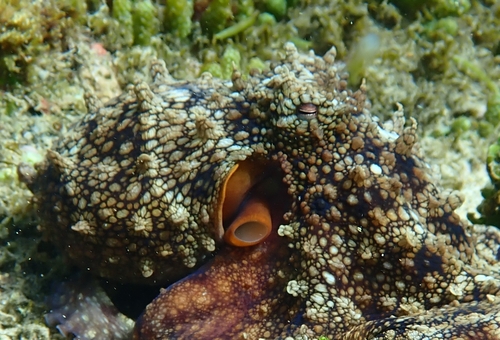
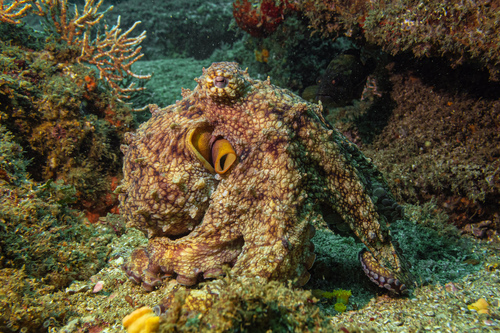
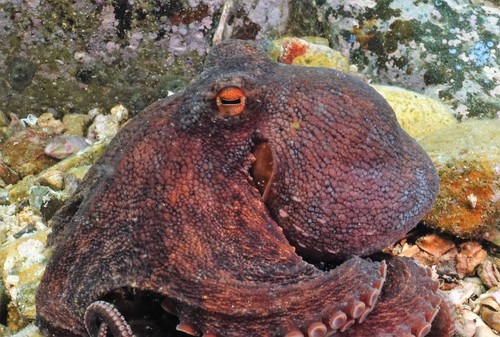
Octopus sinensis d'Orbigny, 1834, commonly called the East Asian common octopus, is adapted for a benthic lifestyle on the sea floor. This species has long arms that bear many suckers, which it uses to catch prey. Its mantle has no rigid skeleton, allowing the octopus to inhabit and hunt in small spaces and crevices along the seabed. It also has horizontal pupils, and versatile skin that can change color to let the octopus camouflage itself against the sea floor. Compared to Octopus vulgaris, O. sinensis has a broader mantle, relatively shorter arms, and roughly 80 fewer suckers in total. In mature male O. sinensis, the third right arm has far fewer suckers than the matching arm of O. vulgaris, with 120 to 140 suckers for O. sinensis versus 150 to 190 for O. vulgaris. This hectocotylized third right arm has erectile tissue at its tip, along with a channel that holds sperm packets. During copulation, male O. sinensis insert this third right arm into the female's mantle.