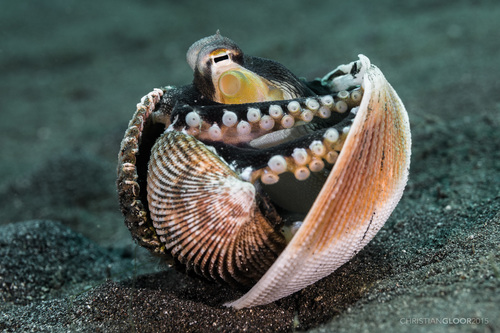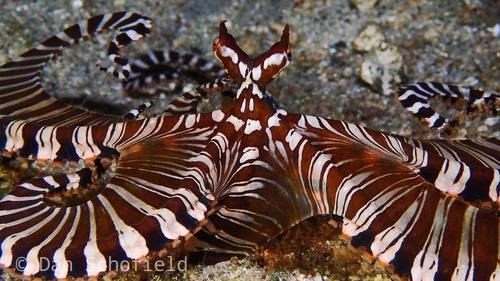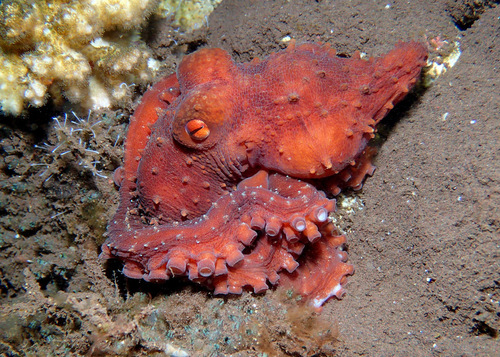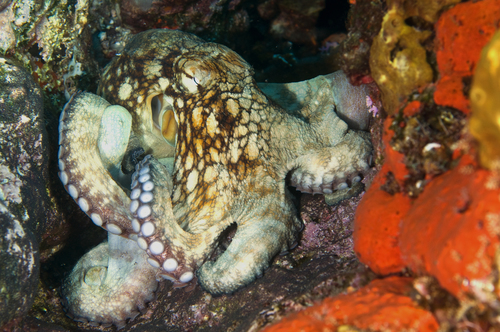
About Octopus cyanea Gray, 1849
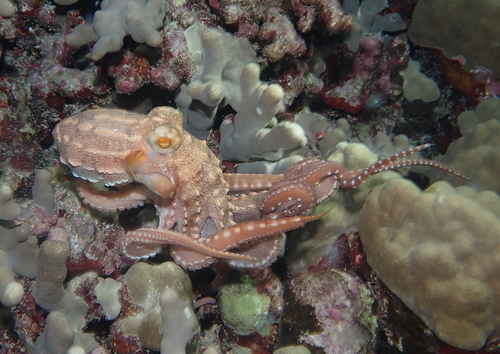
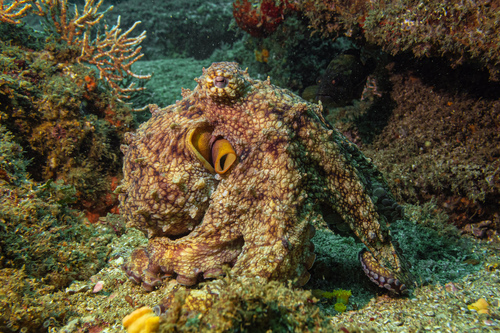
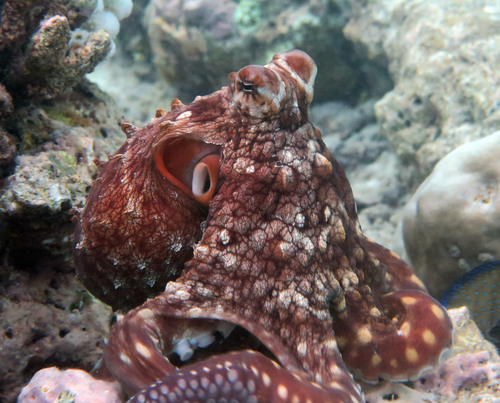
Octopus cyanea Gray, 1849 lives on coral reefs and hunts during the day. It is highly skilled at camouflage: it can not only change color frequently, but also alter the patterns and texture of its skin. One researcher recorded it changing its appearance 1000 times over seven hours. As it moves across the seabed, it adjusts its color and overall appearance to match the underlying substrate. These color changes happen instantly, and are controlled by chromatophores under direct brain control. When this octopus is stationary near prey such as a crab, it sometimes produces a "passing clouds" display. This mimics a dark shadow moving across the octopus's surface, and may encourage the crab to move incautiously. O. cyanea is found on reefs and in shallow waters across the Indo-Pacific. Its range extends from the Red Sea, East African coast, and Madagascar, through southeastern Asia and Oceania, all the way to Hawaii. While most octopus species are nocturnal, O. cyanea is diurnal, though it is mostly crepuscular — active at dawn and dusk. It maintains a den that it returns to after foraging; this den may be a rock crevice, a hidden spot under an overhang, a shelter among coral heads, or a hole it has excavated in rubble or sand. It is a predator that searches reefs for fish, crabs, shrimp, and molluscs. Small prey items are typically eaten where they are caught, while larger prey is carried back to the den to be consumed. Crabs may be killed by a bite and injected with toxic saliva, then chewed apart by the octopus's beak. For molluscs, the octopus drills through their shells and predigests the soft animal inside to make extraction easier. Empty mollusc shells and empty crab carapaces are discarded outside the den, forming a midden. O. cyanea sometimes engages in cooperative hunting with the roving coral grouper. Day octopuses have also been observed joining group hunts with blacktip grouper and goatfish in the Red Sea. During these hunts, individual octopuses have been seen punching and striking groupers with their arms. Researchers theorize this behavior is a "discipline" response towards fish that exploit the hunt rather than participating actively, and it also works to prevent fish from crowding around the octopus. Since some punching events have happened outside of these group hunting situations, it is also speculated that day octopuses may engage in this behavior out of spite, as a response to normally cooperative partners stealing prey from the octopus or other fish in the hunting group. After settling from its planktonic larval stage, O. cyanea has a lifespan of 12 to 15 months. During this period, it grows from approximately 67 grams (0.1 pounds) to 6,500 grams (14.3 pounds). Its growth curve is nearly exponential, and it converts prey into new growth with an efficiency greater than 50%. It relies on protein for growth, energy production, and energy reserves. In captivity, this octopus can breed at any time of year, which probably depends on when the female reaches maturity. Mating can sometimes become cannibalistic. Even so, Octopus cyanea socially tolerates other individuals by sharing tanks and dens, and there is typically no loss from cannibalism or escape when they share space. However, these octopuses also show significant levels of social repulsion, and individuals often choose to occupy a solitary den when that option is available. A male may mate with several different females, but after mating, the suckers on the edge of his webbing increase in size. Over the next two to three months, these suckers continue to enlarge while the male's health declines and he eventually dies. Meanwhile, the female stays beside her eggs, which are deposited in a den, and she dies soon after the eggs hatch.