About Octopus briareus G.C.Robson, 1929
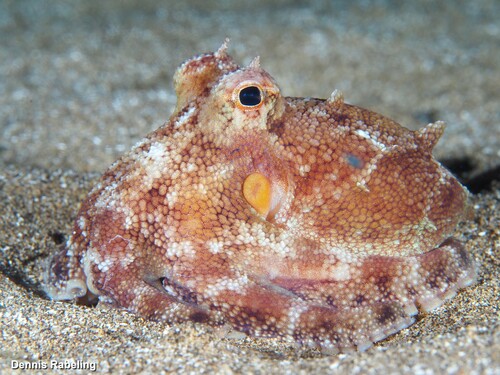
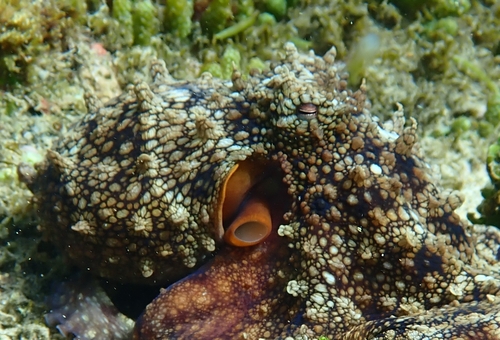
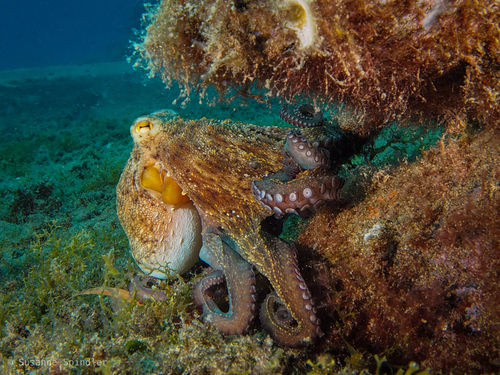
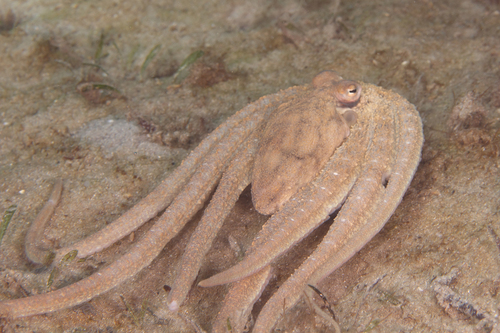
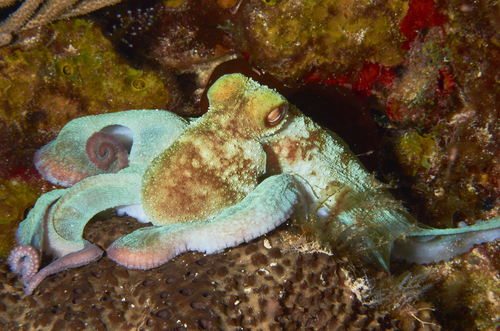
The Caribbean reef octopus, Octopus briareus, is a marine species that lives on coral reefs. It has eight long arms that vary in length and diameter, and a large, bulky mantle that can grow up to 60 cm long. This species is hard to describe because it uses specialized skin cells called chromatophores to change its color and texture to camouflage itself against its surroundings. It can display a very wide range of colors, shifting from crimson to green, and can change its skin texture from bumpy to smooth. Adults typically weigh around 1.5 kg, or 3.3 lb. The Caribbean reef octopus inhabits warm waters in coral reef environments, as well as grassy and rocky sea beds. Its confirmed biogeographic regions include the Nearctic region, the Neotropical region covering Central and South America, oceanic islands, and the Pacific Ocean. This octopus lives in hidden, hard-to-locate rocky lairs, which are usually found in shallow warm waters. Octopus briareus is not a social species, and it keeps a safe distance from other members of its own species except during mating. When confronted by a predator, like most octopuses, it takes in a large volume of water and quickly expels it as a jet to propel itself away from danger. It can also eject ink to obscure a predator's view and further help it escape. This octopus does not stay in one lair for its whole lifetime; instead, it moves to new lairs frequently, except when it is caring for eggs or young. The mating season of Octopus briareus lasts one to two months, and usually occurs around January. Males and females of this species do not show sexual dimorphism. To mate, the male first mounts the female's mantle, then inserts his hectocotylus—a specialized arm that acts as a tube—to deliver sperm into the female's oviduct. The mating process lasts around half an hour. This octopus usually mates during the day, and only the male can start or end mating. After fertilization, the female can store sperm in her oviduct for up to 100 days. The female lays her eggs after she finds a suitable lair, and some females seal themselves inside their lair while pregnant. A single female can lay up to 500 eggs, and clusters of eggs are connected by specialized stalks. The female stays with her eggs until they are ready to hatch, and will attack any creature that comes near the eggs, though she does not eat any creatures she kills during this defense. Eggs take between 50 and 80 days to hatch, and hatch more quickly in warmer water. Newly hatched young are already capable of jet propulsion and squirting ink, just like adult octopuses. Hatchlings grow to 75% of their full adult size in just 14 weeks. Male hatchlings reach sexual maturity in 140 days, while female hatchlings reach sexual maturity in 150 days.