About Octopus bimaculoides Pickford & McConnaughey, 1949
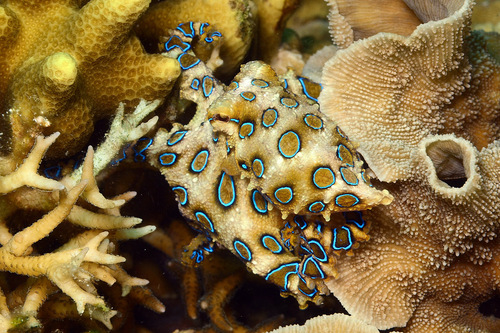
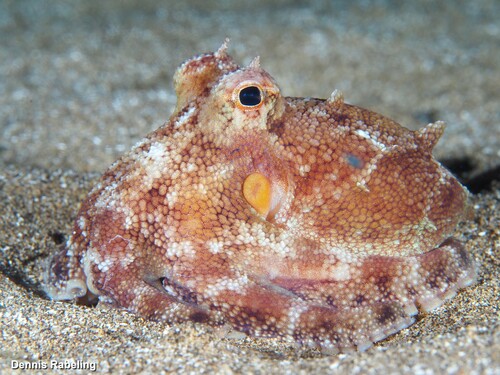
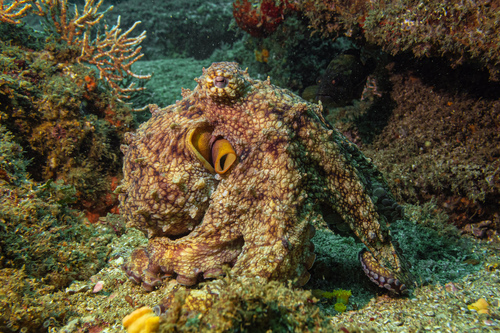
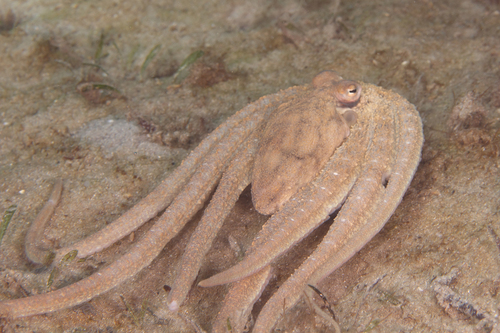
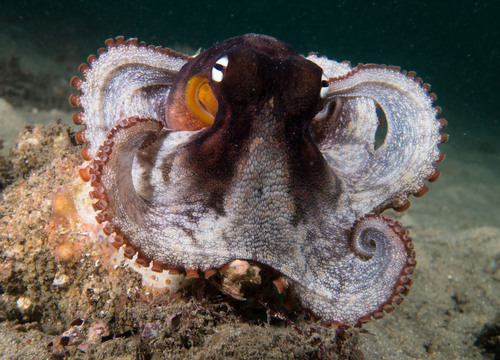
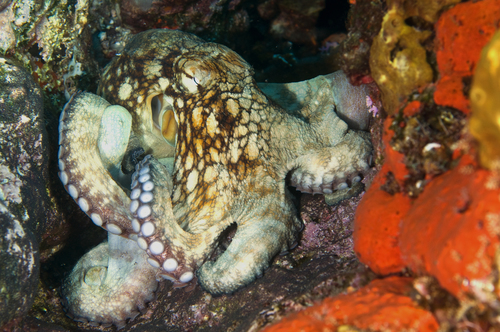
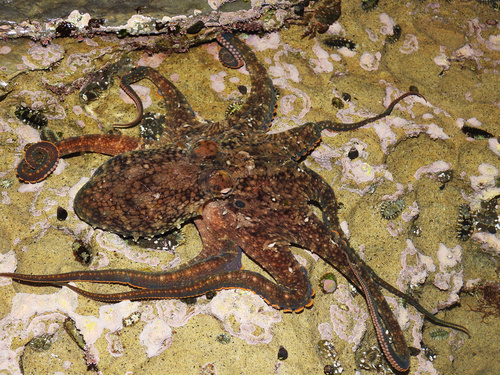
Octopus bimaculoides reaches a mantle size of 17.5 cm (6.9 in), with arms that can grow up to 58 cm (23 in). Its body is not usually heavily textured, and it has several common color schemes, such as grey with yellow splotches. This species uses highly developed crypsis—camouflage or color change to match its surrounding environment. Color change in these octopuses is achieved partially through three types of skin structures, arranged from shallowest to deepest: chromatophores, iridophores, and leucophores. Chromatophores are elastic pigment sacs with attached muscle fibers that allow them to expand and contract. Leucophores are important because they reflect white light, enabling the skin to reflect light wavelengths common in the species’ habitat and produce disruptive camouflage patterns. The brain also contributes to cephalopod camouflage: it has nerves coated in chromatophore fibers that control coloration patterns. This octopus gets its name from a false eye spot (ocellus) located under each of its true eyes. These ocelli are iridescent blue chain-link circles, set within a larger black circle. The octopus’s arms hold many suckers, which it uses to taste. It has three hearts, two gills, blue blood, and a donut-shaped brain. O. bimaculoides is found in coastal waters of the eastern Pacific Ocean, along mid and southern California, and along the western side of Mexico’s Baja California Peninsula. It lives at depths ranging from the intertidal zone down to at least 20 m (66 ft). The species prefers rocky reefs or debris for hiding, tolerates a broad temperature range of 15–26 °C (59–79 °F), and favors temperatures between 18–22 °C (64–72 °F). Individuals become ready to reproduce towards the end of their lifespan. These octopuses are semelparous, meaning they mate and reproduce only once in their lifetime. Mating can occur at any time of year, but is most common during summer when water temperatures are warmer. The male uses spermatophores to fertilize the female, and dies shortly after mating. After mating, the female builds a den where she lays 20 to 100 eggs. She tends the eggs to keep them healthy by blowing cool water through her siphon to supply the eggs with oxygen, and this care continues until the eggs hatch 150 to 210 days after laying. Throughout this brooding period, the female does not eat, her health deteriorates, and she almost always dies after the eggs hatch.