About Ocreatus addae (Bourcier, 1846)
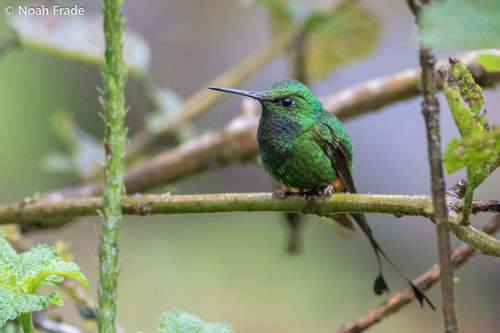
Ocreatus addae, also known as the addae rufous-booted racket-tail, belongs to the racket-tail group, in which all species show pronounced sexual dimorphism. Only males possess elongated outer rectrices (tail feathers) that have bare shafts with terminal flags. In both the addae and annae racket-tails, these tail feathers are decurved and cross over one another, and their terminal flags are asymmetric ellipses. Male rufous-booted racket-tails measure 11 to 15 cm (4.3 to 5.9 in) long, including their 5.5 to 6 cm (2.2 to 2.4 in) long outer tail feathers, and weigh 2.5 to 2.7 g (0.088 to 0.095 oz). Females are 7.6 to 9 cm (3.0 to 3.5 in) long and weigh 2.6 to 3.2 g (0.092 to 0.11 oz). Both sexes of addae and annae share several physical traits: they have greenish upperparts with no glittering forehead, a white spot behind the eye, and buff leg puffs. Males of addae have a mostly white throat with patches of green, and a white belly with green spots. Their terminal tail flags are greenish black. Like female annae, female addae have a white throat and breast that is heavily spotted with green. The addae rufous-booted racket-tail is distributed along the east slope of the Bolivian Andes, while the related annae rufous-booted racket-tail occurs on the east slope of the Andes of central and southern Peru. This species favors the edges of humid to wet forest, but is also found in the forest interior and in more open secondary forest. It is most abundant at elevations between 1,600 and 2,200 m (5,200 and 7,200 ft), though it can be found as low as 600 m (2,000 ft) and as high as 4,000 m (13,000 ft).