About Ocnus planci (Brandt, 1835)
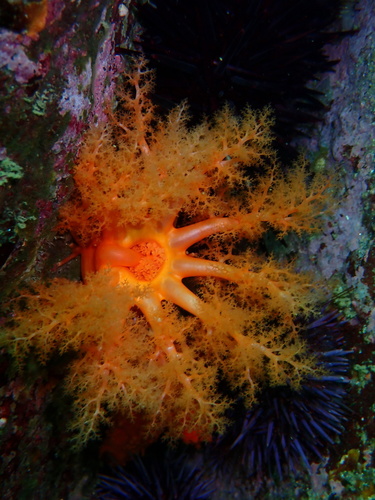
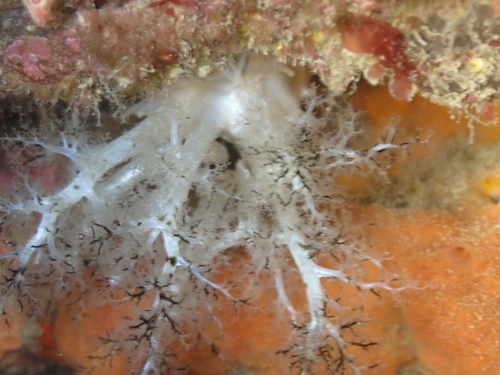
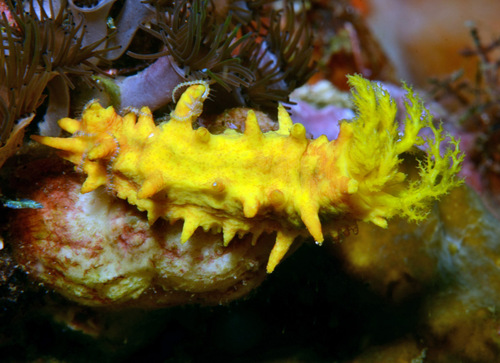
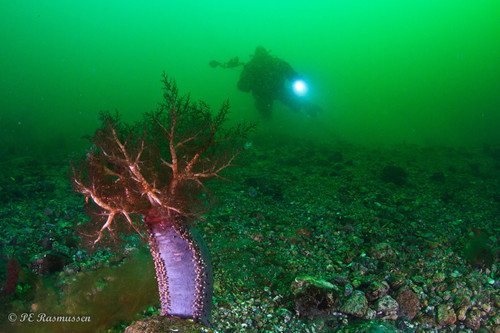
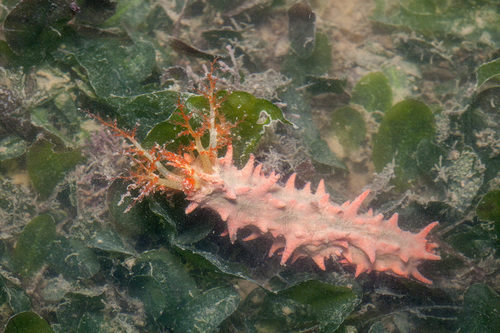
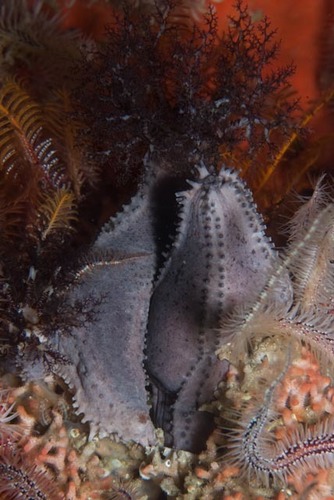
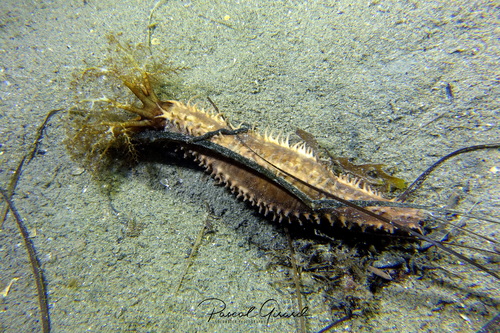
Ocnus planci (Brandt, 1835) is a cylindrical sea cucumber that grows up to 150 mm (6 in) in length and 35 mm (1.4 in) in diameter. It has a brownish body, often marked with irregular dark brown patches. It has ten feeding tentacles: eight large and two small, all branched, leaf-like, and lighter in color than the body. This species is a suspension feeder. It has retractile tube feet arranged in five zigzag double rows. Its skin is thick, smooth, and leathery, strengthened by calcareous spicules; some spicules are plates pierced by more than four holes, while others are cup-shaped. This sea cucumber is found in European waters and off the coast of West Africa, with its neotenous form distributed in the north. It is an epifaunal species that lives on hard substrates including rocks, shells, tubeworms, and algae, at depths ranging from 15 to 175 m (50 to 570 ft). In Northern Ireland, this species occurs in Carlingford Lough and Strangford Lough, and it is listed as a Northern Ireland Priority Species due to its rarity there. Ocnus planci exhibits neoteny, meaning it retains its juvenile form beyond the typical age of maturation. The neotenous form has a single row of tube feet and is less than an inch long. These neotenous individuals were originally mistaken for a separate species named Ocnus brunneus. This species has separate sexes; adult individuals reproduce sexually through spawning in spring. Fertilized eggs are retained by the female on her tentacles, where they develop directly into the adult form without undergoing metamorphosis. The neotenous form reproduces asexually via transverse binary fission.