About Oclemena nemoralis (Aiton) Greene
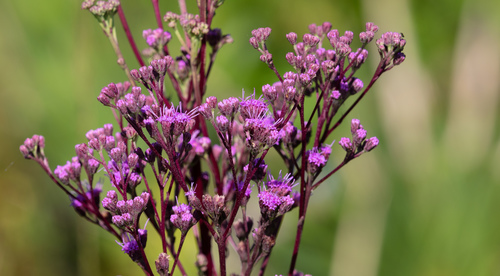
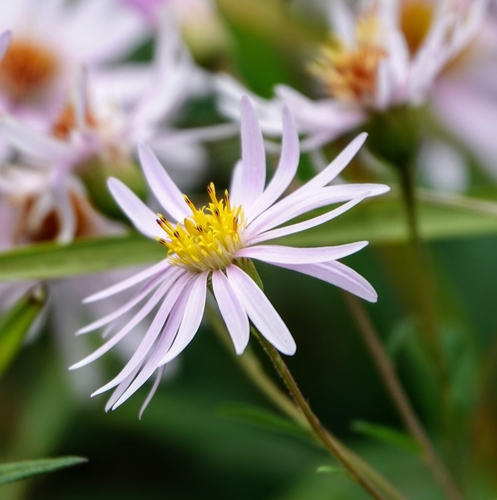
Oclemena nemoralis (Aiton) Greene is a perennial herbaceous plant that reproduces via a swollen tuber located at the tip of a slender, elongated rhizome. Individuals grow between 5 cm and 70 cm (2 in to 28 in) in height. 30 to 100 leaves are evenly distributed along the stem, each measuring 1 to 8 mm wide. Leaf margins are entire, or nearly entire, and revolute. This species can produce up to 15 flower heads, which are nodding when in bud, but most often bears a single flower head. The flower head grows on a thread-like peduncle 3 to 7 cm (1.2 to 2.8 in) long. Each flower head contains 13 to 25 ray flowers that range from pink to purple, and are very rarely white, plus 20 to 35 disc flowers. Oclemena nemoralis is closely related to Oclemena acuminata. Hybrid populations can form anywhere the two parent species grow in contact with each other, which occurs at the forest-bog ecotone. This hybrid is commonly called Blake's aster. Oclemena nemoralis is native to eastern Canada, the northeastern United States, and Saint Pierre and Miquelon. In Canada, it is found in New Brunswick, Newfoundland and Labrador, Nova Scotia, Ontario, Prince Edward Island, and Quebec. In the United States, it occurs in Connecticut, Delaware, Maine, Maryland, Massachusetts, Michigan, New Hampshire, New Jersey, New York, Pennsylvania, Rhode Island, and Vermont. Across most of its native range, Oclemena nemoralis has adapted to grow in acidic sphagnum bogs. In the eastern Upper Peninsula of Michigan, however, it prefers fen habitats. The Ojibwe people use a decoction made from this species' root as ear drops or in a compress to treat sore ears.