About Ochthoeca oenanthoides (Orbigny & Lafresnaye, 1837)
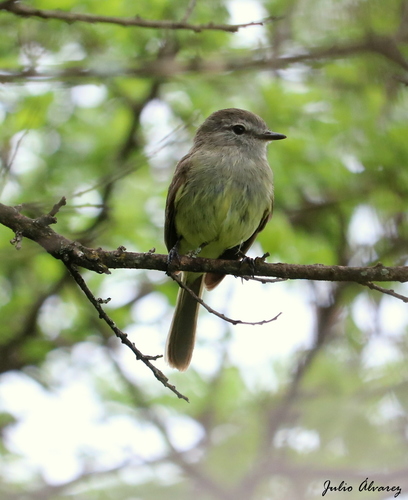
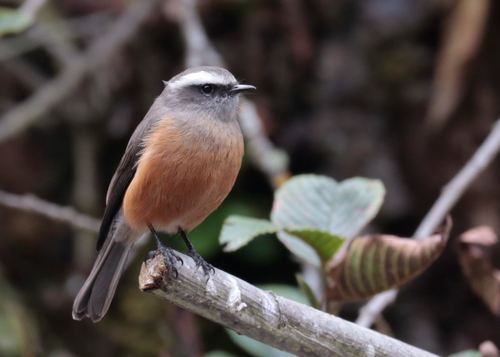
D'Orbigny's chat-tyrant (scientific name Ochthoeca oenanthoides (Orbigny & Lafresnaye, 1837)) measures 15 to 15.5 cm (5.9 to 6.1 in) long, and males and females have identical plumage. For the nominate subspecies, adults have a grayish or grayish brown crown, a wide whitish supercilium that starts at the lores and extends well past the eye, and a blackish "mask". Their upperparts are either grayish brown or grayish. Their wings are a duskier grayish brown marked with a weak grayish cinnamon wing bar; the wing's secondaries have thin white edges, and their tertials have grayish cinnamon edges. Their tail is dusky grayish brown, with white outer webs on the outermost feathers. Their throat is grayish, their breast is dusky cinnamon, their lower belly is deep cinnamon, and their vent is white or grayish white. Juveniles have a creamy white supercilium. Subspecies O. o. polionota is overall darker than the nominate subspecies, with sooty upperparts. Compared to the nominate, its supercilium is whiter, its mask is darker, its wing bars are weaker, its underparts are darker, and its vent has a cinnamon wash. Both subspecies have a dark brown iris, a black bill, and black legs and feet. D'Orbigny's chat-tyrant is an Andean bird, with two subspecies, of which O. o. polionota is the more northerly. O. o. polionota is found in Peru from La Libertad and San Martín departments south to Cuzco and northern Puno departments. The nominate subspecies ranges from southern Puno and Tacna departments in Peru south into far northern Chile's Arica y Parinacota Region, and through western Bolivia into northwestern Argentina as far as La Rioja Province. The two subspecies overlap slightly in Peru, where they occur on the western slope of the Andes. This species inhabits dry montane forest and woodlands, especially woodlands with Polylepis. It often occurs in ravines, but does not appear to be necessarily closely associated with water. It also frequently occurs on rocky slopes with scattered shrubs. In terms of elevation, in Peru it mostly ranges between 3,400 and 4,600 m (11,200 to 15,100 ft), but occurs locally as low as 3,000 m (9,800 ft). In Argentina it can be found as low as 2,000 m (6,600 ft).