About Ochthoeca fumicolor P.L.Sclater, 1856
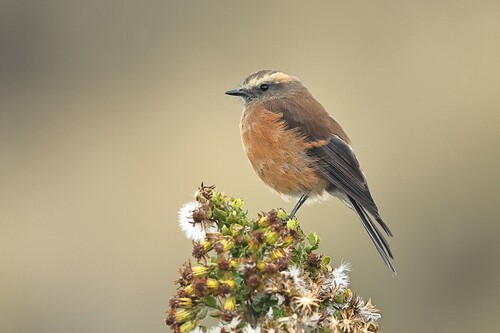
The brown-backed chat-tyrant (scientific name Ochthoeca fumicolor P.L.Sclater, 1856) measures 14.5 to 16 cm (5.7 to 6.3 in) long and weighs 16 to 19 g (0.56 to 0.67 oz). The plumage of males and females is very similar, though females have somewhat paler and duller underparts than males. For adults of the nominate subspecies O. f. fumicolor, the crown is warm brown, and a wide whitish supercilium starts at the lores and becomes somewhat ochraceous past the eye. The rest of the face is grayish. Upperparts are rufescent brown, which shifts to rufous brown on the rump. The wings are dusky or blackish with two prominent rufous wing bars. The tail is dusky to blackish, with white outer webs on the outermost feathers. The throat is grayish, and the rest of the underparts are mostly cinnamon-rufous, with buff undertail coverts. The other recognized subspecies differ from the nominate and each other in the following ways: O. f. ferruginea has a shorter, buffy supercilium and more white on the tail feathers than the nominate. O. f. brunneifrons has a longer, entirely buff supercilium and wider rufous wingbars than the nominate. O. f. berlepschi has a shorter, thinner, dirty whitish supercilium than the nominate, and some individuals have a browner crown. All subspecies have a dark brown iris, a smallish black bill, and black legs and feet. The brown-backed chat-tyrant has a disjunct distribution, with each subspecies occupying a separate range: O. f. ferruginea is found in Colombia's Central and Western Andes, north of Caldas and Cauca departments. O. f. fumicolor occurs in the Andes from southern Táchira in southwestern Venezuela, south through Colombia's Eastern Andes to Cundinamarca Department. O. f. brunneifrons ranges from Caldas and Cauca in Colombia's Central and Western ranges, south on both slopes through Ecuador into Peru; it reaches Cajamarca Department on the western slope and Junín Department on the eastern slope. O. f. berlepschi occurs from Cuzco and Puno departments in southeastern Peru, into La Paz and Cochabamba departments in central Bolivia. The species primarily inhabits stunted montane forest up to the tree line, Polylepis woodlands, and shrubby paramo. It also lives in pastures bordered by shrubs. Its elevation range varies by region: between 2,200 and 4,200 m (7,200 and 13,800 ft) overall, with most records in Venezuela above 2,700 m (8,900 ft), between 2,500 and 3,600 m (8,200 and 11,800 ft) in Colombia, between 2,800 and 4,200 m (9,200 and 13,800 ft) in Ecuador, and between 2,500 and 4,100 m (8,200 and 13,500 ft) in Peru. Scattered records exist from as low as 1,800 m (5,900 ft) and as high as 4,500 m (14,800 ft).