About Ochroma pyramidale (Cav.) Urb.
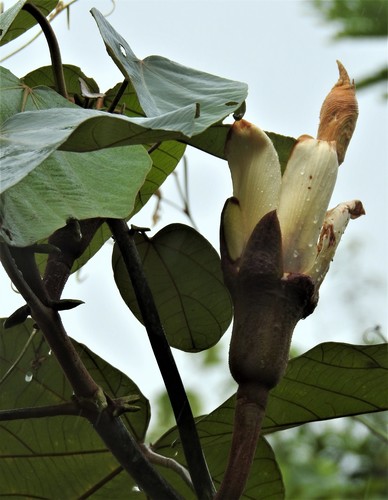
Ochroma pyramidale (Cav.) Urb., commonly known as balsa, is a large, fast-growing tree native to the Americas. It is the only member of the genus Ochroma, and belongs to the subfamily Bombacoideae of the mallow family Malvaceae. The name balsa means "raft" in Spanish and "ferry" in Portuguese. This deciduous angiosperm can grow up to 30 metres (98 ft) tall. It is classified as a hardwood, even though its wood is very soft – it is the softest commercial hardwood, and it is widely used for its light weight. Balsa trees grow extremely quickly: they often reach 27 metres (89 ft) in 10 to 15 years, and typically do not live longer than 30 to 40 years. By volume rather than height, balsa may be the fastest growing known tree. Author Streets documented one individual that grew 11.2 m (37 ft) tall and 17 cm (6.7 in) diameter at breast height over just fifteen months. Like most rainforest trees, balsa does not form annual growth rings, but this extremely fast growth would be equivalent to rings 7 cm (2.8 in) wide. Balsa is often cultivated in dense stands, and historically Ecuador has supplied 95% or more of the world's commercial balsa. Commercial balsa wood gets its valuable high strength-to-weight ratio from a kiln-drying process that leaves the wood's cells hollow and empty. Balsa wood is popular for making light, stiff structures such as model bridges, model buildings, and model aircraft. It is also used in wind turbine blades, fishing wooden crankbaits, makeshift calligraphy pens, composite materials, surfboards, boats, breakaway props for theatre and television, and even the floor pans of the Chevrolet Corvette. Balsa wood was famously used to build the raft for Thor Heyerdahl's historical Kon-Tiki expedition. It is also popular for whittling and making baroque-style picture frames, due to how easy it is to shape. Currently Ecuador supplies 70% or more of the world's commercial balsa. In recent years, around 60% of global balsa is plantation-grown in densely packed stands of roughly 1000 trees per hectare (400 per acre), compared to only two to three trees per hectare (around one per acre) in natural stands. In Ecuador, cultivated balsa trees are harvested after six to ten years of growth. The remaining commercial balsa supply comes from plantations in Papua New Guinea, where a different climate means trees are harvested at 4 to 5 years of age. Balsa wood is very soft and light, with a coarse, open grain. The density of dry balsa wood ranges from 40 to 475 kg/m³ (2.5 to 29.7 lb/cu ft), with a typical density around 160 kg/m³ (10 lb/cu ft). It is the softest wood ever measured by the Janka hardness test, with a rating of 22 to 167 lbf. Living balsa trees have large cells filled with water, which gives the wood a spongy texture. This makes green balsa wood not much lighter than water, and barely able to float. For commercial production, the wood is kiln-dried for approximately two weeks, which leaves the cells hollow and empty. The large volume-to-surface ratio of these thin-walled, empty cells gives dried balsa wood a high strength-to-weight ratio, as the cells are mostly filled with air. Unlike naturally rotted wood, which quickly disintegrates in the rainforests where balsa grows, the cellulose and lignin cell walls of kiln-seasoned balsa wood retain their strong structure. Because of its low density and high specific strength (strength per unit weight), balsa is very popular for light, stiff structures in model bridge tests, model buildings, and model aircraft construction. All grades of balsa are suitable for airworthy control line and radio-controlled aeromodeling, while the lightest "contest grades" are especially valued for free-flight model aircraft. Balsa is also used as a component in full-sized light wooden aeroplanes, most famously the World War II de Havilland Mosquito. It is used to make wooden crankbaits for fishing, particularly Rapala lures. Dried balsa sticks work well as makeshift calligraphy pens when commercial metal nibs of the desired width are unavailable. Balsa wood is often chosen as a core material for composite materials. Because balsa grows quickly and tolerates poor soils, it has a lower cost per performance than polymer foams like EPS, and has better tensile strength than most common foams. For example, wind turbine blades are commonly built with multiple balsa plywood cores and internal spars, covered on both sides with resin-infused cloth. In table tennis rackets, a balsa layer is typically sandwiched between two thin sheets of plywood made from other wood species. Balsa is also used in laminates combined with glass-reinforced plastic (fibreglass) to make high-quality balsa surfboards, and the decks and topsides of many types of boats, especially pleasure craft under 30 metres (98 ft) in length. On boats, balsa core is usually end-grain balsa, which is far more resistant to compression than balsa laid lengthwise. More than 90% of the world's balsa wood volume is processed into end-grain panels for the composites industry, most often used as structural cores in wind turbine blades, where strong, rigid, durable, and environmentally sustainable materials are required. Balsa is also used to make breakaway wooden props such as tables and chairs that are designed to be broken during theatre, film, and television productions. The fifth and sixth generation Chevrolet Corvette had floor pans made of balsa sandwiched between sheets of carbon-fibre reinforced plastic. Norwegian scientist and adventurer Thor Heyerdahl, who believed early contact between South American and Polynesian peoples was possible, built the Kon-Tiki raft from balsa logs, and he and his crew sailed it across the Pacific Ocean from Peru to the Polynesian Tuamotu Archipelago in 1947. The Kon-Tiki logs were unseasoned, and their slight buoyancy came mostly from their sap having lower density than seawater. This serendipitous quality may have saved the expedition, by preventing seawater from waterlogging the wood and sinking the raft. In parts of Africa and South America, balsa tree leaves are used to improve the traditional panning method for extracting gold from ore. When mixed with water, the leaves produce a soapy solution that helps lighter unwanted material wash away.