About Ochrolechia parella (L.) A.Massal.
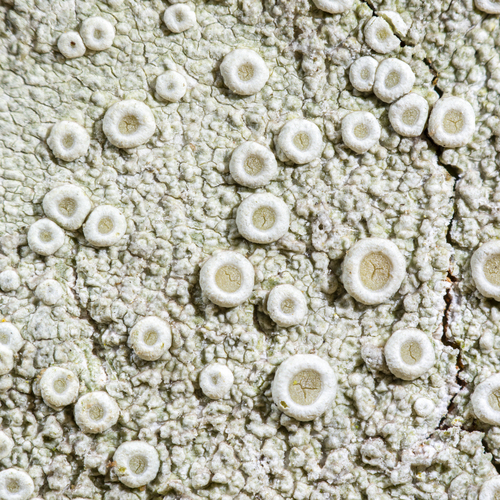
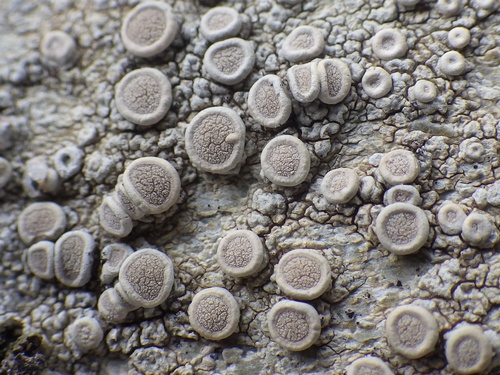
The genus Ochrolechia consists of crustose lichens that typically form uneven, often thick, crust-like growths. The thallus, or body of the lichen, can vary in appearance from smooth and continuous to slightly cracked, which is called rimose. In some cases, the thallus may appear as scattered, convex warts, or more rarely, as minutely shrubby due to the presence of tiny papillae or spine-like extensions. Thallus colour ranges from white or pale grey to dark grey, and often has a greenish tint. A prothallus — the preliminary growth that may be visible around the edges of the thallus — is sometimes present and grey, though it may also be absent. The upper surface of the thallus generally lacks a distinct protective cortex layer, or may have a very thin cortex made up of thin-walled fungal filaments called hyphae. The lichen's symbiotic photosynthetic partner, the photobiont, is a chlorococcoid alga, which contributes to the lichen's overall colour and carries out photosynthesis. The reproductive structures of Ochrolechia, called apothecia, are disc-like and typically expanded, though in rare cases they may be pore-like (poriform). The apothecial discs are usually yellowish or brownish-pink, and are often covered with a fine white powdery coating called pruina. The apothecia are surrounded by a well-developed thalline margin, a rim of tissue derived from the thallus itself. In some species, a narrow true exciple — the tissue that surrounds the hymenium, the spore-producing layer — is visible. The hymenium in Ochrolechia apothecia is relatively tall, measuring between 150 and 200 μm. The hamathecium, which supports developing spores, is made up of thin, densely branched, interconnected filaments called paraphyses. The asci, which are spore-producing cells, contain between two and eight spores, and have thick amyloid walls (meaning they stain blue with iodine); these asci are similar to those found in the genus Pertusaria. The ascospores themselves are relatively large, lack internal divisions (aseptate), have relatively thin walls for their size, and have a smooth texture. Ochrolechia also reproduces asexually through pycnidia, which are flask-shaped structures embedded in the thallus. The conidia (asexual spores) produced by the pycnidia are cylindrical to elongated, and straight rather than curved. Chemically, Ochrolechia species are known to produce orcinol depsides and depsidones, particularly gyrophoric and lecanoric acids, as well as xanthones and fatty acids. These compounds contribute to the lichen's characteristics, and can be used in chemical spot tests to help identify species.