About Ochrolechia africana Zahlbr.
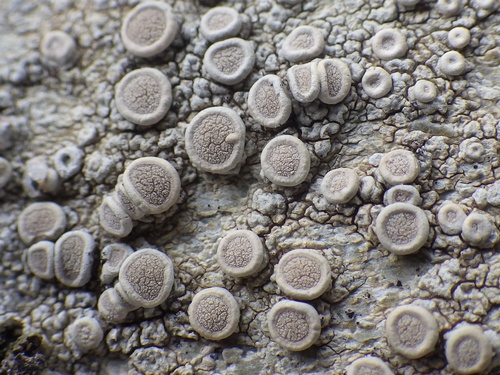
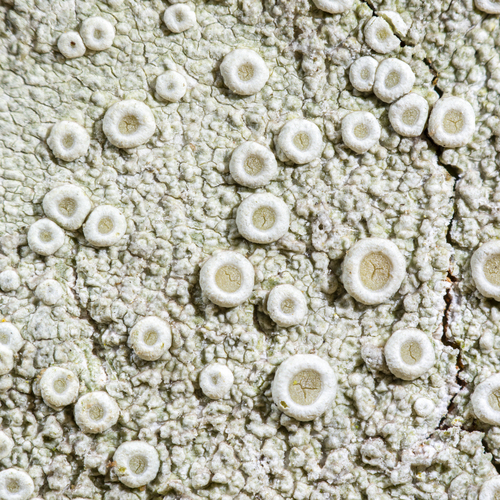
Ochrolechia africana (Zahlbr.) has a crustose thallus that is yellowish-grey to gray, with a surface texture ranging from smooth to warted (verruculose or verrucose). Its apothecia are usually less than 1.5 mm (0.1 in) in diameter, have thick margins, and are often covered in a frosty-looking pruina, though some forms do not have pruina. The algal layer forms an almost complete layer under the hypothecium, creating abundant but discontinuous clumps. Ascospores of this species measure 43–67 by 18–30 μm. Ochrolechia africana produces several secondary lichen chemicals: the orcinol depsides gyrophoric acid, lecanoric acid, 5-methyl-O-methylhiascic acid, and 4,5-di-O-methylhiascic acid, plus the xanthone lichexanthone. Lichexanthone is the compound that makes this lichen fluoresce bright yellow under UV light. The Chinese alpine lichen Ochrolechia alticola looks somewhat similar to O. africana, but differs in having a C+ red chemical reaction in the cortex of the apothecial margin, lacking 5-O-methylhiascic acid, and having a different habitat. Ochrolechia africana is a widely distributed species found in tropical and subtropical regions of southern Africa, Asia, Australia, North America, and South America. It was reported as a new species to China in 2013, and is one of approximately 25 known Ochrolechia species that occur in China. It most commonly grows on both wood and bark of deciduous trees, though it has also been recorded growing on rocks. Irwin Brodo and James Lendemer documented an atypical population of O. africana in the Coastal Plain of southeastern North America; these specimens were sorediate and fertile, unlike the typical asorediate and fertile form of the species.