About Ochotona collaris (Nelson, 1893)
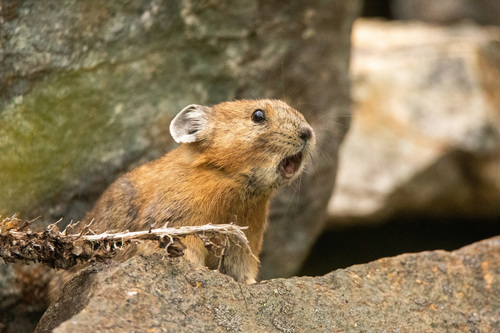
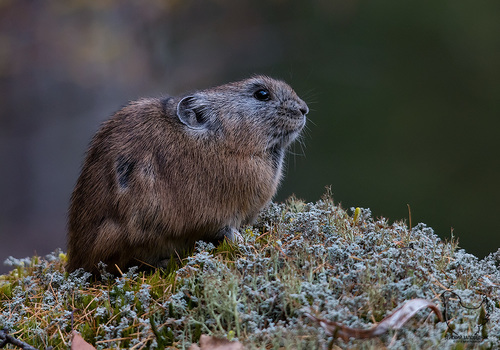
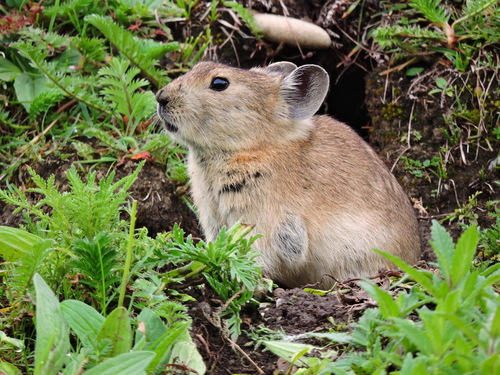
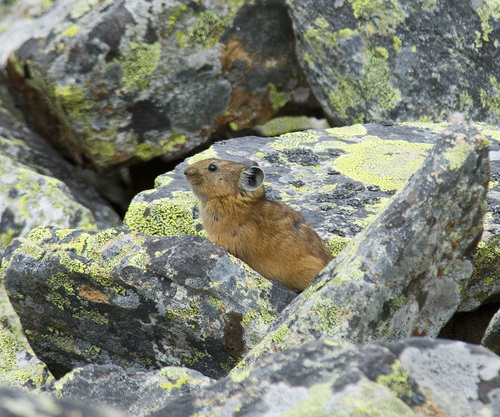
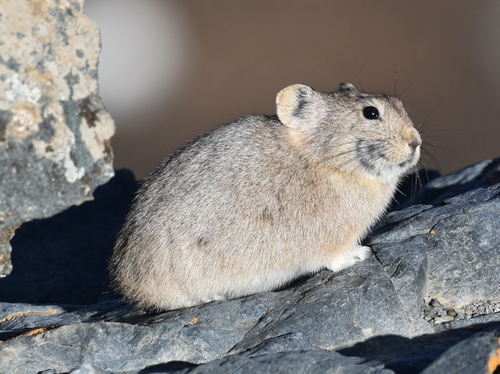
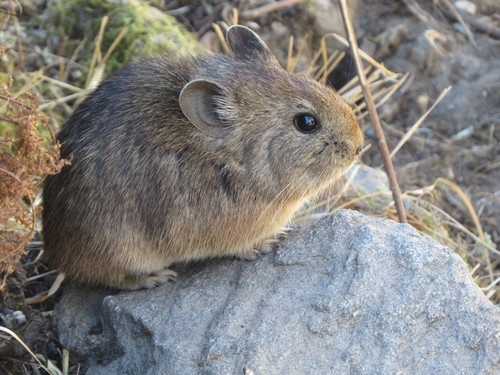
Ochotona collaris, commonly called the collared pika, resembles other members of the genus Ochotona in general appearance. Individuals have dull grayish fur on their dorsal side, with gray patches on the shoulders and nape that form an indistinct collar, and opaque white fur on their ventral side. Their winter fur is similar to that of the American pika (Ochotona princeps), but in other seasons, collared pikas have darker gray fur that is less thick than it is in winter. Collared pikas undergo just one molt per year. In summer, young individuals that have already reached adult size are fully gray, while mature adults have brownish tinges around their heads and necks. Two identifying features that distinguish collared pikas from American pikas include creamy-colored fur over the facial gland (brown in American pikas), and a broader skull with a shorter nasal region, larger tympanic bullae, and different tooth morphology. Collared pikas are small, with longer hind limbs than fore limbs that measure 2.9 to 3.1 cm (1.1 to 1.2 in) long. They have five digits on each front foot and four on each hind foot. The soles of their feet are covered in long fur, but their digital pads remain exposed, and they have curved claws. Body mass ranges from 130 to 200 g (4.6 to 7.1 oz), and total body length ranges from 17.8 to 19.8 cm (7.0 to 7.8 in). The average weight for both males and females is around 157 g (5.5 oz), and maximum growth rates increase further north within the species' range. Their skulls are constricted and flat, lack supraorbital processes, and have slender zygomatic arches, and they have 26 teeth total. Unlike some mammals that have reduced clavicles for greater range of motion, collared pikas have a well-developed clavicle that supports the scapula. They do not have a pubic symphysis, so their pelvic girdle lacks a pubic arch. A notable trait of male collared pikas is that they have no scrotum, and the position of their testes is not visible externally. This means the species has no sexual dimorphism, so sex can only be distinguished by examining specific genitalia within the pseudocloaca. Collared pikas are distributed across western Northwest Territories, almost all of Yukon Territory, northern British Columbia, and central and southern Alaska. Approximately 60% of the global collared pika population lives in Canada, with most individuals found in Yukon. In Alaska, collared pikas are most common in the Yukon-Tanana uplands, Chigmit Mountains, and north to the head of Lynn Canal near Skagway. In Canada, their range extends from the Richardson Mountains south into northwestern British Columbia and west near the Mackenzie River in the Northwest Territories. Of the 30 living pika species, only two live in North America: the collared pika and the American pika. Collared pikas occur over 800 km (500 mi) further north than American pikas, with a distribution gap between the two species spanning parts of British Columbia and Alberta, Canada. Collared pika colonies are primarily found in mountain regions, where they typically inhabit rock slides near vegetated areas and meadows. Some individuals have been recorded living in rock piles on isolated nunataks in Denali National Park. The species' reliance on talus habitat breaks its overall range into many separate, condensed patches. Collared pikas are diurnal herbivores, and spend most of their summer daylight hours foraging to gather vegetation for storage, a behavior called haying. They do not burrow, instead using their talus sites for shelter and habitation. They are most active in the early morning and late afternoon. Each collared pika maintains and aggressively defends its own territory and personal vegetation cache, or haypile, making the species asocial and solitary. Collared pikas do not hibernate during cold winters, staying active year-round and relying on their stored food caches for energy; they use snowpack as insulation during cold months. The diameter of a collared pika's home range is approximately 30 m (98 ft), and caches and dens are spaced 30 to 70 m (98 to 230 ft) apart. Like other pikas, collared pikas are cold-adapted lagomorphs that select rock slide habitats because the rocks provide protection from high daily temperatures. How far a collared pika travels to forage depends strongly on predation risk, and individuals rarely go more than 10 m (33 ft) from their talus site when gathering food. Hay gathering begins around late June or early July, and increases steadily over the course of the summer. Collared pikas usually maintain multiple haystacks across their home range, and they often reuse the same haystack locations each year. While they have multiple caches, they focus most effort on one primary haystack, with the other caches being smaller and more localized. They will add any available vegetation near their rock slide habitat to their caches, including leaves, flowering plants, and berries, and other animals' feces have even been found in their haystacks. The size of a collared pika's food cache corresponds to the size of its shelter site. The species is often kleptoparasitic, stealing stored food from other individuals. During rest periods, collared pikas have been observed sitting on rocks and basking in sunlight. Collared pikas generally mate with their nearest neighbors. They are thought to be facultatively monogamous, but may also practice polygynandry and mate with multiple partners, because males often travel through the territories of several females during spring before mating season begins. Males begin encountering receptive females in late spring, and mating peaks in May and early June. Both male and female collared pikas reach reproductive maturity at one year of age. Females give birth to two or three young per year in a nest located within the talus. They typically produce only one litter per year, though they may produce a second litter that is not successfully weaned. While both sexes can reproduce at one year of age, male reproductive success depends on acquiring territory to attract females. Females provide the majority of parental investment, and face high energetic costs during gestation and lactation. The species' lack of sexual dimorphism makes it difficult to determine how much males contribute to caring for young. Gestation lasts approximately 30 days, and newborns are born blind and nearly hairless. Young stay in the nest for around 30 days before they are weaned and emerge to the surface. Juveniles stay on their natal territory for only a short time, usually a few days, before becoming independent and dispersing to find their own territories. Juveniles reach full adult size around 40 to 50 days after birth. Timing of birth is critical for northern alpine herbivores like the collared pika, due to the short snow-free growing season and limited available food. Most collared pikas breed synchronously, but research has found a correlation between variation in the timing of snowmelt and variation in when the first litter is initiated. Asynchronous breeding caused by unpredictable snowmelt timing can still ensure some reproductive success for the species.