About Ochotona alpina (Pallas, 1773)
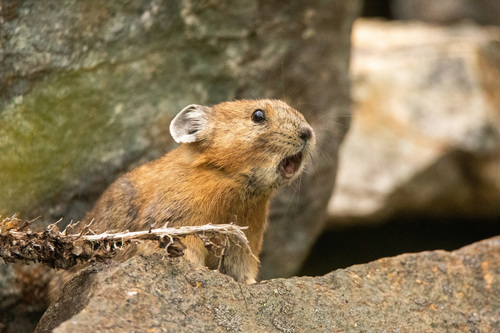
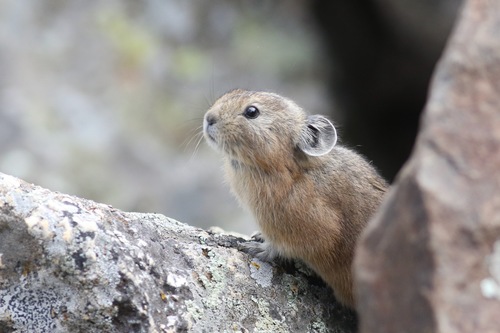
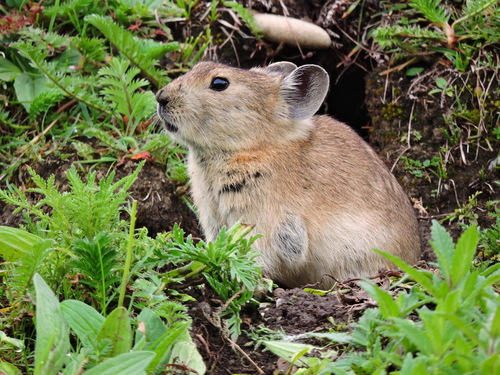
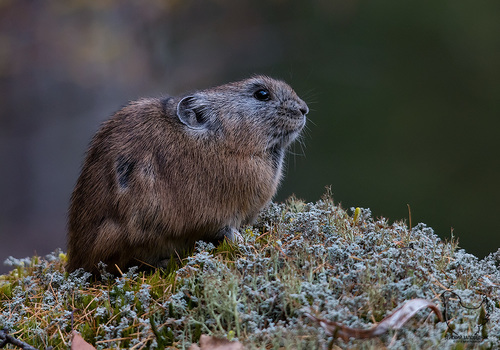
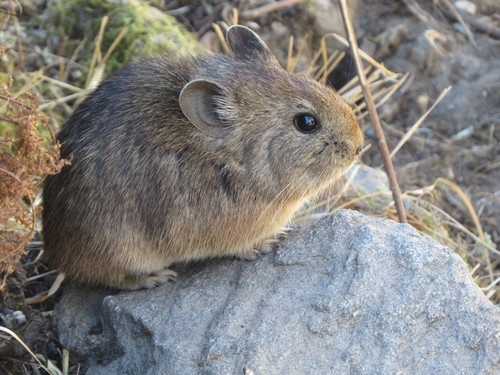
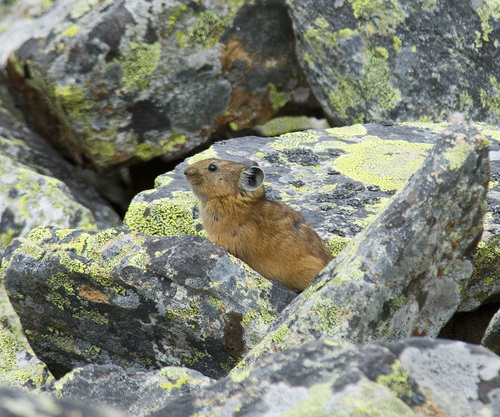
The alpine pika, scientifically named Ochotona alpina (Pallas, 1773), has a body length ranging from 152 to 235 mm (6.0 to 9.3 in), with long, rounded ears that are 17 to 26 mm (0.67 to 1.02 in) long, and weighs between 226 and 360 g (8.0 to 12.7 oz). Its skull is narrow, measuring 41 to 54 mm (1.6 to 2.1 in) in length; compared to the northern pika's skull, it is longer and less rounded. The alpine pika also has a longer snout, the back of its skull bends more downward, and its bullae are deeper and much narrower than the northern pika's. Its parietal bones, which join at a fibrous joint to form the sides and roof of the skull, protrude at the front, forming a sloping angle at the back with the interparietal bone, the bone located between the parietal bone and the supraoccipital bone at the back lower part of the skull. It has a large, thick cheek bone. Summer fur varies greatly between different subspecies, but is generally dark or cinnamon brown. Its back is dull yellowish ochre-grey, with hairs tipped dark brown to black. The side of the body between the rib cage and the uppermost largest part of the hip bone is tinged rust-red, and its underside is pale yellowish ochre. In winter, its fur turns grey with a yellowish tinge; the underside becomes greyish brown, and the front of the back and the head are tinged yellow. Its incisive foramina, the funnel-shaped openings in the bony skull plate located on the roof of the mouth right behind the incisor teeth that blood vessels and nerves pass through, are round, small, and separated from the palatine foramen. Even with geographic and seasonal variation, adult alpine pikas are larger than adult northern pikas in sympatric zones, and are usually more dull in color.
The alpine pika lives in mountainous areas of western Mongolia adjacent to the Gobi Desert, eastern Kazakhstan, southern Russia (including Tuva, Irkutsk, Altai, and Krasnoyarsk), and China (including northern Xinjiang and Heilongjiang). It occurs in mountain ranges such as the Altai, Khangai, and Sayan, and is distributed east and south of Lake Baikal, extending eastward to the Amur River drainage. An isolated population of alpine pika lives on the Helan Mountains at the border of northwest Ningxia, Hexi Zoulang, and Gansu. The subspecies O. a. cinereofusca is found in Heilongjiang and Russia, while O. a. nitida is found in northern Xinjiang, Russia, Mongolia, and Kazakhstan. This species typically occupies rocky habitats, including talus piles (accumulations of broken rock at the base of cliffs, volcanoes, or valley shoulders, built up by repeated rockfall from adjacent cliff faces) with larger stones, and other rocky areas. It does not live in swampy montane tundra or talus that lacks vegetation, and may also occupy burrows under tree roots or old moss-scree. In their zone of sympatry with the northern pika, the alpine pika's habitat is separated by altitude or microhabitat, and it can live at both higher and lower altitudes than the northern pika. It occurs at elevations of 400 to 2,500 m (1,300 to 8,200 ft) above sea level in the Altai Mountains, and above 2,000 metres (6,600 ft) in China. In the early 1970s, an unexplained decline in alpine pika populations happened across the western Sayan Mountains. In 1977, Khlebnikov proposed the decline was caused by an epidemic, but it was hard to confirm whether such a large area was affected all at once. By 1986 or 1987, a few sites that had high alpine pika population densities 16 to 17 years earlier no longer held the species, a change attributed to the alpine pika's low reproductive rate and the isolated, insular nature of its habitat.
The alpine pika is a generalist herbivore. It mainly forages for mosses, tree branches, pine nuts, and plant stems, which it collects during summer to build haypiles for winter use. In 1984, I.V. Travina estimated that when population density is 10 to 12 individuals per hectare, these haypiles can total up to 30 kg per hectare (12 kg per acre). These stored food stores are sometimes shared with other species such as reindeer. In 1978, Khlebnikova documented the effects alpine pikas have on plant diversity and composition in the regions they live in. These effects include reduced soil seed content, a lower proportion of flowering plants, and slower succession of plants such as Siberian pine, because the pikas forage on young trees. However, remnants of haypiles may support plant growth, and accumulated pika pellets create areas of nitrogen-rich nitrophilic vegetation. The alpine pika lives in family groups, with population densities of 10 to 12 individuals per hectare. Feeding territories of different families do not overlap, and they generally stay the same from year to year. The larger home territories of different family groups do overlap with one another. From April to December, both male and female alpine pikas mark corners of stones, most often located near the center of their home territory, by rubbing their neck glands against the stones. Like other pikas that live in talus piles, female alpine pikas have low fecundity, and litter size decreases as elevation increases. A.F. Potapkina observed a seasonal increase in the number of offspring per litter. On average, females in the western Altai Mountains produce two litters per year, while females in the northwestern Altai and western Sayan Mountains produce 2.7 litters per year, with 10% of females in this latter region producing up to three litters. In 1984, G.I. Makushin and G.I. Orlov found the average annual mortality rate of alpine pika is 53% for populations living in forests, and 41% for populations living in alpine zones; most mortality occurs in individuals aged between one and three years. Annual population density fluctuations for most alpine pika populations are insignificant.