About Ochna serrulata (Hochst.) Walp.
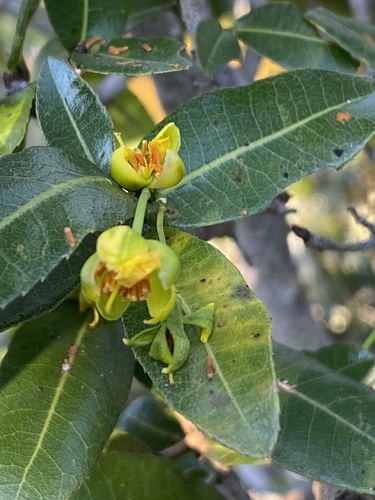
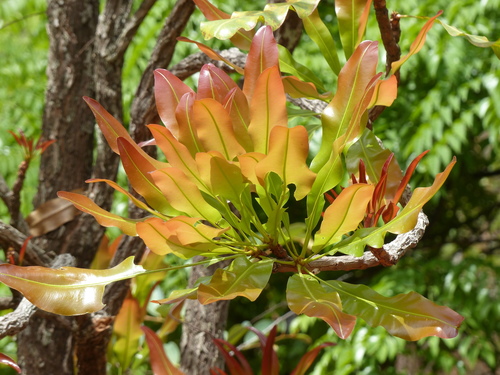
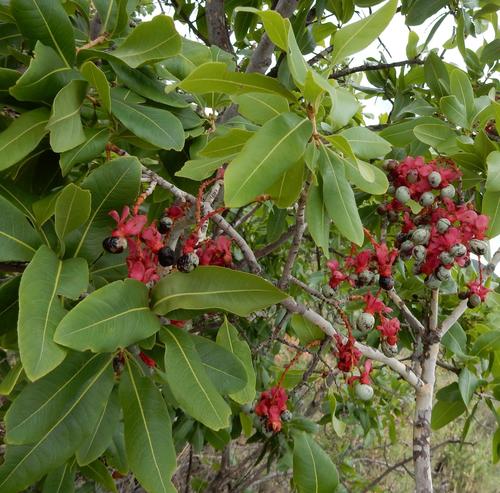
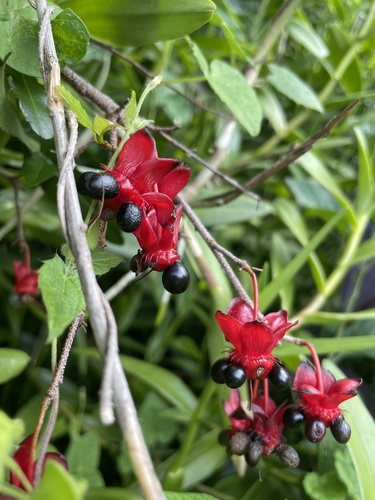
Ochna serrulata is most commonly a small shrub growing 1 to 2 meters (3.3 to 6.6 feet) high, though it may occasionally grow into a small tree that reaches 6 meters (20 feet) tall. Its narrow leaves range from oblong to elliptic in shape, measuring 30 to 60 mm (1.2 to 2.4 in) long by 8 to 15 mm (3⁄8 to 5⁄8 in) wide. The leaves are shiny green, with fine serrated teeth along their edges. Fragrant yellow flowers bloom in spring, typically around 2 cm (0.79 in) in diameter. The yellow petals usually drop soon after the flower opens. Its pollen grains are elongated, measuring roughly 35 by 18 microns. Each flower produces five or six small fruitlets that sit on the flower receptacle. As fruitlets develop, the sepals and receptacle enlarge and turn bright red, often giving the entire shrub a distinctly red appearance. The fruitlets are around 5 mm (1⁄4 in) in diameter; they start pale green and turn black when fully mature. At locations including Kirstenbosch, fruitlets begin ripening in early summer, and the red sepals remain on the plant until late summer. Flowers typically attract bees and butterflies, while birds eat the plant's fruitlets. Seeds can be dispersed by both birds and water. This species is native to forest areas of South Africa, occurring across the country from Cape Town in the south, along the east coast to Kwazulu-Natal, and inland through Eswatini and Gauteng. It is a tough, adaptable shrub that can grow in sunny open positions as well as the full shade of deep forest. It has been widely cultivated outside South Africa as an ornamental garden plant, and has become an invasive weed in New South Wales and southern Queensland in eastern Australia, where it grows near human settlements in and around large towns and cities. In cultivation, it makes a very attractive native shrub for South African gardens. It is hardy and resilient, and can be grown in both sunny and shaded locations. It grows slowly initially, but its growth rate increases once it is well established, particularly if watered regularly. It is an excellent plant for attracting birds to gardens. It does not tolerate frost well, but it adapts well to light pruning and stays attractive year-round, even when it does not bear fruit. Ochna serrulata is also cultivated in Hawaii, one of several species grown for its colorful flowers and unusual fruits.