About Ochagavia litoralis (Phil.) Zizka, Trumpler & Zöllner
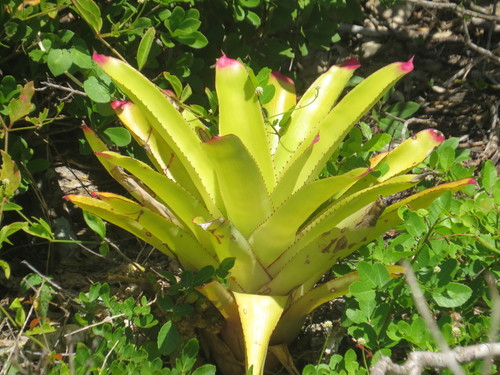
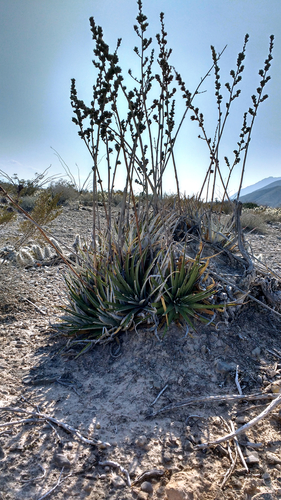
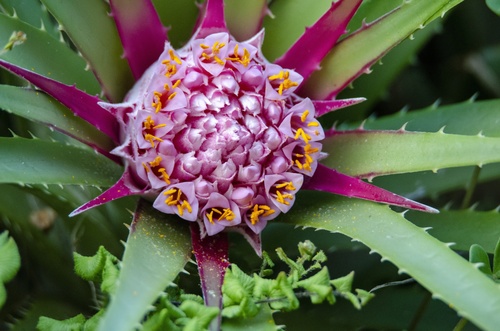
Ochagavia litoralis (Phil.) Zizka, Trumpler & Zöllner is a species of flowering plant in the bromeliad family, Bromeliaceae, that is endemic to Chile. Its common names are calilla and chupón. This species has a stem that may reach over 20 centimeters in length, and it produces offsets that can grow into colonies. Its narrow, pointed leaves are 17 to 38 centimeters long, with a leathery texture, and whitish scaly undersides. The inflorescence is spherical or oval, holding up to 35 flowers. The inflorescence is up to roughly 8 centimeters long and wide, and is carried on a stalk that grows up to 12 centimeters long. The flowers are a few centimeters long, each bearing three pink petals, and are surrounded by bracts. Both the stamens and style extend out from the open flower. The fruit is a berry that measures 2 to 3 centimeters long. This plant is restricted to central Chile, where it grows primarily in coastal areas. While the species has been recorded in inland regions, no recent collections have been made there. Scattered rare populations exist around 15 kilometers inland, and these populations are classified as endangered. The species grows mostly on steep seaside cliffs, sometimes forming dense stands. It is sometimes cultivated as an ornamental plant, and can be found in botanical gardens, where it is often displayed alongside succulent collections.