About Oceanodroma monorhis (Swinhoe, 1867)
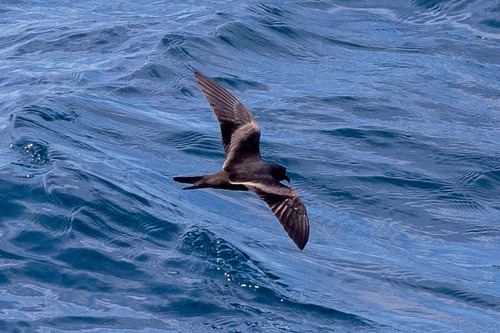
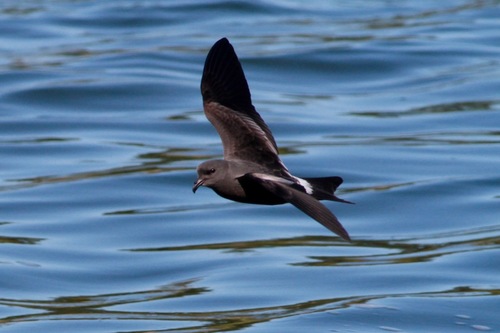
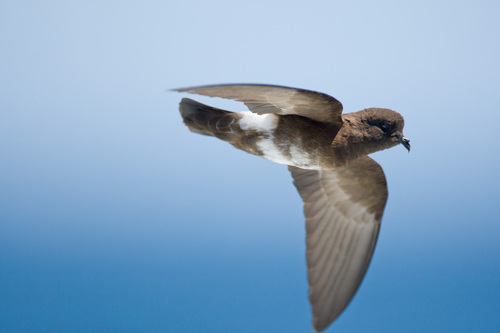
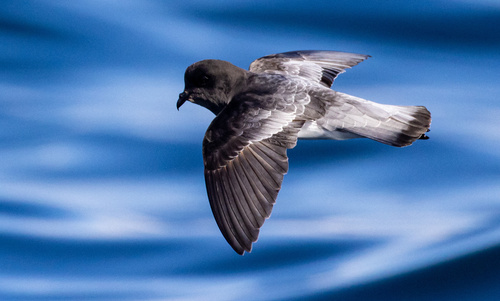
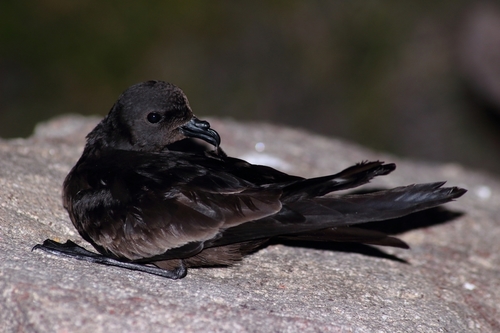
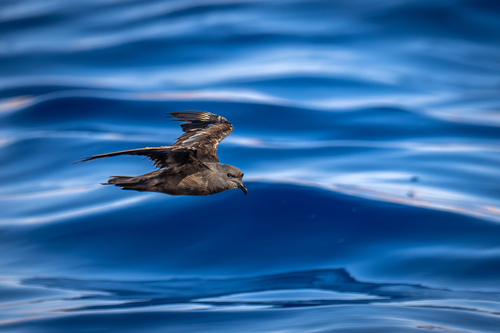
Swinhoe's storm petrel, with the scientific name Oceanodroma monorhis (Swinhoe, 1867), is a small seabird. It measures 18–21 cm in length and has a wingspan of 45–48 cm, and is distinctly larger than the European storm petrel. All plumages of this species are essentially dark brown. It has a fluttering flight pattern, and patters on the water surface to pick planktonic food items from the ocean. Unlike the European storm petrel, it does not follow ships. In terms of structure and flight behaviour, it most closely resembles Leach's storm petrel, sharing that species' forked tail and longish wings, but it lacks a white rump and has a different call. It is difficult to tell apart from other all-dark Hydrobates species; the first recorded English individual had to undergo DNA testing to rule out that it was a Leach's storm petrel, because north-eastern Pacific populations of Leach's storm petrel include individuals with completely dark rumps.
This species breeds on islands in the northwest Pacific off the Russian Far East, China, Japan and Korea. It nests in colonies near the sea, inside rock crevices, and lays a single white egg per clutch. Outside the breeding season, it lives at sea, with its range extending into the Indian Ocean and Arabian Sea. Confirmed breeding sites include Verkhovsky Island (south of Vladivostok, Russia), where 7,500 pairs breed, and Japan, which hosts at least 1,000 breeding pairs. Populations in China, Taiwan, North Korea and South Korea are still poorly understood, and records suggest breeding may also occur in the North Atlantic. During winter, it migrates south and west to the northern Indian Ocean (Brooke 2004). Sato et al. (2010) estimate the global minimum population is at least 130,000 pairs, confirming the species has a very large total population. However, Birds Korea (2010) note that approximately 100,000 pairs nest on Gugeul Islet, which means over 75% of the global population may breed on just one very small island. The species nests on six or seven breeding islets in South Korea (Chang-Yong Choi in litt. 2012). Anecdotal evidence suggests some of the species' colonies are in decline (N. Moores in litt. 2011).