About Oceanites oceanicus (Kuhl, 1820)
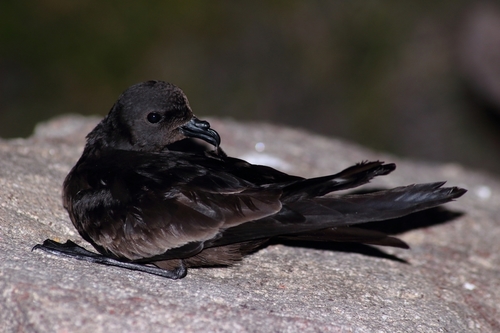
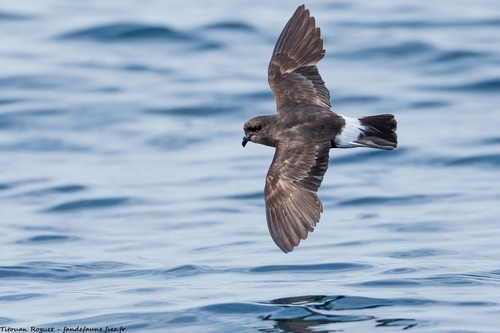
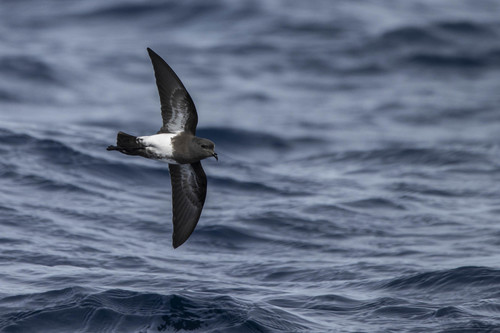
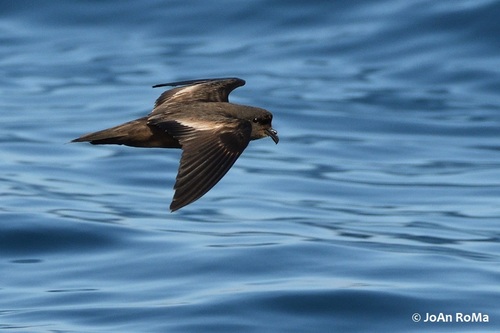
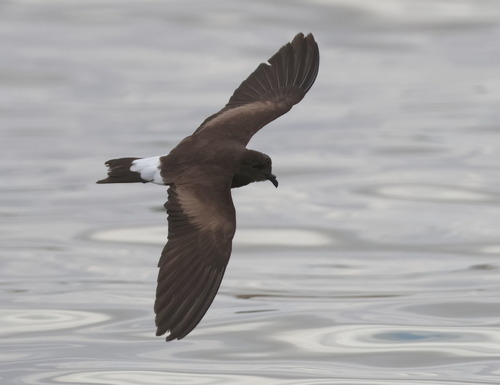
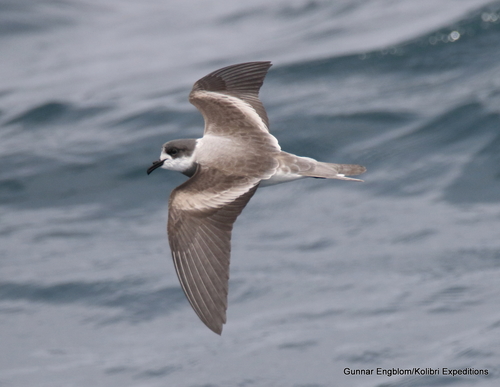
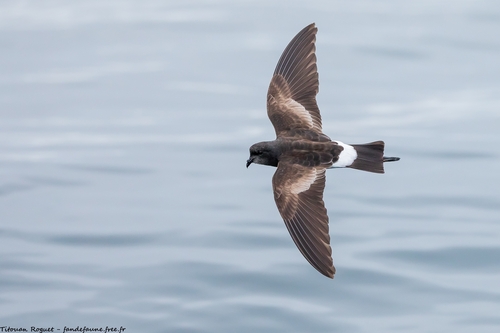
Wilson's storm petrel (scientific name Oceanites oceanicus (Kuhl, 1820)) is a small seabird, measuring 16–18.5 cm (6.3–7.3 in) in length with a 38–42 cm (15–16.5 in) wingspan. It is slightly larger than the European storm petrel, and is essentially dark brown in all plumages, with the exception of a white rump and white flanks. In flight, its feet extend just past its square-ended tail. By comparison, the European storm petrel has very distinct whitish lining on its underwing and a nearly all-dark upperwing. Wilson's storm petrel has a diffuse pale band along its upper wing coverts, and does not have the distinctive white underwing lining seen on European storm petrels. In pre-breeding age individuals, the webbing between the toes is yellow with black spots. This species breeds on Antarctic coastlines and nearby islands such as the South Shetland Islands during the southern hemisphere summer. It spends the rest of the year at sea, and moves into northern oceans during the southern hemisphere winter. It is much more common in the North Atlantic than in the Pacific. Wilson's storm petrel is common off eastern North America during the northern summer, and pelagic boat trips have revealed that this bird is seasonally abundant in suitable European waters, most notably around the Isles of Scilly and Great Britain. Outside the breeding season, Wilson's storm petrel is strictly pelagic; combined with its remote breeding sites, this habit makes it a difficult bird to spot from land. Only severe storms will occasionally push this species into headlands close to shore. Wilson's storm petrel has a more direct gliding flight than other small petrels. Like most other small petrels, it flies low over the sea surface, and has a habit of pattering on the water surface as it picks planktonic food items from the ocean surface. Its unique fluttering and hovering flight is often achieved with its wings held high. Even in calm weather, it can use the slight breeze produced by waves to soar, while using its feet to stabilize itself. Like the European storm petrel, it is highly gregarious, and will follow ships and fishing boats. A soft peeping call is often heard while the birds are feeding. They feed predominantly on planktonic invertebrates close to the water surface, and rarely plunge below the surface to capture prey. However, they may sometimes take 3–8 cm long fish from the family Myctophidae. With an average weight of 40 g, it is the smallest warm-blooded animal that breeds in the Antarctic region. It nests in colonies close to the sea, in rock crevices or small burrows in soft earth, and lays a single white egg. Like most petrels, its walking ability is limited to a short shuffle to the burrow. In the Antarctic, nests may sometimes become snowed over, leading to the destruction of the nest or chick. This storm petrel is strictly nocturnal at breeding sites to avoid predation by larger gulls and skuas, and will even avoid coming to land on clear moonlit nights. Both parents tend the nest and feed the single chick. The chicks call and beg for food, more vigorously when hungry. Chicks remain at the nest for around 60 days and are fed krill, fish and amphipods. Adults can identify their nest burrows in the dark and recognize their mates using olfactory cues. Population estimates for Antarctica put the number of breeding pairs between 10⁵ and 10⁶. Wilson's storm petrel is widespread across its large range, and is evaluated as Least Concern on the IUCN Red List of Threatened Species.