About Occidryas anicia (Doubleday, 1847)
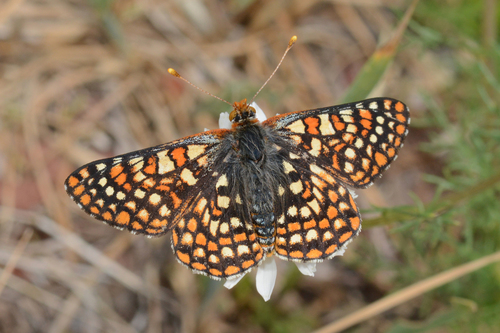
This species, Occidryas anicia, commonly known as the Anicia Checkerspot, has distinct morphological characteristics. On the dorsal side, its wings are primarily red with black bands and yellow markings, and it has pointed forewings. Individuals found at higher elevations are noticeably darker. The clubs of its antennae are yellow with a black base, and the abdomen bears off-center white spots. Its brown compound eyes distinguish this species from other butterflies in the Nymphalidae family, and it has the longest dorsal arms of any species in its genus. The Anicia Checkerspot can be told apart from Euphydryas editha and Euphydryas gillettii by its lack of white spots on the abdomen, a marigold band at the submarginal wing region, and larger, more pointed forewings. For the visually similar Euphydryas chaldedona, male genitalia are the only reliable distinguishing feature, with other differences being far less noticeable. The Anicia Checkerspot is native to western North America. Its range extends north to Yukon, British Columbia, and Manitoba, and south to New Mexico and Arizona. This non-migratory species occurs at any elevation across a variety of habitats, including mountain summits, grasslands, canyons, and dry conifer forests. It produces only one generation of adults per year. Female Anicia Checkerspots lay two to three batches of eggs, which they hide underneath the leaves of their host plants. Eggs hatch after approximately two weeks. After hatching, larvae construct a communal silk shelter on their host plant for protection. This shelter is maintained until winter or until the host plant is defoliated. Larvae enter diapause after their third or fourth molt, which typically begins in early autumn. Larvae emerge from diapause and resume feeding in early spring. Moisture and temperature in spring are key environmental cues that trigger the end of diapause for Anicia Checkerspot larvae. Diapause can last for more than one year, and climate change can disrupt this process by altering the conditions of these environmental cues. After diapause ends, larvae go through 3 to 4 additional molts before pupating. The triggers that initiate pupation are still not well understood. Climate change can negatively impact this butterfly’s overall life cycle through its effects on environmental conditions. Caterpillar mortality for this species is 98%, which matches the mortality rate seen in other butterfly species. Adult Anicia Checkerspots have their annual flight period from late May to mid-August, with timing varying based on elevation and geographic range. Adults fly during this period to find mates before the end of their short adult lives.