About Oblada melanura (Linnaeus, 1758)
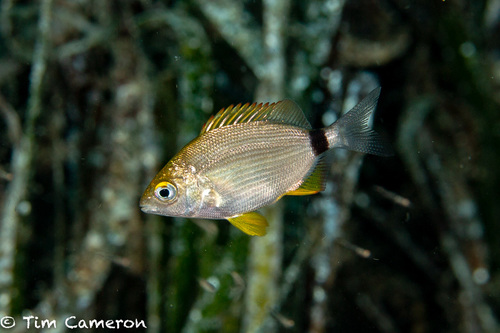
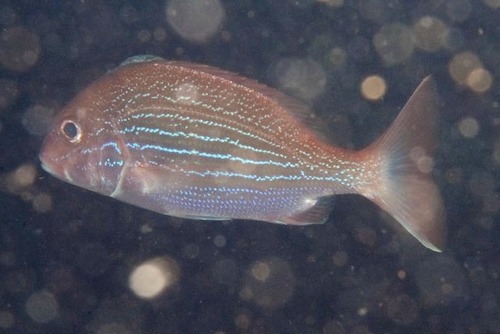
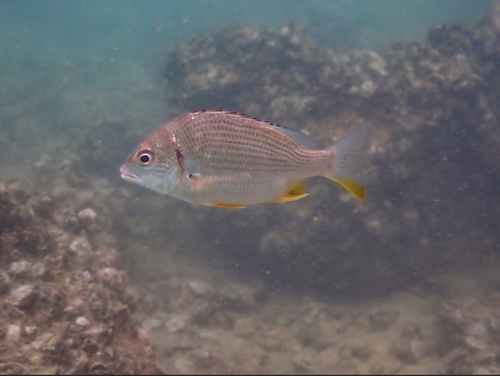
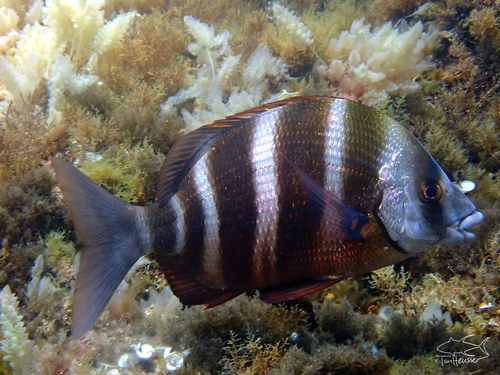
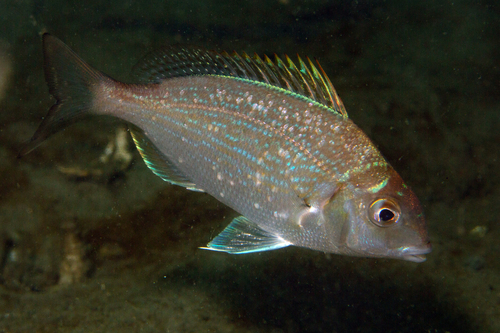
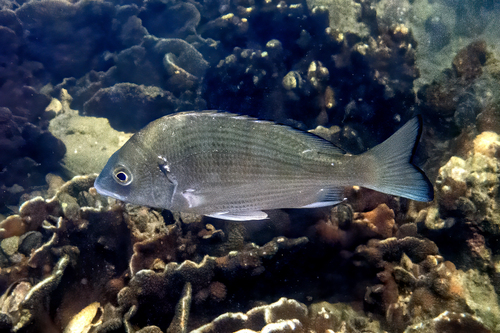
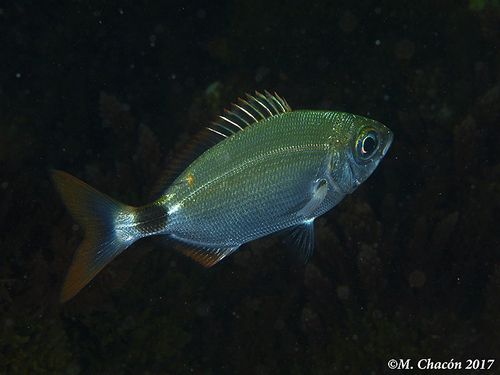
The saddled seabream, Oblada melanura, has an oblong, somewhat compressed body. The dorsal profile of its head is straight, and it has an elongated, sharply pointed snout with a low-set, horizontal mouth with fleshy lips. Its eyes are small, and its rear nostrils are slits. Scales on the crown do not extend past the rear margin of the eyes, and the preoperculum has no scales. The teeth at the front of the jaws are small and arranged in bands; the upper jaw has 3–6 rows of molars, while the lower jaw has 2–4 rows of molars. The dorsal fin is supported by 11 or 12 spines and 11 or 12 soft rays, and the anal fin contains 3 spines and 10 or 11 soft rays. Its body background color is grey with silvery tints, darker on the back, with 14 or 15 vertical dark brown or grey bars along the flanks. There is a large white-edged black saddle marking on the caudal peduncle. The dorsal and caudal fins are pale yellowish or pinkish, and the other fins are dark. This species has a maximum published total length of 36.6 cm (14.4 in), though 20 cm (7.9 in) is more typical, and a maximum published weight of 525 g (18.5 oz). The saddled seabream is distributed in the Eastern Atlantic, ranging from the Bay of Biscay, Madeira, Cape Verde, Canary Islands, and Strait of Gibraltar south to Angola. It is also found in the Mediterranean Sea, the Sea of Marmara, and the southern part of the Black Sea. It occurs at depths down to 30 m (98 ft) over rocky substrates, in beds of Zostera seagrass, and among seaweed.