About Oberea tripunctata (Swederus, 1787)
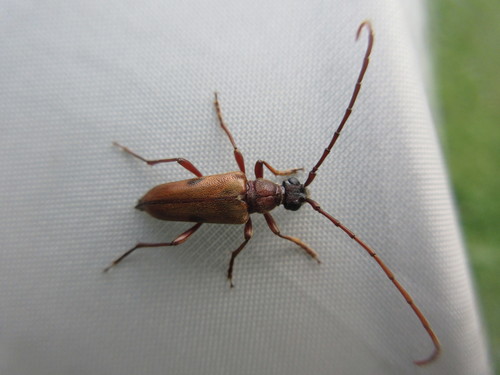
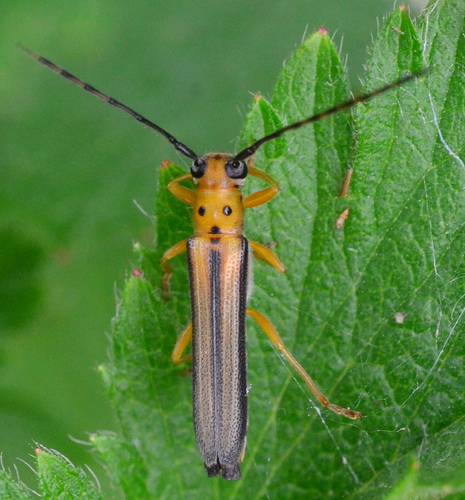
Oberea tripunctata, commonly known as the dogwood twig borer, matches the typical body shape of other beetles in the genus Oberea, with slender, elongated adult bodies. Adult individuals measure between 10 and 15 millimeters in length and 3 millimeters in width. Their heads range from dark to black, and three prominent black spots arranged in a triangle mark their thorax. Two distinct dots are also visible directly behind the head. Adult wing covers are yellowish tan, with a narrow black line along the inner edge and a broader, darker line along the lateral margin of the outer wing. In their final developmental phase, dogwood twig borer larvae are yellowish, legless, and reach approximately 19 millimeters in length. Adult dogwood twig borers emerge in early June, and they rarely appear in large numbers. They feed on dogwood twigs, causing girdling around the tips of branches. Females lay their eggs one at a time on healthy twigs. After eggs hatch, larvae enter the twig and bore inward toward its center. As larvae bore, they create a series of closely packed holes to expel boring dust called frass, which sometimes causes internal sections of the twig to separate from the rest of the dogwood tree. Larvae overwinter inside the plant stems. Some larvae take up to two years to finish development. Larvae that pupate during spring typically exit the stem between mid-May and early June. Dogwood twig borer larvae are sometimes referred to as elm twig girdlers.