About Obama nungara Carbayo, Alvarez-Presas, Jones & Riutort, 2016
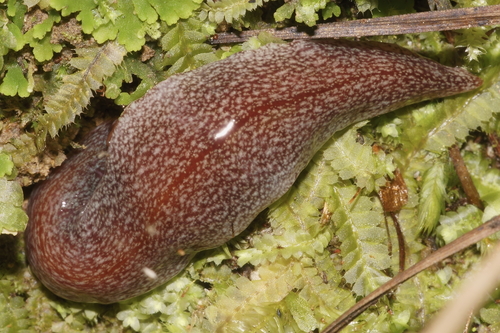
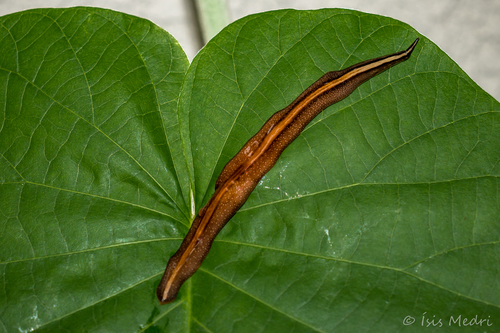
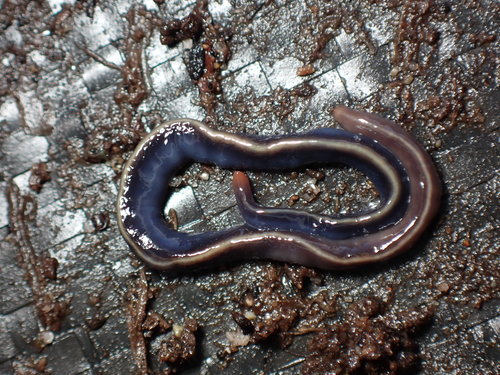
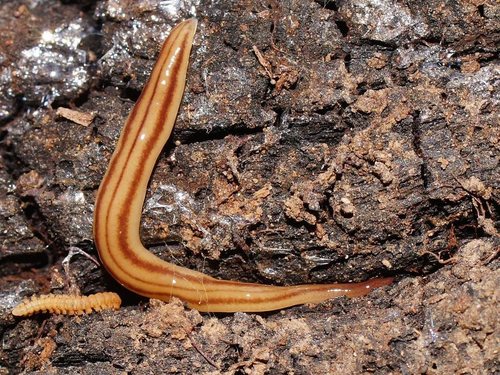
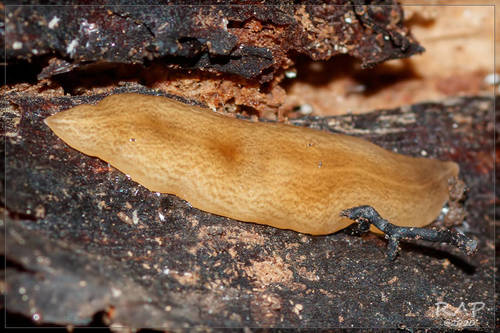
Obama nungara is a medium-sized land planarian with a lanceolate body that reaches up to 70 millimetres (2.8 in) in length. The background color of its dorsum ranges from golden yellow to honey yellow, and is covered in dark-brown to black spots and flecks that cluster into short, irregular longitudinal streaks, creating a light to dark-brown marbled appearance. A fine longitudinal line with no brown pigment usually runs along the middle of the dorsum; this line sometimes has a diffuse dark border formed by concentrated brown pigment, and in some specimens, the line is covered in pigment and is nearly unnoticeable. The ventral side of the body is a uniform cream to grey-white color. Like most species in the genus Obama, O. nungara has hundreds of eyes distributed across its body. The eyes form a single row around the anterior tip of the body; after the first few millimeters, they become arranged in multiple rows, spread onto the dorsal surface, and occupy around one third of the body width on each side. Dorsal eyes are surrounded by clear, unpigmented halos, which appear as small whitish dots when viewed closely or under a stereo microscope. The general color pattern of O. nungara is very similar to that of Obama marmorata, a species that lives alongside O. nungara in sympatry in some parts of southern Brazil. Because of this similarity, O. nungara was originally misidentified as O. marmorata. O. nungara is native to South America. Populations found in Santa Catarina and Rio Grande do Sul, the two southernmost states of Brazil, are confirmed to be native. The species is also present in Argentina, where it may be either native or introduced. It is very common in human-disturbed areas, particularly gardens and parks.