About Nyssa sylvatica Marshall
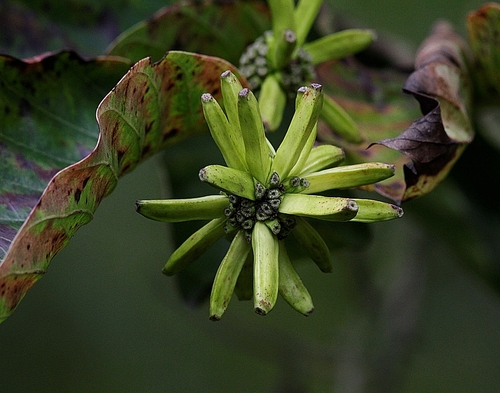
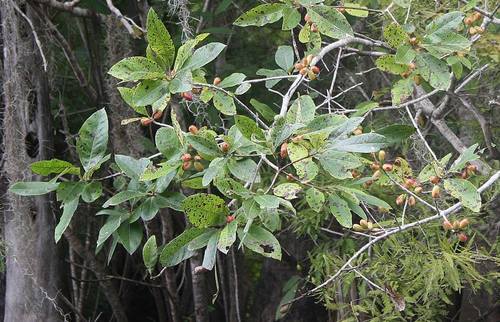
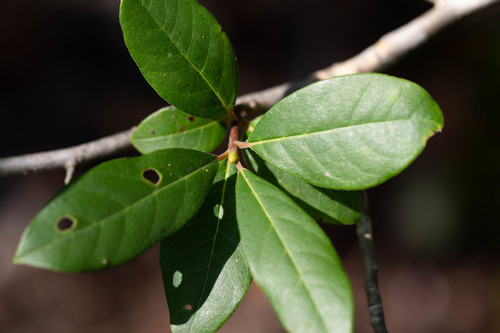
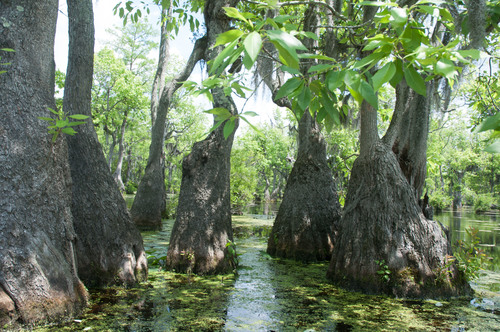
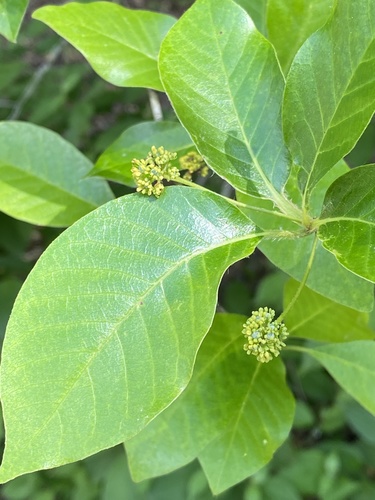
Nyssa sylvatica Marshall, commonly called black tupelo, typically reaches 20–25 meters (66–82 ft) in height, and rarely grows as tall as 35 meters (115 ft). Its trunk usually measures 50–100 centimeters (20–39 in) in diameter, and rarely reaches up to 170 cm (67 in). Trees of this species usually have a straight trunk, with branches that extend outward at right angles to the trunk. Young trees have dark gray, flaky bark, which becomes furrowed as the tree ages; on very old stems, the bark resembles alligator hide. The tree's twigs are reddish-brown, and are usually covered by a greyish outer layer. The pith of the twigs is chambered, with greenish partitions. Leaves of Nyssa sylvatica vary in size and shape: they may be oval, elliptical, or obovate, and measure 5–12 cm (2–4.5 in) long. Leaf upper surfaces are lustrous, with entire, often wavy margins. Foliage turns purple in autumn, eventually becoming an intense bright scarlet. Deer very strongly prefer the leaves of seedlings and saplings of this species, and large deer populations can make it almost impossible for the tree to become established. Mature trees are largely left undisturbed by deer by comparison. The tree's flowers are very small, greenish-white, and grow in clusters at the top of a long stalk. They are a rich source of nectar for bees. The species is often dioecious, meaning male and female flowers grow on separate trees, so a male and female tree must grow near each other for the plant to set seed. However, many trees are polygamo-dioecious, meaning they bear both male and female flowers on the same individual. The fruit is a black-blue, ovoid stone fruit, approximately 10 mm long, with thin, oily, bitter-to-sour flesh. It is very popular with small bird species. One to three fruits grow together on a long, slender stalk. They are a valuable energy food for birds, especially the American robin. Young Nyssa sylvatica develops a large, deep taproot, which makes transplanting the tree difficult. As a result, it is fairly uncommon in cultivation and the nursery trade. Additional botanical characteristics are: Bark: Light reddish brown, deeply furrowed and scaly. Young branchlets are pale green to orange, sometimes smooth, often covered in fine downy hairs, and turn dark brown as they mature. Wood: Pale yellow, with white sapwood; it is heavy, strong, very tough, hard to split, and not durable when in contact with soil. It is used for turnery. Specific gravity is 0.6353; weight per cubic foot is 39.59 pounds. Winter buds: Dark red, obtuse, one-quarter of an inch long. Inner scales enlarge as the growing shoot develops, and turn red before falling. Leaves: Alternate, often crowded at the end of lateral branches, simple, ranging from linear to oblong to oval, two to five inches (127 mm) long, one-half to three inches (76 mm) broad, with a wedge-shaped or rounded base, entire margins that are slightly thickened, and an acute or acuminate tip. When leaves emerge from the bud, they are folded along the midrib, with a coating of rusty, matted hairs on their lower surface. When fully grown, leaves are thick, dark green and very shiny on the upper surface, and pale and often hairy on the lower surface. They are feather-veined, with the midrib and primary veins prominent on the lower surface. In autumn, leaves turn bright scarlet, or a mix of yellow and scarlet. Petioles are one-quarter to one-half an inch long, slender or stout, round or margined, and often red. Flowers bloom from May to June, when leaves are half grown. They are polygamo-dioecious, yellowish green, and borne on slender downy stalks. Staminate flowers grow in many-flowered heads; pistillate flowers grow in clusters of two to several. The calyx is cup-shaped with five teeth. The corolla has five petals, overlapping in bud, yellow green, ovate, thick, slightly spreading, and inserted on the margin of a conspicuous disk. There are five to twelve stamens; in staminate flowers they extend beyond the petals, while in pistillate flowers they are short, and often absent. The pistil has an inferior ovary that is one to two-celled, with a stout style that extends beyond the petals and curves downward above the middle. Pistils are entirely absent in sterile flowers. There is one ovule per cell. The fruit is a fleshy drupe, with one to three produced from each flower cluster. It is ovoid, two-thirds of an inch long, dark blue, and acidic. The stone is more or less ridged. Fruit ripens in October. Nyssa sylvatica grows in various uplands and alluvial stream bottoms, ranging from southwestern Maine and New York, west to extreme southern Ontario, central Michigan, Illinois, and central Missouri, and south to southern Florida, eastern Texas, and eastern Oklahoma. Optimum growth occurs on lower slopes and terraces in the Southeastern United States. It also grows locally in the mountains of eastern and southern Mexico, found in the southern Sierra Madre Oriental and Sierra Madre de Oaxaca in Hidalgo, Puebla, and Veracruz states, and the Chiapas Highlands of Chiapas. Across its extensive range, Nyssa sylvatica grows in a wide range of climates, and is found in both upland and wetland habitats. It commonly grows in the creek bottoms of the southern coastal plains, and at altitudes up to about 900 m (3,000 ft) in the Southern Appalachians. These trees grow best on well-drained, light-textured soils on the low ridges of second bottoms and the high flats of silty alluvium. In uplands, it grows best on the loams and clay loams of lower slopes and coves. The species occurs in 35 different forest cover types. When growing on drier upper slopes and ridges, it seldom reaches log size or good quality. In Mexico, it is a common species in montane cloud forests, particularly in moist or riparian habitats, growing between 1,000 and 2,200 m (3,300 and 7,200 ft) in elevation. In ecology, Nyssa sylvatica's flowers are an important source of nectar, and its fruits are an important food source for many birds and mammals. Hollow trunks provide nesting or denning space for bees and various mammals. It is among the longest-lived non-clonal flowering plants in eastern North America, and can live over 650 years. Nyssa sylvatica is cultivated as an ornamental tree for parks and large gardens, where it is often used as a specimen tree or shade tree. It grows best in sheltered but not crowded positions, developing a pyramidal shape when young, and becoming wider-spreading with age. The main stem grows in a single tapering unbroken shaft to the tree's summit, with branches emerging at right angles to the trunk that either extend horizontally or droop slightly, forming a long-narrow, cone-like crown. Leaves have short petioles, so they have little individual motion, but branches sway as a whole. Foliage is fine and abundant and lies horizontally, so foliage arrangement is similar to that of beech (Fagus). Its often spectacular autumnal coloring, with intense reds to purples, is highly valued in landscape plantings. It is claimed to be the most fiery and brilliant member of the group of brightly colored fall trees that includes maple, dogwood, sassafras, and sweet gum, as well as various tupelo species. In the United Kingdom, the cultivar 'Wisley Bonfire' has received the Royal Horticultural Society's Award of Garden Merit.