About Nyssa biflora Walter
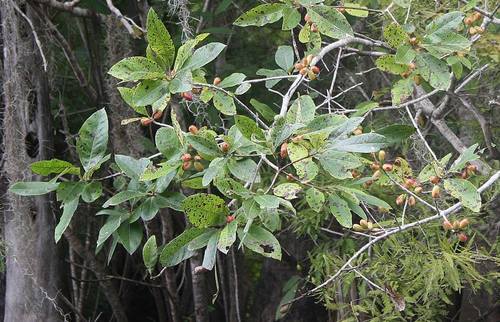
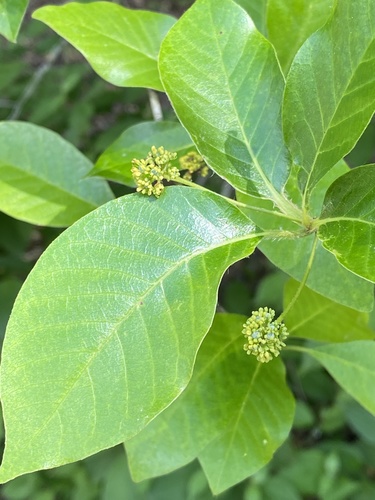
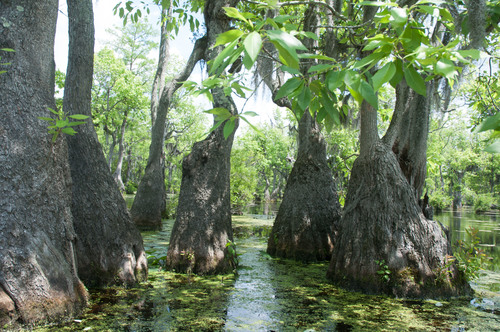
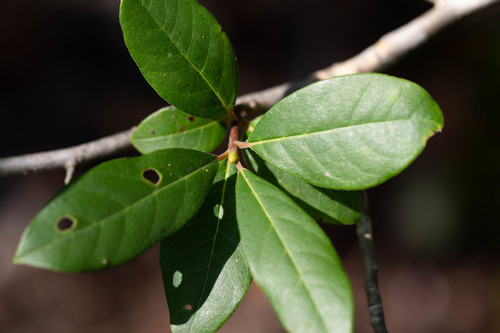
Nyssa biflora Walter, commonly called swamp tupelo, can be distinguished from black tupelo by its smaller leaves, which measure less than 2.5 to 3 inches (6.4 to 7.6 cm). Its leaves are more commonly oblanceolate or narrow elliptic than the broader leaves of black gum, though the species' overall morphology is variable. Swamp tupelo seeds also have deeper grooves than black tupelo seeds. Compared to water tupelo (Nyssa aquatica), swamp tupelo also has much smaller leaves. The tree's crown is narrow and irregular in appearance. Under optimal growing conditions, swamp tupelo can reach heights of 100 feet (30 m) or more. As the tree matures, its base typically enlarges into a buttress, and its bark has irregular fissures. Swamp tupelo grows primarily in coastal plains, ranging from New Jersey, Delaware, eastern Maryland, and southeastern Virginia, south to southern Florida, and west to eastern Texas. Its range extends north up the Mississippi Valley to southern Arkansas, and to west and south Tennessee. This species grows in humid warm climates. It not only tolerates flooding but actually thrives in flooded conditions, and is seldom found on sites that are not inundated for most of the growing season. Swamp tupelo grows in headwater swamps, strands, ponds, river bottoms, bays, estuaries, and low coves. It normally does not grow in the deeper parts of swamps or overflow river bottoms. Water regime is more important to swamp tupelo growth than soil type. The best growth occurs on sites where soil is continuously saturated with very shallow moving water. Growth can be reduced by as much as 50 percent when water is stagnant, such as in ponds. Intermittent flooding with periodic drying cycles, or continuous deep flooding even by moving water, also reduces growth. Swamp tupelo produces minute greenish-white flowers that emerge in spring alongside new leaves, usually in late April. Insects, primarily bees, are the main pollinators, but pollen is also dispersed by wind. The fruit is a drupe that changes from green to dark blue as it ripens, usually in early November. Fruits are eaten by black bears, small mammals, and birds, which helps disperse the species' seeds. Unlike the fruits of N. aquatica, swamp tupelo fruits do not float. Seeds normally overwinter and germinate the following spring. Germination does not occur underwater, but submerged seeds germinate once water levels drop below the soil surface. Germination is rapid in moist, drained conditions at 21 °C (70 °F) and higher temperatures. After germination, seedlings must grow quickly to keep their apex and leaves above water, because prolonged submergence during active growth will kill them. Submergence during the dormant season, however, has no negative effect. Swamp tupelo normally develops a taproot, and has a swollen base that extends up to the average height of growing season water levels. Specialized water roots develop under flooded conditions to help support the tree and capture nutrients. These roots tolerate high carbon dioxide concentrations, oxidize the rhizosphere, and carry out anaerobic respiration, making them key to the species' ability to thrive in flooded conditions. Common tree and shrub species associated with swamp tupelo include red maple (Acer rubrum), buttonbush (Cephalanthus occidentalis), buckwheat-tree (Cliftonia monophylla), dogwood (Cornus spp.), swamp cyrilla (Cyrilla racemiflora), swamp-privet (Forestiera acuminata), Carolina ash (Fraxinus caroliniana), loblolly-bay (Gordonia lasianthus), dahoon (Ilex cassine), inkberry (I. glabra), yaupon (I. vomitoria), fetterbush lyonia (Lyonia lucida), and bayberry (Myrica spp.).