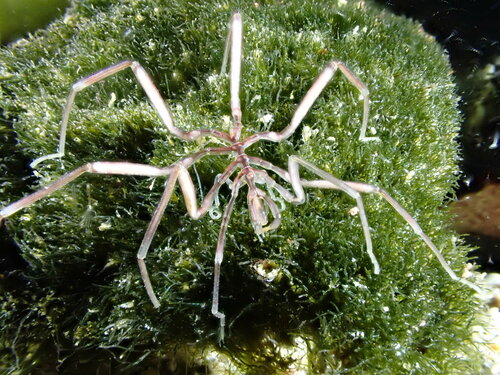
About Nymphon gracile Leach, 1814
When William Elford Leach first described Nymphon gracile Leach, 1814, he noted its body is made up of four leg-bearing segments. The first segment is head-like, with two eyes on each side. A cylindrical rostrum is inserted under the first segment, mandibles are longer than the rostrum and made of two joints, and six-jointed palps are inserted under the mandibles. The species has eight total legs, and Leach recorded that the egg-carrying structure in females is composed of ten joints. In broader anatomical terms, the body has four segments and eight legs. Each leg is divided into eight distinct segments: coxa, first trochanter, second trochanter, femur, tibia 1, tibia 2, tarsus, and propodium, and ends in a claw. The proboscis, palp, and chelicera arise from the first body segment, and the anus is located on the fourth body segment. While it is often very difficult to tell different sea spider species apart, N. gracile has distinct characteristics that make it easier to identify. This species typically has a fairly elongated proboscis, and its smooth cylindrical body can reach around 4mm in length. Sexual dimorphism occurs in this species: males generally have larger palps and chelifores than females. The proboscis of juvenile N. gracile is shorter and broader than that of adult individuals. Nymphon gracile is found in the Northeast Atlantic and the Mediterranean Sea. It inhabits the sublittoral zone, and lives among hydroids and sea anemones. Eggs of Nymphon gracile develop from August to February, and are carried on the ovigerous legs of male N. gracile. During vitellogenesis, yolk is synthesized intra-oöcytecally, with a small oöcytic contribution. This process is similar to the vitellogenesis seen in annelids and Limulus polyphemus. When carrying eggs, males often become covered in algae or other biota. The main feeding organ of Nymphon gracile is a triradially symmetric proboscis, with a terminal mouth that has three movable lips. The species has chelifores positioned laterally, and palps positioned dorsally. Gland openings near the mouth are thought to secrete saliva. Food is processed and filtered through the midgut, and intracellular digestion occurs via pinocytosis. The species uses all of its appendages during feeding. For this species, a characteristic feeding behavior is using the chelae to macerate prey.

