About Nymphoides peltata (S.G.Gmel.) Kuntze
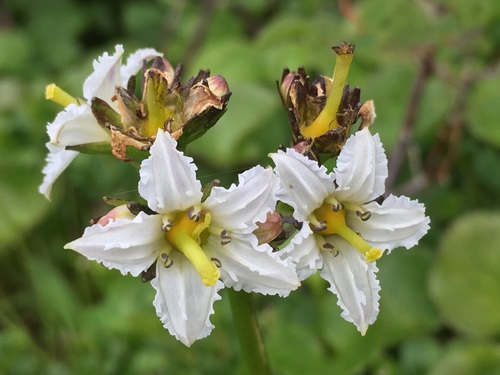
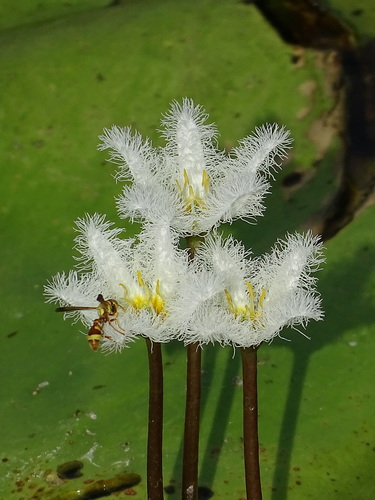
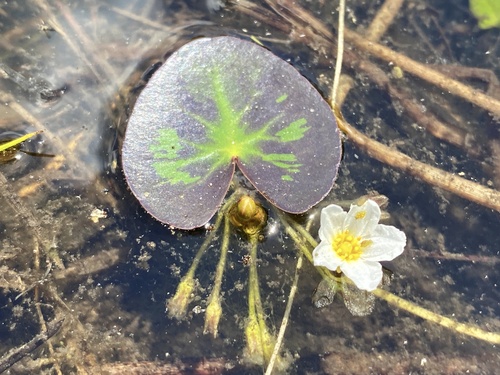
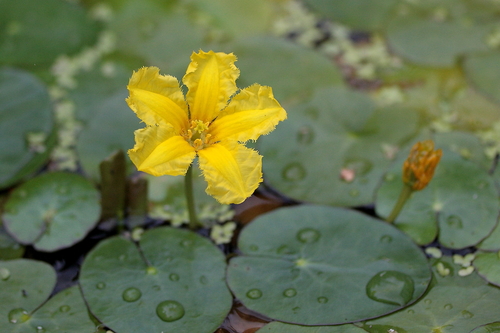
Fringed water-lily, scientifically known as Nymphoides peltata (S.G.Gmel.) Kuntze, is an aquatic, bottom-rooted perennial plant. It grows underwater creeping stolons that can extend into water up to 2 metres deep, and every node on a stolon can grow a new shoot and roots. N. peltata has cordate floating leaves 3–12 cm in diameter, rarely reaching 15 cm. The leaves are nearly circular with wavy margins and a narrow slit that extends to the stem; their upper surface ranges from green to yellow-green, often marked with purple blotches, while their undersides are purple. Leaves attach to submerged rhizomes, and have slightly wavy margins. They support a loose inflorescence holding two to five yellow flowers, each 3–4 cm in diameter with a five-lobed corolla and fringed petal margins. Flower peduncles rise a short distance above the water surface. Each flower develops a 1.5–2.5 cm beaked capsule that holds many flattened seeds with stiff marginal hairs. N. peltata looks similar to species in the genera Nuphar and Nymphaea of the family Nymphaeaceae. It can be told apart from both by its wavy leaf margins and clustered flowers (2–5 per cluster, rather than single flowers). Nuphar is easily distinguished from N. peltata by its much larger leaves, which can grow up to 30 cm, and its cup-shaped flowers. Nymphaea has angled leaf bases, unlike the rounded leaf bases of Nymphoides; Nymphaea also has much shorter peduncles supporting larger flowers than N. peltata. Flowers are usually required to identify different species within the Nymphoides genus. N. peltata is a freshwater species that does not grow in waters with an average salinity exceeding about 300 mg/L. It is most commonly found in slow-moving rivers, lakes, ponds, and reservoirs, but can also establish in swamps and wetlands. It also grows in ditches, canals, dike break-through pools, and backwaters, especially areas subject to winter flooding. The presence of N. peltata can indicate an environment with water movement. Depending on water temperature, N. peltata flowers mainly between July and September, though flowering can occur as early as May or as late as October. Each flower lives for only one day, while individual leaves persist for 23–43 days. Seeds are released 32–60 days after the end of the flowering period, and can germinate under hypoxic conditions. In autumn, the aboveground biomass of N. peltata dies, sinks to the substrate and decomposes, and the plant overwinters as dormant rhizomes. These rhizomes can survive freezing temperatures as low as −30 °C. During winter, stolons and stems either on or buried beneath the substrate stay dormant until spring, and some small 1–2 cm submerged leaves sometimes grow on these stems. After winter, the species needs light and oxygen to produce new growth, and floating leaves begin to appear in spring. N. peltata can reproduce both vegetatively and sexually. Fragments of an existing plant, including stolons, rhizomes, and leaves attached to part of a stem, can grow into a new individual plant. Seeds are produced through either cross-pollination or self-pollination, though self-pollination usually produces fewer, less viable seeds than cross-pollination. Seed dispersal is aided by the seeds' semi-hydrophobic nature, which makes them float on the water surface until disturbed. The seeds are adapted to adhere to surfaces such as the bodies, webbed skin folds, and short head feathers of waterfowl, all of which are hydrophobic. The marginal trichomes surrounding the seeds keep them attached to the bird while the bird is in flight, but once the bird enters water the seeds detach and sink to the substrate, where germination can begin. Adhesion to amphibious animals and boats are two other possible seed dispersal mechanisms. Seeds eaten by waterfowl or fish are fully digested and are no longer viable. N. peltata is listed as critically endangered in Spain, Belarus, and the Czech Republic, endangered in Lithuania, and vulnerable in Germany, Switzerland and Japan. N. peltata is an edible plant. Its leaves, flowers, and stems are cooked and eaten as a potherb; only the interior of the stem is consumed. Its seeds are ground and used for other culinary purposes. Fresh leaves are commonly used to treat headaches.