About Nymphicus hollandicus (Kerr, 1792)
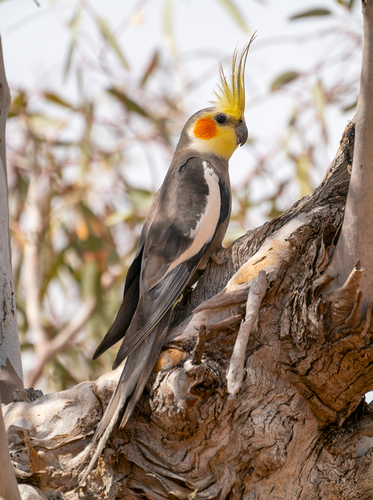
The cockatiel (Nymphicus hollandicus), also known as the weero, weiro, or quarrion, is a small parrot that forms its own unique branch of the cockatoo family, and is endemic to Australia. Cockatiels are popular exotic household pets and companion parrots worldwide, are relatively easy to breed compared to other parrot species, and as caged birds they rank second in popularity only to the budgerigar. The cockatiel is the only living species in the genus Nymphicus. Previously, scientists were uncertain whether to classify the cockatiel as a crested parakeet or a small cockatoo, but more recent molecular studies have placed it in its own separate subfamily, Nymphicinae. It is currently classified as the smallest subfamily within the cockatoo family Cacatuidae. This species is native to Australia, where it typically prefers Australian wetlands, scrublands, and bushlands. Many different genetic mutations of the cockatiel exist.
Cockatiels are native to Australia, where they mostly inhabit arid or semi-arid landscapes, though they always stay close to sources of water. The species is largely nomadic, moving to locations where food and water are available. They are most commonly seen in pairs or small flocks, though sometimes hundreds of individuals will gather in a flock around a single body of water. Wild cockatiels primarily feed on seeds, especially seeds from Acacia, wheat, sunflower, and Sorghum. They frequently feed on cultivated crops, which is a source of frustration for many farmers. In Australia, wild cockatiels can be found in and around western New South Wales, Queensland, Alice Springs, the Kimberley region, and the northwestern corner of Western Australia. They are not present in the country's most fertile southwest and southeast corners, the deepest inland deserts of Western Australia, or Cape York Peninsula.