About Nymphargus grandisonae (Cochran & Goin, 1970)
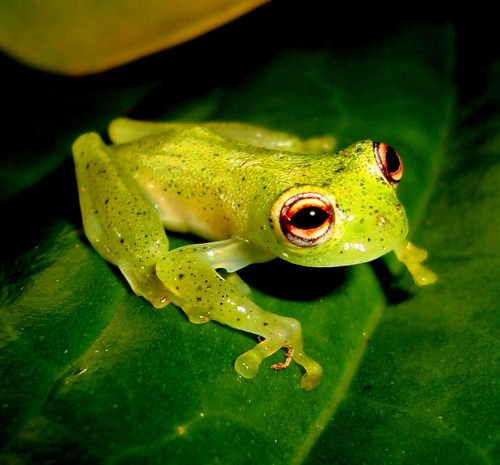
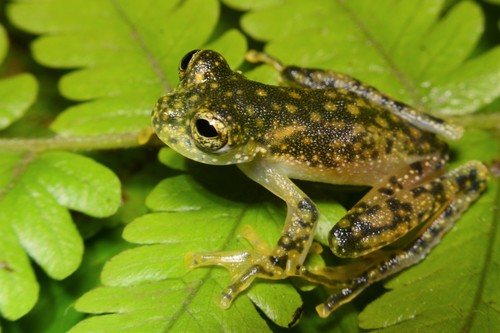
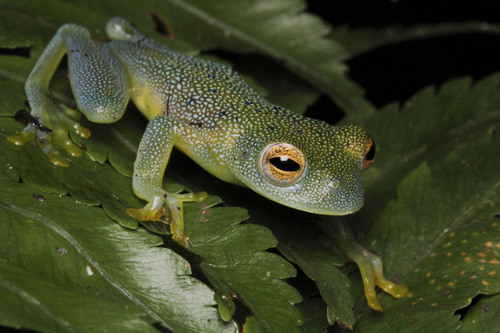
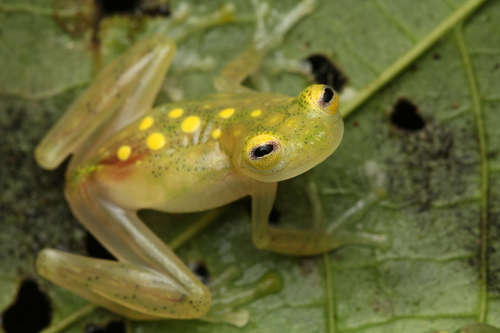
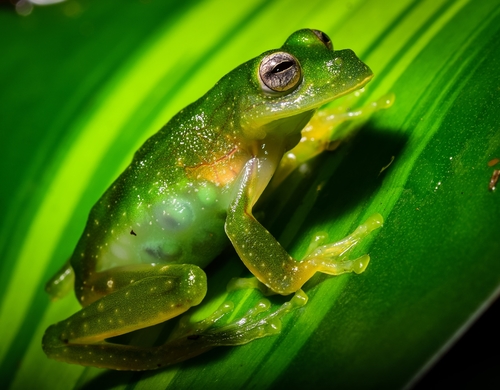
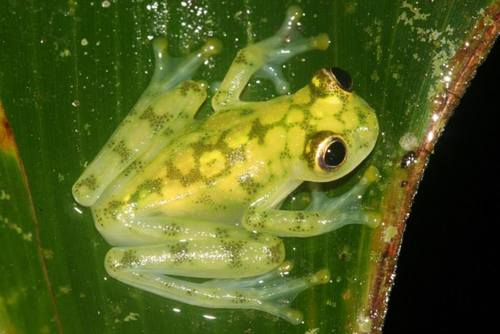
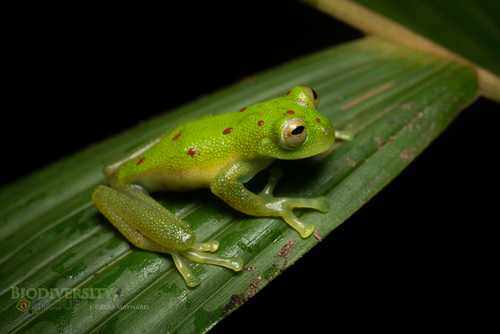
Adult males of Nymphargus grandisonae measure around 27 mm (1.1 in) in length, while adult females are around 30 mm (1.2 in) long. This species has large, bulbous eyes with yellow irises, and a slender body and limbs. Large adhesive discs are present at the tips of the fingers and toes. Males have a hooked spur on the upper arm, which they use when fighting rival males. The upper surfaces of the head and body are green, marked with many small red circular spots, and the underparts are whitish or creamy yellow. This frog is endemic to Colombia and Ecuador. In Colombia, it occurs on the western slopes of the Western Cordilleras and the Central Cordilleras. In Ecuador, it is found in the provinces of Carchi, Cotopaxi, Pichincha, and Santo Domingo de los Tsáchilas. It occupies an altitudinal range between 1,140 and 2,010 m (3,700 and 6,600 ft). It inhabits foliage in swamps and near streams, within cloud forest, along forest edges, in pastures, and beside roadsides, and it is never found far from forest. Nymphargus grandisonae is a nocturnal species that breeds in streams and pools. Males gather in vegetation a few meters above bodies of water and call to attract females. They will call from their preferred locations for a few days up to three months, with an average calling period of 36 days. When fighting rival males, they dangle from twigs and leaves using their hind limbs, and use the spurs on their forelimbs to fight, and they sometimes sustain injuries during these fights. One amplexus pair was observed over several hours under red light (to avoid disturbance): the pair moved across multiple leaves before returning to their starting leaf, where the female positioned her abdominal tip near the leaf edge and began laying eggs while moving slowly forward. The male made repeated leg movements that may have helped spread his sperm over the eggs. After the clutch was fully laid, the male detached and moved to another leaf where he called 13 times. The female then slowly moved back and covered the clutch with her body for 25 minutes. The observed clutch contained 61 eggs, which were positioned such that hatching tadpoles would fall into the water below the leaf.