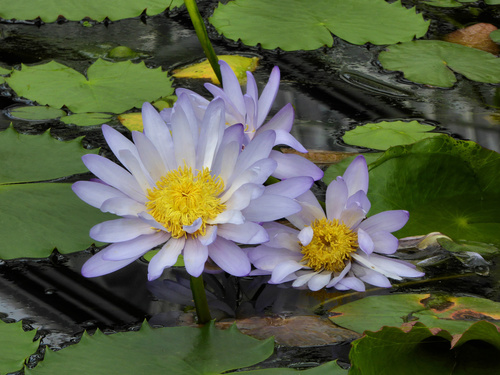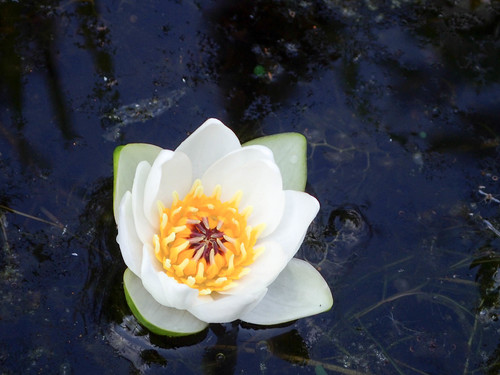
About Nymphaea tetragona Georgi
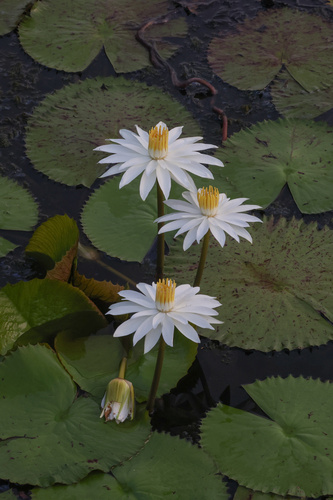
Vegetative characteristics: Nymphaea tetragona leaves may be cordate or ovate, have entire margins, and may be tinted purple, or sometimes mottled reddish brown or purple. Its rhizomes are erect and unbranched.
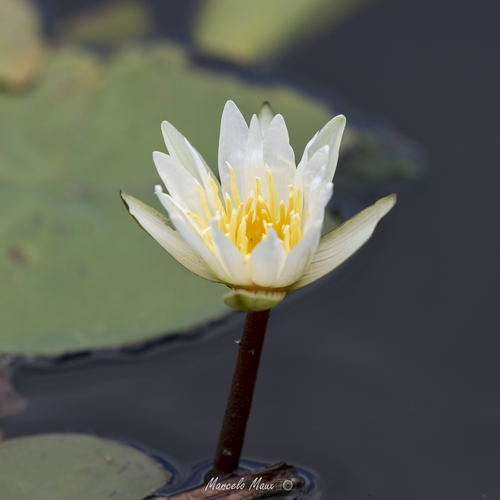
Generative characteristics: This species produces a single floating flower 1.5 to 3 inches wide, with up to 15 white petals. Each flower has 30 to 45 yellow stamens. Sepals and outer petals are arranged in whorls of four, and sepals are green. The receptacle is four-angled, and sepals are inserted into it. The seeds are smooth and rounded, measuring 2-3 × 1.5-2 mm, and are 1.3-1.5 times as long as they are broad. This species has 112 pairs of chromosomes.
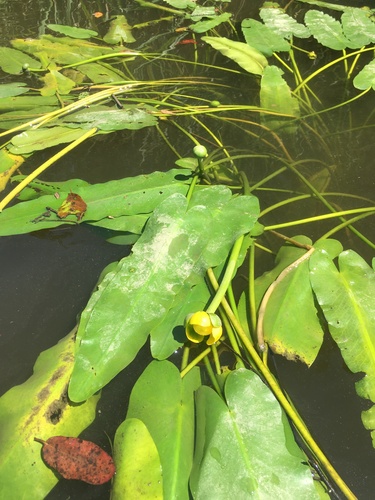
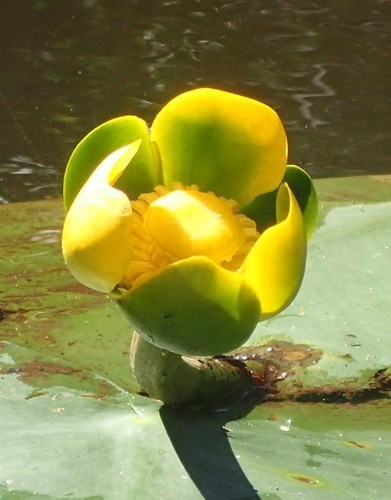
Distribution and habitat: It occurs in Midwestern Nepal, China, India, Japan, Kashmir, Kazakhstan, Korea, Russia, Vietnam, North America, and Europe. In North America and Europe, its native range is restricted to boreal regions above 50° N latitude. It is native to the area extending from Northern Europe to Korea and the Himalaya, and from Subarctic America to Northwest USA. It grows in ponds, lakes, and quiet streams. In Minnesota, it is found in slow-moving streams, often associated with beaver dams that create suitable habitat. In Minnesota, it is typically found in 1 to 2 meters deep water, growing alongside Zizania aquatica, Sagittaria sp, Scirpus sp, Typha sp, Nymphaea odorata var. tuberosa and Nuphar variegata (Yellow Pond-lily), which are also commonly found in these locations.
Ecology: The leaves are sometimes infected by the fungal pathogen Rhamphospora nymphaeae, which causes spots to form.
Reproduction: Nymphaea tetragona reproduces sexually via seeds. Mature fruits decay to release seeds, which remain buoyant for about one day – a trait that supports dispersal in the calm waters this species inhabits, including ponds, swamps, lakes, and streams. Longer-distance water dispersal is carried out by fish that feed on its seeds. Overland dispersal occurs via waterbirds, or via human activity. While this species generally has sufficient dispersal ability, successful seed establishment in suitable ecological conditions is considered more important than dispersal ability.