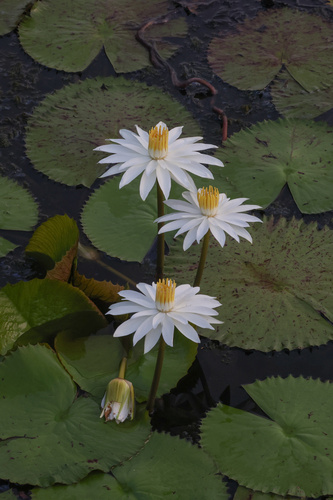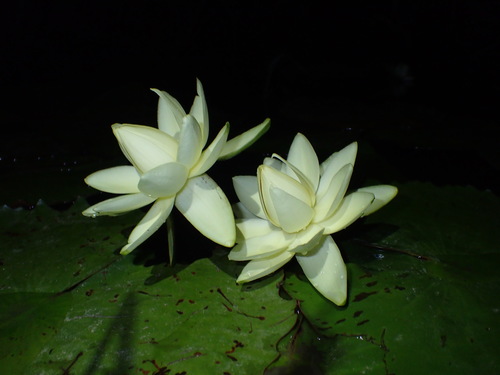
About Nymphaea rudgeana G.Mey.
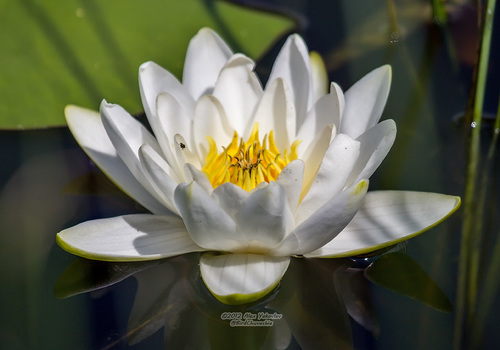
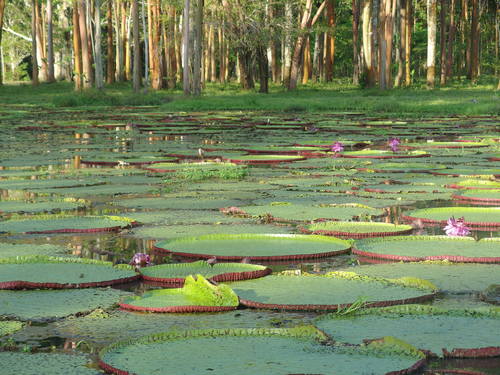
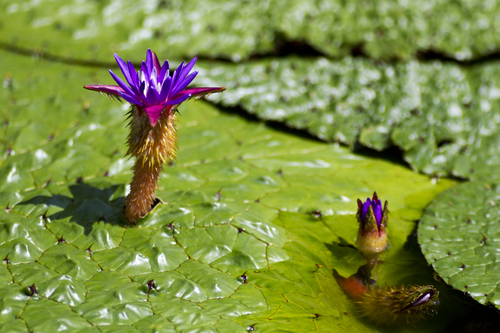
Vegetative characteristics: Nymphaea rudgeana G.Mey. has an ovoid to subglobose rhizome that can grow over 7 cm long and 8 cm wide, and it does not produce stolons. Its leaves are thick, leathery, and shaped round, kidney-shaped, or broadly heart-shaped. Leaf blades are typically 17–18 cm long and 19–21 cm wide, and can grow up to 35 cm long when growing in deeper water. The leaf margin is dentate with uneven, blunt teeth, and becomes almost entirely smooth towards the leaf apex. This species is the only member of its subgenus that has leaves with dentate margins. When growing in flowing water, it also produces submerged leaves with entire margins. The adaxial (upper) leaf surface is shiny, light green, with some red colouring in the centre and near the edge. Younger leaves have brownish red spots. The abaxial (lower) leaf surface, which has protruding leaf venation, is brownish-purple with irregular spotting. The petiole is reddish-brown, glabrous, up to 9 or 11 mm wide, and has 2 primary air canals plus 4 to numerous secondary air canals. 6–7 roots emerge from each leaf base. Generative characteristics: The flower has four green or pink, elliptic sepals with an acute to obtuse apex, which may or may not have blackish stripes. White to pink petals gradually transition into stamens. The floral fragrance is described as lemon-scented; this rich, fruity odour is similar to the fragrance of Nymphaea amazonum. Habitat: This species can grow in salty or brackish water. It has been observed growing in 20–100 cm deep shallow water at river margins, and has also been found growing in an artificial lake with slight water flow. Vegetative reproduction: No asexual reproduction is known to occur in this species; it produces neither stolons nor proliferating pseudanthia. Generative reproduction: Cross pollination is common in this species' protogynous flowers. Autogamy is also possible, because the stigma remains receptive on the second day, when pollen is released. This species produces very numerous seeds. One single fruit was recorded to contain 4365 seeds, and a total seed range of 1000 to 8000 seeds per fruit has also been reported. Pollination: The beetle species Cyclocephala castanea and Cyclocephala verticalis visit the flowers of Nymphaea rudgeana. These insects are not trapped inside the flowers overnight, though there are consistent reports of finding dead insects inside the flowers. Uses: The Palikur people of French Guiana use the foliage and flowers of this species as emollients. Several other ethnobotanical uses have also been recorded: decoctions are used to treat morphea, a drink made from the plant is used against erysipelas, and the plant is also used to treat facial tumours, toothaches, and leprous wounds. Native people use the seeds as food. Cultivation: Nymphaea rudgeana is very rare in cultivation, but it can be cared for easily. It should be grown in high light conditions, in rich, loamy fertile substrate, at temperatures between 23 and 29 °C.