About Nymphaea pulchella DC.
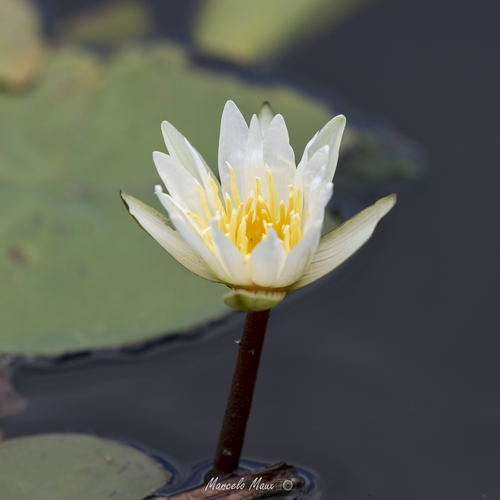
Nymphaea pulchella DC. is an aquatic herb with cylindrical to subglobose tubers. Its leaves are elliptic, suborbicular to orbicular, with a sinuate to dentate margin. Veins show minimal prominence on the abaxial leaf surface. Its diurnal flowers can extend up to 20 cm above the water surface. The flowers are supported by glabrous, brownish, non-brittle peduncles that have six primary central air canals and 12-13 secondary peripheral air canals. The androecium is made up of 43-80 stamens. The seeds are ellipsoid, smooth, and hispid, with trichomes arranged in continuous longitudinal lines. This species grows in freshwater habitats including lakes, ponds, lagoons, streams, and temporary puddles. It does not produce proliferating pseudanthia for vegetative reproduction. It is autogamous, but reproduction is more successful when pollinators are present. Flowering and fruiting occur year-round, and generative reproduction is the main reproductive mode of this species. The bee species Trigona spinipes is an effective pollinator of Nymphaea pulchella. In some cases, pollen-covered bees fall into the stigmatic fluid of the flower and die. The flowers are also visited by the bee species Apis mellifera, as well as flies.