About Nymphaea nouchali Burm.fil.
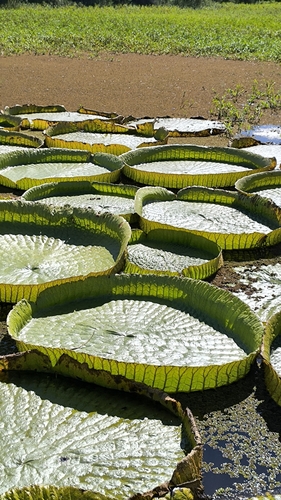
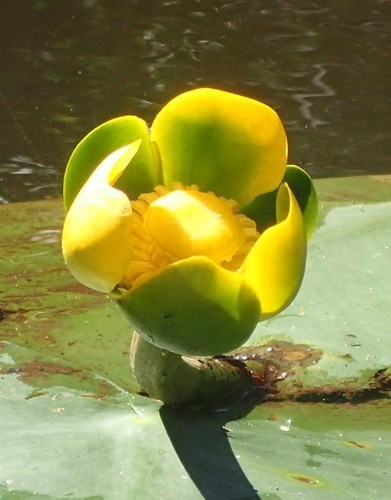
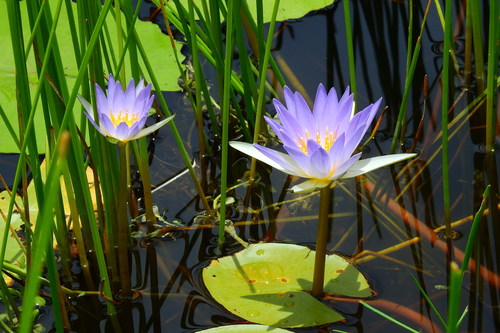
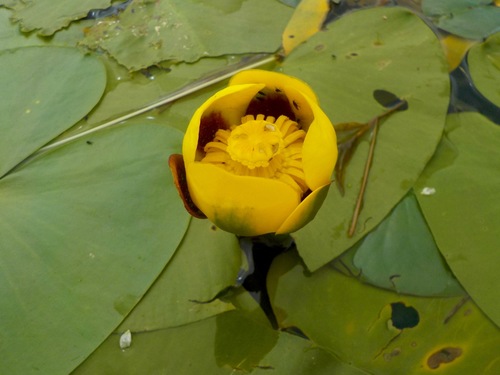
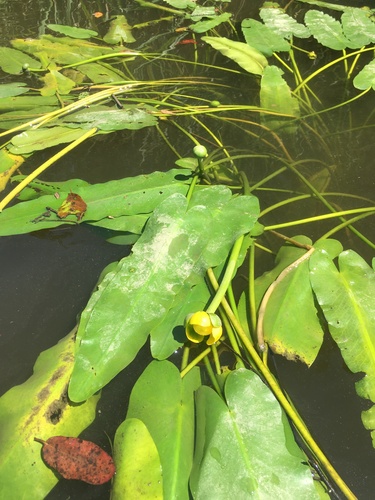
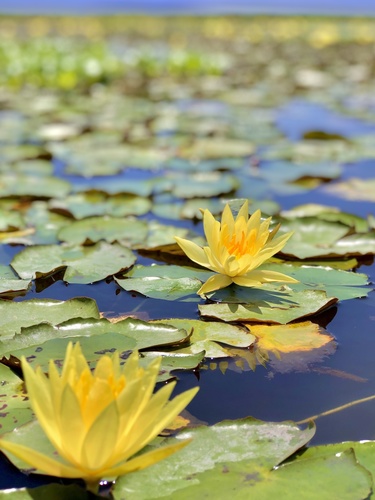
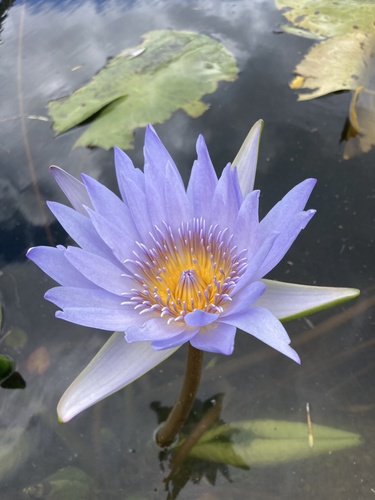
Nymphaea nouchali Burm.fil. is a day-blooming, non-viviparous water lily with submerged roots and stems. Some of its leaves stay submerged, while others rise slightly above the water surface. The leaves are round and green on the upper side, and typically darker on the underside. Floating leaves have undulating edges that create a crenellated appearance. Leaves measure around 20–23 cm (7.9–9.1 in) across, and the plant can spread up to 1.5 metres (4.9 ft) from its rhizome. This water lily produces attractive flowers, which are most commonly white or blue. Variants of the species can have flowers in white, blue, violet, purple, pink, cream, or yellowish white. Flowers have four or five sepals and 13–15 petals; petals have an angular shape that gives the flower a star-like appearance when viewed from above. The cup-shaped calyx has a diameter ranging from 4–15 cm (1.6–5.9 in). This aquatic plant is native to a wide range that extends from Afghanistan and the Indian subcontinent to Taiwan, Southeast Asia, and Australia. It has long been valued as a garden flower in Thailand and Myanmar, used to decorate ponds and gardens. In its natural habitat, N. nouchali grows in static or slow-flowing aquatic environments that are low to moderate in depth. Its leaves may be infected by the aquatic fungus Doassansiopsis nymphaea. In Indian Ayurvedic medicine, N. nouchali is recognized as a medicinal plant called ambal, primarily used to treat indigestion. Like all water lilies, N. nouchali contains the alkaloid nupharin, making its pear-shaped, brown cottony-covered, potato-sized rhizomes, leaves, and most of the plant poisonous. Unlike European water lily species, the nupharin in this species' rhizomes can be, and must be, neutralized by boiling. In India, the processed rhizomes have been consumed as a famine food or used as medicine. In Vietnam, they are eaten roasted. In Sri Lanka, N. nouchali was historically eaten as a type of medicine, and was too expensive to be a common everyday meal. In the 1940s, some villagers started cultivating the water lilies in paddy fields that were left uncultivated during the monsoon Yala season, which brought prices down. Today it is eaten boiled and added to curries. The tubers of this species are fully edible; during the dry season they are made up almost entirely of starch, and have been eaten boiled or roasted in West Africa. In Bangladesh, the stems of Nymphaea nouchali, known locally as shapla, are widely eaten as a vegetable. The popular dish shaplar data is cooked with mustard seeds, spices, and sometimes dried fish. Unlike areas where N. nouchali is only used as a famine food, it is a regular part of rural diets and seasonal cuisine in Bangladesh. The dried plant is harvested from ponds, tanks, and marshes during the dry season in India, where it is used as animal forage.