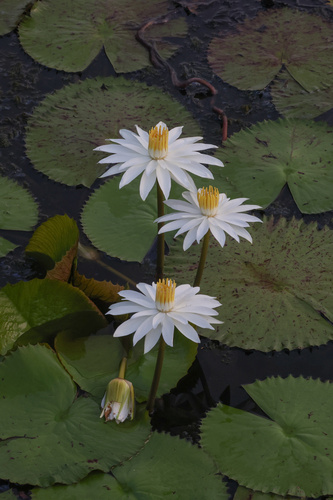
About Nymphaea lotus L.
Vegetative characteristics: Nymphaea lotus L. is a rhizomatous perennial aquatic herb. It has ovoid, erect, stoloniferous rhizomes that may be branched or unbranched, and these rhizomes bear leaf scars. Its stolons are slim. The floating leaves are coriaceous, orbicular to suborbicular with a dentate margin; they measure 10–32 (up to 50) cm long and 11–28 (up to 50) cm wide. Leaf venation of this species is actinodromous. Generative characteristics: Flowers are white or cream, fragrant to nearly inodorous, nocturnal, protogynous, and pedunculate. They are 6–10 (up to 25) cm wide, and extend 15–20 cm above the water surface. The receptacle is conical. The peduncle is stout, pubescent, 0.6–2.0 cm wide, and has 6 primary central air canals and 12 secondary peripheral air canals. The flower has four green, broadly ovate sepals, which are 4.5–9 (up to 11) cm long and 2–3.5 cm wide. There are 19–20 oval petals with rounded apexes. The androecium is made of 40–80 (up to 90) yellow stamens. The gynoecium contains 20–30 carpels. The fruit is large, globose, 6–9 cm wide, retains persistent sepals, and bears numerous arillate, ellipsoid seeds. Seeds measure 1.4–1.8 mm long and 0.9–1.2 mm wide. The peduncle does not coil when the plant develops fruit, and proliferating pseudanthia are absent. Distribution: This species grows in various parts of East Africa and Southeast Asia. Nymphaea lotus var. thermalis was previously thought to be a Tertiary relict variety endemic to the thermal waters of Europe, such as the Peţa River in Romania. DNA analysis has concluded that Nymphaea lotus var. thermalis is not distinct from Nymphaea lotus L., so it cannot be classified as a separate relic population. Ecology: Nymphaea lotus L. has the exceptional ability to persist through dry seasons using its rhizomes. It can reduce evaporation by up to 18 percent on most days during the summer period. Edible use: The tubers and seeds of Nymphaea lotus L. are used as food.