About Nymphaea gigantea Hook.
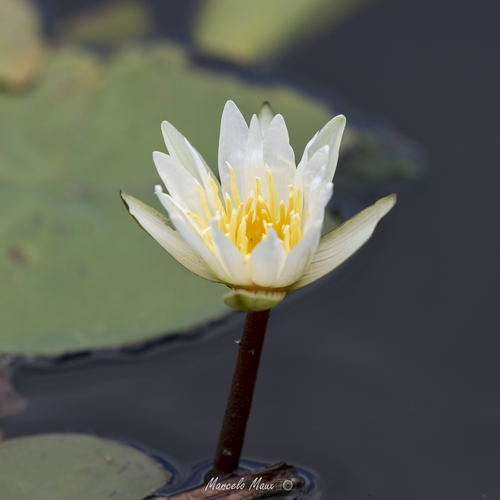
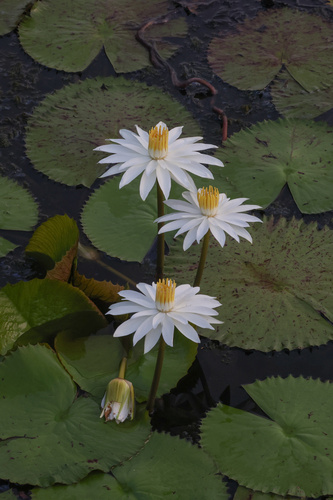
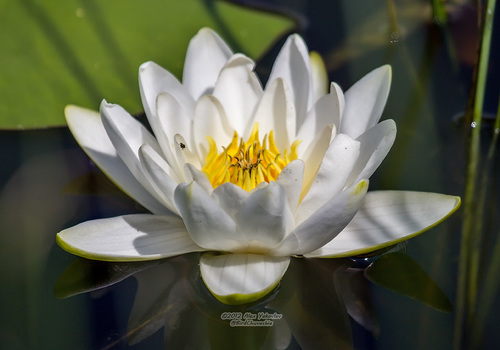
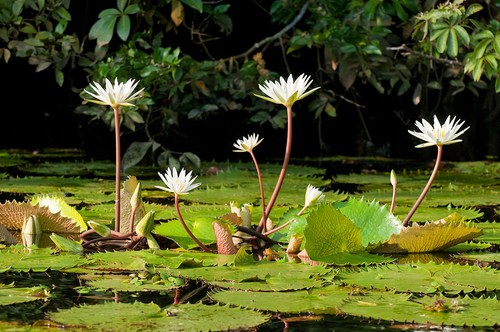
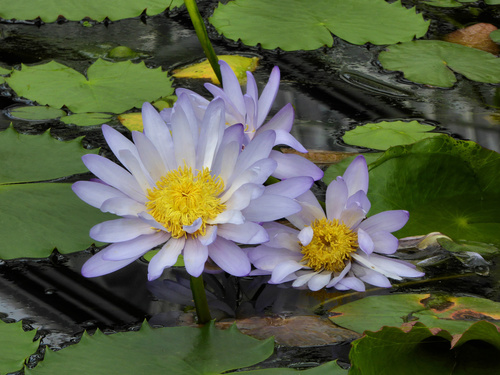
This species, commonly known as the giant waterlily, has a scientific name of Nymphaea gigantea Hook. It has a rhizomatous growth habit: its main stem grows horizontally underground, specifically in the mud at the bottom of a lake or pond, with only its leaves and flowers visible above the water surface. Its rhizome is globose. The large floating leaves are orbicular to slightly egg-shaped, and cordate, meaning the leaf stem attaches to the leaf blade at the base of a deep radial cleft; leaf stems can reach up to 5 m (16 ft) in length. Leaves can grow up to 80 cm (31 in) in diameter, are glabrous (hairless) on both sides, and have regularly-spaced teeth along the margins that are about 5 mm (0.20 in) long. The large flowers are solitary and can reach up to 25 cm (9.8 in) in diameter. They are held on a rigid, upright peduncle that can extend up to 50 cm (20 in) above the water surface. Flowers have four green sepals around 11 cm (4.3 in) long, which sometimes have blue or purple streaks, and up to 32 petals that are initially lilac or blue before fading to almost white as they age. Botanically, the fruit of this species is a berry. After a flower is fertilized, contraction of the peduncle (flower stalk) pulls it underwater, where the fruit ripens just below the water surface. Fruits are roughly the size of an apple and can contain up to 3,000 seeds. In Australia, the giant waterlily's native range extends from northeastern New South Wales, through eastern and northern Queensland and northern parts of the Northern Territory, to the far northeast of Western Australia. Some non-authoritative sources also claim it is native to New Guinea. It grows in permanent and semi-permanent waters including lakes, billabongs, and sluggish rivers, where the bottom is deep mud and water depth is at least 1.5 m (4 ft 11 in). Flowering occurs throughout the year, but is most common in warmer months. The flowers are open during the day and closed at night. This species was brought to England by Frederick Strange, received newspaper coverage there, and was subsequently adopted for cultivation by nurseries. Various parts of Nymphaea gigantea are edible, and the plant was an important staple food for Indigenous Australians across northern Australia. Indigenous women collected golfball-sized tubers from the muddy bottom of water bodies, which were then roasted before eating. Flower buds and peeled stalks were eaten raw. Seeds could be eaten directly after roasting the whole fruit, or pounded into flour to make damper.