About Nyctyornis athertoni (Jardine & Selby, 1828)
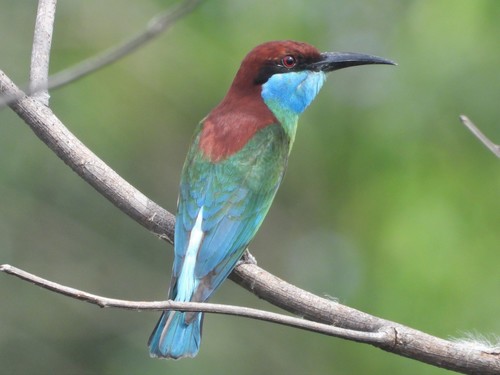
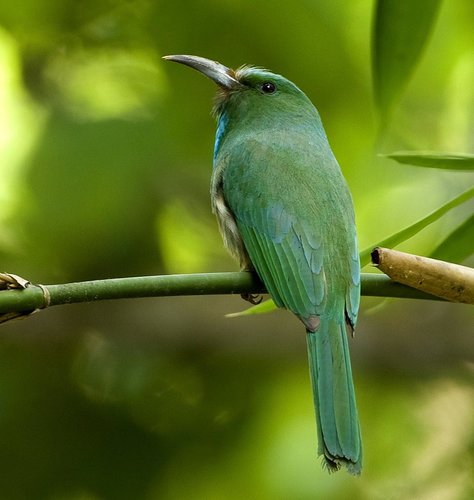
This is likely the largest species in the bee-eater family. Adult blue-bearded bee-eaters measure 31 to 35 cm (12 to 14 in) in length and weigh 70 to 93 g (2.5 to 3.3 oz). The species has a large, sickle-shaped bill, and its square-ended tail lacks the characteristic "wires" seen on most smaller bee-eaters. Its body plumage is grass green, with a turquoise forehead, face, and chin. The throat feathers are elongated, creating a bearded look when fluffed out. The belly ranges from yellowish to olive, with green or blue streaks. Populations in peninsular India are recorded as paler green than populations in northeast India. While males and females look similar to the human eye, the blue throat feathers of males have higher ultraviolet reflectivity than those of females. The species is named after Lieut. John Atherton of the 13th Light Dragoons, who died in 1827; Atherton was a nephew of Mrs. P. J. Selby, who obtained the original specimen of the bird. William Selby and Sir William Jardine described the species in their 1828 publication Illustrations of Ornithology, specifically Series 1, Volume 2 part 4, November 1828, plate 58. E. C. Stuart Baker originally gave the type locality as Cachar District, Assam, and the holotype is held in the Selby Collection at UMZC, catalog number 25/Mer/7/b/2. Sir N B Kinnear later re-designated Bangalore as the type locality, based on the fact that Atherton was posted in Bangalore when he wrote to Selby, and noted that Atherton had been assisted by a French collector thought to be Leschenault, though the species is rare in the Bangalore region. Atherton told Selby the bird was very rare, lived in the thickest jungles, fed at night, and was noisy with "curr, curr" calls. The nominate subspecies occurs in India and parts of mainland Southeast Asia, while the subspecies N. a. brevicaudatus is an insular population native to Hainan. A described subspecies from northeastern India, N. a. bartletti named by W. N. Koelz, is usually treated as part of the nominate population. This species inhabits a range of habitats, mostly at medium altitudes below 2000m. Its typical habitat is thin to fairly thick forest at medium elevations that includes open clearings. It occurs singly or in small groups of up to three, has a highly patchy distribution, and can easily go undetected in areas where it lives. It has been recorded from the hill regions of the Satpuras, Western Ghats, Eastern Ghats, Nilgiris, Chota Nagpur, and Sub-Himalayan forests. This bird makes loud calls but does not call frequently, and it is less active than smaller bee-eater species. Its calls include cackling calls similar to those of a hornbill, a repeating dry "Kit-tik... Kit-tik", and hollow nasal "kyao" calls. Breeding pairs may perform duets of cackling and rattling that end in short purring notes. Its flight is undulating and very similar to that of barbets. In India, the breeding season runs from February to August. Courtship behavior includes ritual feeding, bowing, and tail fanning. Nest excavation may start one month before egg-laying. The nest is a deep tunnel dug into a mud bank, and it contains four very spherical, white eggs. The species feeds mainly on bees. It exploits the defensive behavior of Giant honey bee (Apis dorsata) colonies by provoking the colony to release a mass of guard bees, which it then catches and eats in the air as they pursue the bird. While it mainly forages by making aerial sallies, it has also been recorded gleaning food from bark. It may sometimes join mixed-species foraging flocks. Individuals have been observed at the flowers of Erythrina and Salmalia, though it is unclear whether they were feeding on nectar or on insects attracted to the flowers. The blood parasite Leucocytozoon nyctyornis has been described from this species, and feather parasites of the genus Brueelia are also known to occur on it.