About Nyctinomops laticaudatus (E.Geoffroy, 1805)
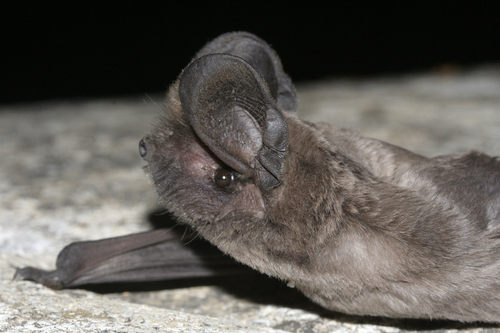
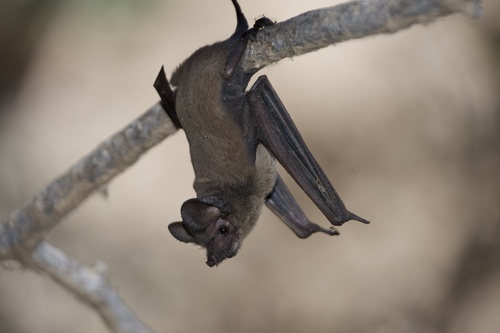
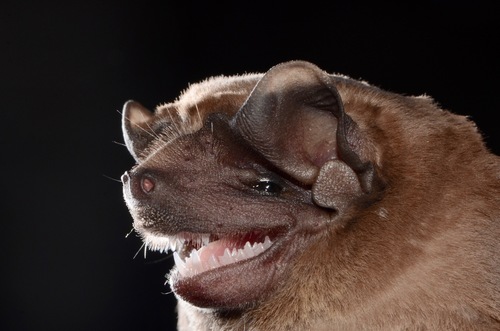
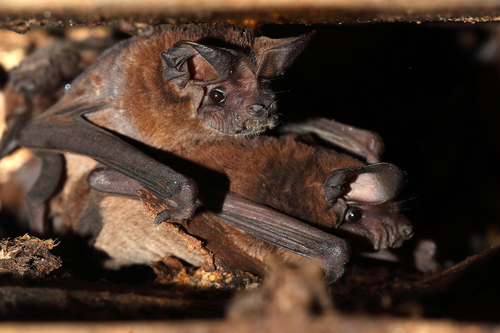
The broad-eared bat, scientifically named Nyctinomops laticaudatus (E.Geoffroy, 1805), is a relatively small bat species. It reaches a total length of about 10 cm (3.9 in), and has an average weight of 11 g (0.39 oz). Its body is dark chocolate brown with paler underparts, and it has hairless, translucent wings. The snout is pointed with an upturned tip, and its lower jaw is longer and narrower than what is typical for free-tailed bats. As its common name suggests, this species has unusually wide, rounded ears that join together in the middle of the forehead. Broad-eared bats inhabit tropical and subtropical regions, ranging from coastal Mexico to southern Brazil. They can be found across a variety of forest types, as well as in scrubland, cerrado habitats, and even urban areas. They occur from coastal plains up to cloud forests at elevations of 1,500 m (4,900 ft), but are more common at elevations below 500 m (1,600 ft). Five subspecies of Nyctinomops laticaudatus are currently recognized. These are: N. l. laticaudatus, found in southern Paraguay and adjacent parts of Brazil and Argentina; N. l. europs, found in South America east of the Andes, from Venezuela to northern Paraguay and Argentina; N. l. ferrugineus, found in coastal regions of central and northeastern Mexico; N. l. macarenensis, found in South America west of the Andes, from westernmost Venezuela to northernmost Peru; and N. l. yucatanicus, found in Central America, southern Mexico, and Cuba.