About Nyctimene robinsoni Thomas, 1904
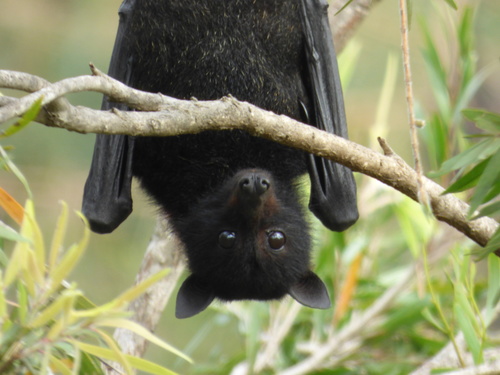
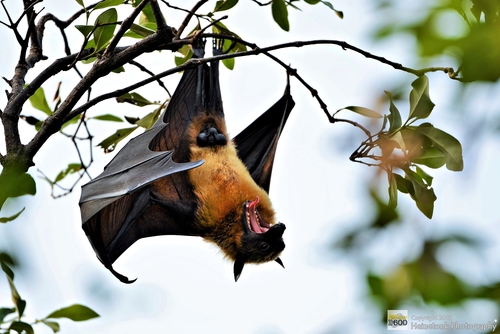
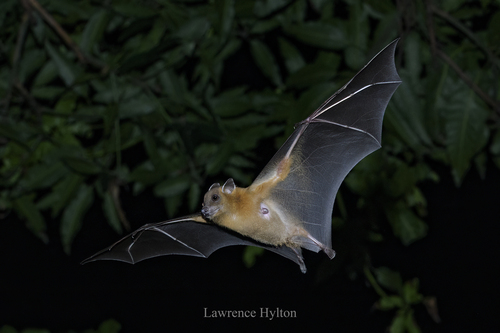
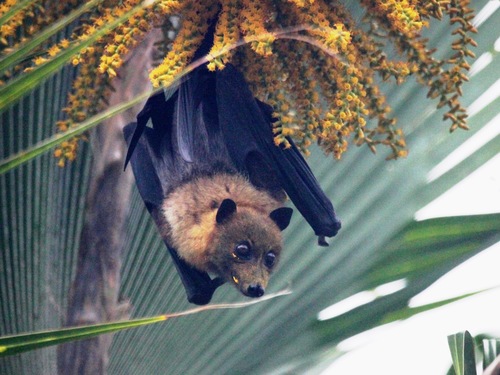
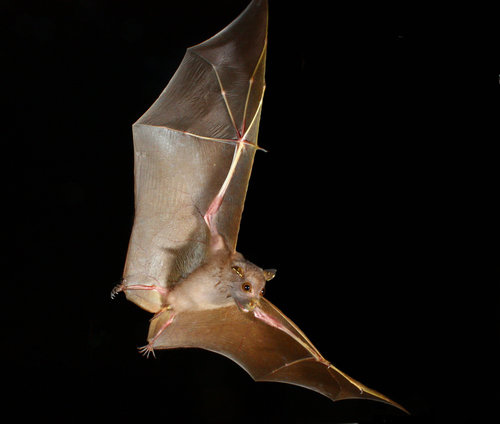
Nyctimene robinsoni Thomas, 1904 is a species of fruit-eating bat in the family Pteropodidae, and it is the only member of the Nyctimene genus found on mainland Australia. This species can be easily identified by its unusual protruding nostrils, which sit on a short, broad, rounded muzzle. Its ears and wing membranes have many small contrasting spots in yellow-green or pale yellow; this spotted trait is also seen in the related Torres species Nyctimene cephalotes. These spots are thought to provide camouflage when the bats rest during the day, and they have also been found to be photoluminescent. This photoluminescence has not been observed in any other bat species, nor has it been recorded in captive specimens of N. robinsoni. The species' fur (pelage) ranges in color from russet to greyish brown, with greyer tones on the face and head, and a dark line running down the back from the neck. When light reflects off its eyes, they appear bright red. Measured body dimensions are as follows: forearm length 65 to 70 millimetres, combined head and body length 82 to 93 millimetres, and ear length from base to tip 16 to 20 millimetres. Recorded body weight ranges from 42 to 56 grams, with an average weight of 48 grams. Its dentition is adapted for a frugivorous (fruit-eating) diet: it lacks lower incisors, and presses its lower jaw against upper canines to consume fruit. When flying, it vocalizes a high-pitched 'seep' call. The distribution of N. robinsoni extends along Australia's east coast, from north of Lismore, New South Wales to Cape York, and also includes the islands of the Torres Strait. The species is relatively common in Queensland, and becomes rarer to see south of Ingham. Its habitats include rainforests, tropical vine forests, wet sclerophyll forests, open forests, woodlands, and heathland, in tropical and subtropical regions.