About Nycticorax nycticorax (Linnaeus, 1758)
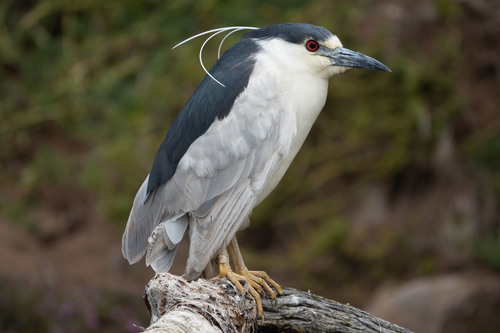
Description: Adult black-crowned night herons (Nycticorax nycticorax) have a black crown and black back, with the rest of the body white or grey. They have red eyes, short yellow legs, pale grey wings, and white underparts. Between one and eight long, slender white plumes extend from the back of the head, most often between two and four; these plumes are erected during greeting and courtship displays. Males and females look similar, though males are slightly larger. This species does not match the typical body shape of other herons. Compared to more well-known relatives like egrets and day herons, black-crowned night herons are relatively stocky, with shorter bills, legs, and necks. They normally hold a somewhat hunched resting posture, but extend their necks when hunting, appearing more like other wading birds. During a short period of courtship at the start of the nesting season, adult legs turn bright salmon-pink, and the bare skin around the eyes becomes blue. Subspecies of Nycticorax nycticorax differ very little. The nominate subspecies N. n. nycticorax and N. n. hoactli are especially similar in plumage, and some authors have classified N. n. hoactli as a synonym of the nominate subspecies; however, N. n. hoactli is on average slightly larger. N. n. obscurus is the most distinct subspecies, and is clearly darker than N. n. hoactli from further north in South America. N. n. falklandicus is intermediate in appearance, with both paler and darker individuals recorded. Immature black-crowned night herons have dull grey-brown plumage on their heads, wings, and backs, marked with numerous pale teardrop-shaped spots. Their underparts are paler, with brown streaks. Birds in their second and third years develop plumage that grows increasingly similar to adult plumage, but do not gain the adult white head plumes. Young birds have orange eyes and duller yellowish-green legs. Black-crowned night herons are very vocal in their nesting colonies, and their calls are commonly written as quok or woc. Distribution: The breeding habitat of this species is fresh and saltwater wetlands across most of the world. The nominate subspecies N. n. nycticorax breeds in Europe, Asia, and Africa. Subspecies N. n. hoactli breeds in North and South America, ranging from Canada as far south as northern Argentina and Chile. N. n. obscurus breeds in southernmost South America, and N. n. falklandicus breeds in the Falkland Islands. Black-crowned night herons nest in colonies, building stick platforms either in groups of trees or on the ground in protected sites such as islands or reedbeds. Females lay between three and eight eggs per clutch. Populations in the northern parts of the species' range are migratory, while all other populations are resident, even in cold Patagonia. European birds winter in Africa, with a small number remaining in southern Spain. Central and east Asian birds winter in southern Asia. North American birds winter in Mexico, the southern United States, Central America, and the West Indies. A colony of black-crowned night herons has regularly summered at the National Zoo in Washington, D.C. for over a century. The birds also live year-round on the shores around San Francisco Bay, with the largest rookery located in Oakland. Their constant presence at Oakland's Lake Merritt, throughout the city's downtown area, along with their resilience to urban environments and displacement efforts, led to them being named Oakland's official city bird.