About Nycticebus menagensis Lydekker, 1893
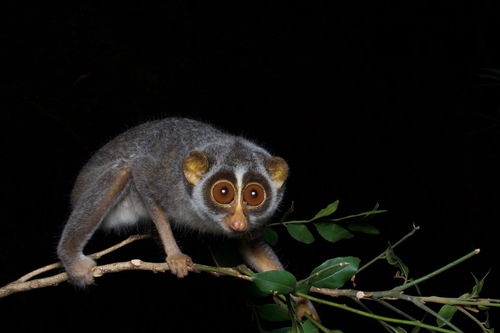
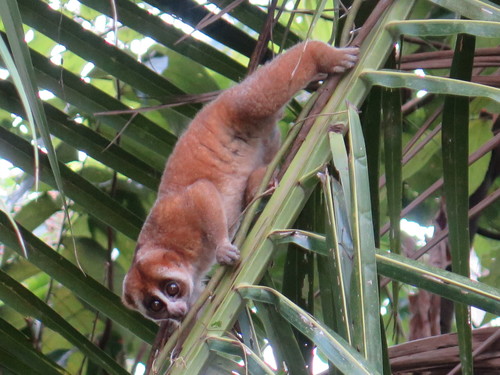
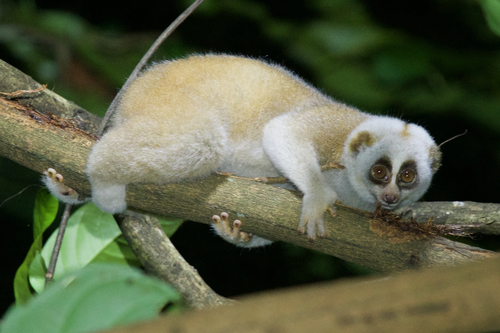
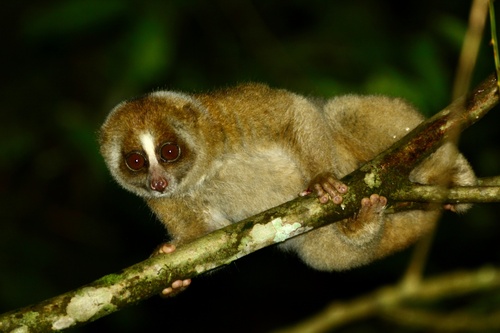
Like all slow lorises, Nycticebus menagensis (the Philippine slow loris) has a vestigial tail, a round head, and short ears. It has a rhinarium, the moist, naked surface around the nostrils, a broad, flat face with large eyes. On its front feet, the second digit is smaller than the other digits; on its hind foot, the big toe opposes the other toes, which improves its ability to grip. The second hind toe has a curved grooming claw that the animal uses for scratching and grooming, while all other nails are straight. It also has a specialized arrangement of lower front teeth called a toothcomb, which, as with other lemuriform primates, is also used for grooming. It has a small swelling called the brachial gland on the ventral side of its elbow, which secretes a pungent, clear oily toxin. The animal uses this toxin defensively by wiping it onto its toothcomb. The body weight of this species typically falls between 265–325 grams (9.3–11.5 oz), though weights as high as 700 grams (25 oz) have been recorded. Average body length is 274.2 mm (10.80 in), and skull length ranges from 54.5 to 56.5 mm (2.15 to 2.22 in). This places it roughly intermediate in size between the smaller pygmy slow loris and the larger Sunda slow loris. Bornean slow lorises are among the smallest in their genus, and this species can be distinguished from other Bornean slow lorises by its pale golden to red fur, low-contrast markings on its face and head, and the consistent absence of a second upper incisor. The rings surrounding its eyes are either rounded or have diffused edges on top, while the bottom of the rings occasionally extends down below the zygomatic arch. The stripe between its eyes is narrow, its ears usually have no fur, the patch on the top of its head is mostly diffused, and the fur band in front of the ears varies in width. Compared to the other three slow loris species found on Borneo, both N. menagensis and N. kayan have pale body coloration. N. menagensis has pale, very low-contrast facial markings, with markedly less contrast than the dark, high-contrast face mask of N. kayan. Additionally, N. menagensis has short, unfluffed body hair, which differs from the longer, fluffier body hair of N. kayan. N. menagensis is found primarily in coastal and lowland areas of northern and eastern Borneo, in Brunei, Sabah, and East Kalimantan. It is also found in the southern Philippine Sulu Archipelago, and may occur on other nearby islands such as Banggi Island off Sabah. In the Sulu Archipelago, it occurs in the western Tawi-Tawi Group, including the islands of Tawi-Tawi, Bongao, Sanga-Sanga, Simunul, and possibly other small islands. It does not live on Jolo island or further east, contrary to an earlier erroneous report from Mindanao. The species may be extinct on some Philippine islands, but is likely to still persist on smaller islands. Because the species is popular as a pet, zoologists Guy Musser and Lawrence Heaney suggested in 1985 that the Philippine populations may have been introduced to the area by humans. Of the four slow loris species living on Borneo, N. menagensis is believed to be only partly sympatric with N. kayan, with overlapping ranges in East Kalimantan and Sabah. Fossils of this species have been found at the Late Pleistocene Niah site in Sarawak. Bornean slow lorises are the least studied of Indonesia's slow lorises. During a field study at Sabangau National Park in Central Kalimantan, only 12 slow loris sightings were recorded over a 75-day period. All sightings were of individuals in trees at heights of 15–20 m (49–66 ft). Individuals were encountered alone, as a mother with offspring, or in adult trios. Both of the observed trios were on fruiting trees: Calophyllum hosei and Syzygium cf. nigricans. In another survey carried out at Wehea Forest, East Kalimantan, only one Philippine slow loris was encountered in an area spanning more than 30 km2 (12 sq mi); this individual was seen at a height of 30 m (98 ft). Other surveys confirm the animal is difficult to locate and occurs at low population densities. This species lives in primary and secondary lowland forest, gardens, and plantations, at elevations between 35–100 m (115–328 ft). Interviews with local people in the Philippines indicate it is commonly seen in calamansi citrus trees, and may be tolerant of a wide range of habitats. It is nocturnal and almost entirely arboreal. While data on its diet is limited, based on cranial size and morphology, the Philippine slow loris is suspected to be one of the more insectivorous slow loris species. It has also been observed feeding on gum from an unidentified species of liana, a long-stemmed woody vine.