About Nycticebus coucang (Boddaert, 1785)
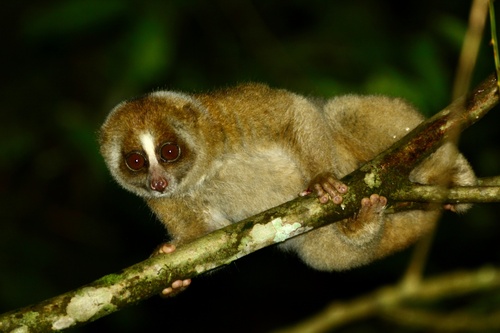
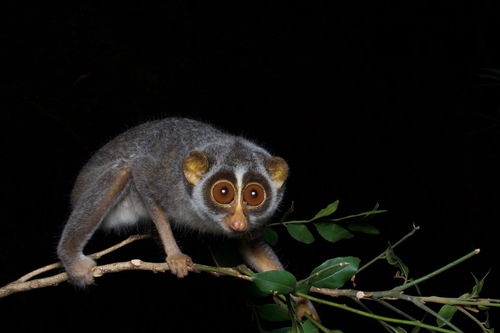
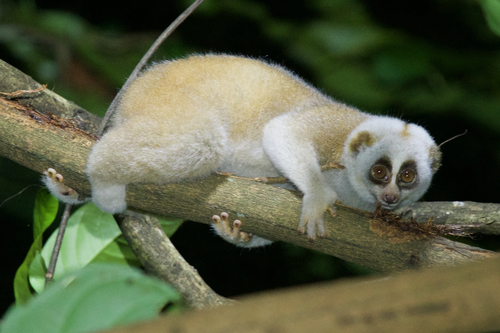
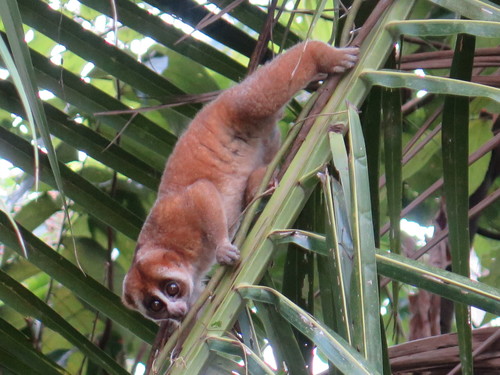
The Sunda slow loris (Nycticebus coucang), also called the greater slow loris, is a strepsirrhine primate and a species of slow loris native to Indonesia, West Malaysia, southern Thailand and Singapore. It measures 27 to 38 cm (11 to 15 in) from head to tail and weighs between 599 and 685 g (21.1 and 24.2 oz). Like other slow lorises, it has a wet nose called a rhinarium, a round head, small ears hidden in thick fur, a flat face, large eyes and a vestigial tail. The Sunda slow loris is nocturnal and arboreal, and typically occurs in evergreen forests. It prefers rainforests with continuous dense canopies, and has an extremely low metabolic rate compared to other mammals of its size. Its diet consists of sap, floral nectar, fruit and arthropods, and it feeds on exudates such as gum and sap by licking wounds in trees. Individuals are generally solitary; one study found only 8% of its active time was spent near other individuals. It has a monogamous mating system, with offspring living with the parents. It sleeps during the day, rolled up in a ball in hidden above-ground parts of trees, often on branches, twigs, palm fronds, or lianas. The species is polyoestrous, usually giving birth to a single offspring after a gestation period of 192 days. Young Sunda slow lorises disperse between 16 and 27 months old, generally when they reach sexual maturity. The species is listed as Endangered on the IUCN Red List. It is threatened with extinction due to growing demand in the exotic pet trade, and has become one of the most abundant primate species sold at Indonesian pet markets. Its teeth are often pulled out before it is sold as a pet, which can result in infection and/or death. This lack of teeth makes reintroduction to the wild impossible. It also suffers from severe habitat loss across its native range. The Sunda slow loris is found in continuous canopy tropical rainforests, but it is adaptable and can also live in other habitat types. Its native range includes Indonesia (the islands of Sumatra, Batam and Galang in the Riau Archipelago, and Tebing Tinggi Island and Great Natuna (Bunguran) in the Natuna Islands); Malaysia (the Malay Peninsula and Pulau Tioman); southern peninsular Thailand; and Singapore. Though it was presumed extinct in Pulau Tioman, records indicate slow lorises may still inhabit the island. The facial markings and morphology of the Tioman slow loris population differ substantially from mainland individuals, which suggests this population may be distinct. The Sunda slow loris is sympatric, meaning it shares its range, with the Bengal slow loris in Thailand, and hybridisation between the two species has occurred. Like other slow lorises, the Sunda slow loris is an arboreal and nocturnal primate. It rests by day in tree forks or thick vegetation, and feeds on fruit and insects by night. Unlike other loris species, it stays in trees for most of its life: while the Bengal slow loris often sleeps on the ground, the Sunda slow loris sleeps in a ball on branches or in foliage. It usually sleeps alone, but has been observed sleeping with multiple conspecifics, including other adults. Adult Sunda slow lorises live in overlapping ranges of 0.004 to 0.25 km2 (0.0015 to 0.0965 mi2). Despite its slow metabolic rate, the Sunda slow loris eats a high-energy diet. Its slow lifestyle may be an adaptation to the energy cost of detoxifying certain secondary plant compounds found in many genera of food plants in its diet. The largest proportion of feeding time is spent eating phloem sap (34.9%), floral nectar and nectar-producing plant parts (31.7%), and fruits (22.5%). It also consumes gums and arthropods such as spiders and insects, and obtains gum by licking wounds on trees. It is also known to feed on molluscs, including the giant land snail Achatina fulica, and birds' eggs. All slow loris species produce a toxin from glands on the insides of their elbows. They spread this toxin across their own bodies and the bodies of their offspring using their toothcomb while grooming. When threatened by predators, the Sunda slow loris can bite, roll into a ball to expose its toxic saliva-covered fur, or roll up and drop from trees. However, its primary predator avoidance method is crypsis (hiding). Recorded predators of the Sunda slow loris include the Asiatic reticulated python, the changeable hawk-eagle and the Sumatran orangutan. Since the Sunda slow loris is largely solitary, reproduction is one of the few occasions when it gathers with conspecifics. One study recorded the maximum number of slow lorises seen together as six: one female in estrus followed by five males. This observation may suggest a more promiscuous mating system, where females mate with more than one male. Despite this, the testis size of the Sunda slow loris is small compared to similarly sized prosimians, a trait that indicates monogamy. In the wild, the mating system of the Sunda slow loris is thought to vary between populations. Females reach sexual maturity between 18 and 24 months old, while males can reach sexual maturity by 17 months old. The species is polyestrous, meaning females have multiple periods of sexual receptivity each year. In captivity, however, there is a clear birth peak between March and May. This is thought to occur because reproductive patterns of captive prosimians in the northern hemisphere are altered. The estrus cycle lasts 29 to 45 days, with most copulations occurring on a single day. Males follow females in estrus, and copulation is initiated by the female. The female will hang from a branch and may vocalize. She also uses urine-marking and vocalization to solicit mating. The male holds both the female and the branch while copulating, and may create a mating plug after copulation. The average gestation period is 192.2 days, after which one young is born, though twinning has been observed. Both male and female young disperse in the wild between 16 and 27 months old.