About Nycticebus bengalensis (Lacépède, 1800)
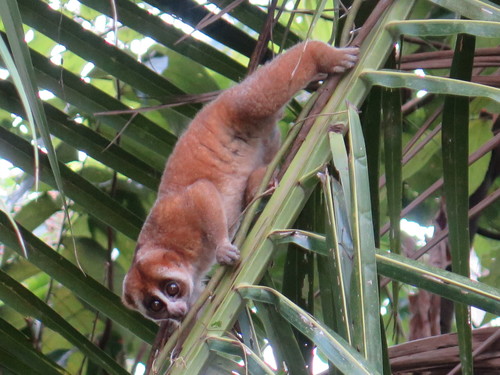
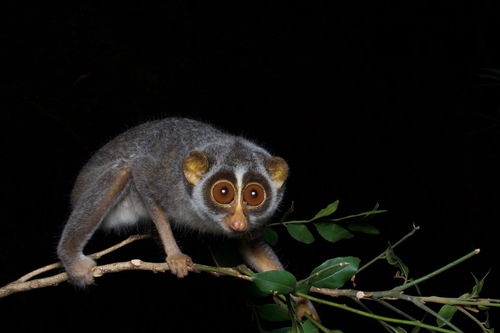
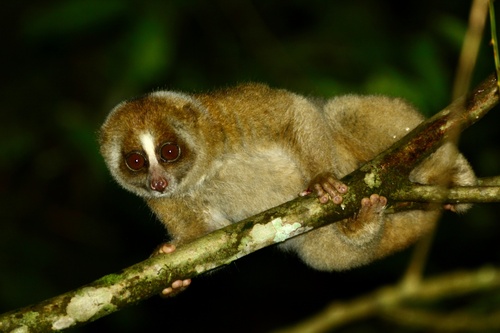
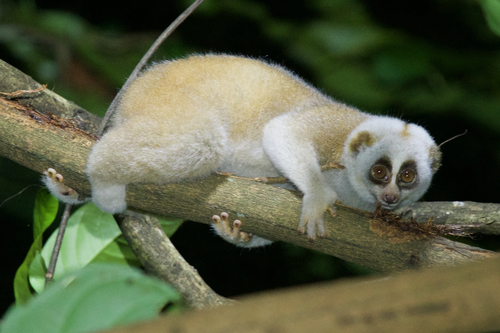
The Bengal slow loris (Nycticebus bengalensis), also called the northern slow loris, is a strepsirrhine primate and a slow loris species native to the Indian subcontinent and Indochina. It has a larger geographic range than any other slow loris species. Until 2001, it was classified as a subspecies of the Sunda slow loris (N. coucang), and phylogenetic analysis shows it is most closely related to the Sunda slow loris. Introgresive hybridization has caused some individuals from both species to carry mitochondrial DNA sequences that match the other species. It is the largest slow loris species, with a head-to-tail length of 26 to 38 cm (10 to 15 in) and a weight of 1 to 2.1 kg (2.2 to 4.6 lb). Like other slow lorises, it has a wet rhinarium (nose), round head, flat face, large eyes, small ears, a vestigial tail, and dense, woolly fur. The toxin it secretes from its brachial gland, a scent gland on its arm, has a different chemical composition than the toxins of other slow loris species, and may be used to communicate information about sex, age, health, and social status. The Bengal slow loris is nocturnal and arboreal, and lives in both evergreen and deciduous forests. It prefers rainforests with dense canopies, and its presence in its native habitat is an indicator of a healthy ecosystem. It acts as a seed disperser and pollinator, and is prey for carnivores. Its diet is primarily made up of fruit, and also includes insects, tree gum, snails, and small vertebrates. In winter, it depends on plant exudates such as sap and tree gum for food. The species lives in small family groups, marks its territory with urine, and sleeps during the day curled up in dense vegetation or tree holes. It does not breed seasonally, reproducing once every 12 to 18 months and usually giving birth to a single offspring. Mothers carry their offspring for the first three months, and offspring reach sexual maturity at around 20 months of age. The Bengal slow loris can live up to 20 years. The species is listed as Endangered on the IUCN Red List, and is threatened with extinction due to rising demand from the exotic pet trade and traditional medicine. It is one of the most common animals sold in local animal markets. In traditional medicine, it is primarily used by wealthy to middle-class urban women after childbirth, and is also used to treat stomach problems, broken bones, and sexually transmitted diseases. It is also hunted for food and affected by habitat loss. Wild populations have declined severely, and the species is already locally extinct in several regions. Though it occurs in many protected areas across its range, this does not protect it from rampant poaching and illegal logging. Key conservation priorities for the species include strengthening protection measures, stricter enforcement of wildlife protection laws, and improving connectivity between fragmented protected areas. This species has the largest geographic range of all slow loris species, and is native to Bangladesh, Northeast India, and Indochina, which includes Cambodia, Laos, Burma, Vietnam, southern China, and Thailand. It is the only nocturnal primate found in the northeast Indian states of Assam, Mizoram, Nagaland, Meghalaya, Manipur, and Tripura. In China, it occurs in parts of Yunnan and southwest Guangxi, and has been recorded in the Chittagong Hill Tracts of Bangladesh. It is known from 24 protected areas in Vietnam, and is distributed across most of Thailand. In Burma, it has been reported from Bhamo, Sumprabum, Kindat, Chin Hills, Pathein, Thaungdaung, and Pegu; populations in Laos have been recorded in the north, central, and southern portions of the country. The Bengal slow loris is sympatric, meaning it shares its range, with the pygmy slow loris in southeast China, Vietnam, and Laos. It is also sympatric with the Sunda slow loris on the southern peninsula of Thailand. In 2001, Groves reported that hybrids exist between these two species in this region. Across its entire geographic range, Bengal slow loris populations are in severe decline. Their habitat has been heavily degraded, and growing human populations will increase pressure on the species. As of 2000, only 9% of Bangladesh's original forest cover remained intact. In northeastern Cambodia, deforestation is accelerating, with 6% of natural forest lost between 1999 and 2000. Over the same period, Myanmar lost 14% of its natural forest, and Thailand lost 26%. In Vietnam, only 30% of original forest cover remains, due to deforestation caused by the Vietnam War, and only 10% of that remaining forest is closed-canopy. Habitat destruction remains widespread, and all slow loris populations within Vietnam's borders are significantly depleted. The species is already locally extinct in southern Quảng Nam Province and parts of the Vietnamese highlands, and local extinction is also expected in Song Thanh and Kon Cha Rang nature reserves. In India, dense forest canopy has declined by as much as 55% in some areas and continues to disappear rapidly. As early as 1987, the Indo-China region was reported to have lost 75% of the natural habitat for slow lorises. In 1992, total population size was estimated at between 16,000 and 17,000 individuals based on available habitat; however, recent publications note that far fewer individuals remain due to a contracted geographic range. The Bengal slow loris may now be restricted to a small number of isolated populations, and faces serious risk of local extinction in parts of Assam and Meghalaya. Its population is declining and threatened in Arunachal Pradesh. A 2006 study estimated population density in Assam, India, between 0.03 and 0.33 individuals per km². A 2007 survey at Thrisna Wildlife Sanctuary and Sipahijola Wildlife Sanctuary in Tripura, India, recorded an encounter rate of 0.22 individuals per km, with seven out of nine sightings falling within a 1.71 km² (0.66 sq mi) area, and most animals found at a height of 8–15 m (26–49 ft) near the interior of wet deciduous forest. In 2008, species abundance was measured at 0.18 individuals per km at Gibbon Wildlife Sanctuary in Assam. Since the 1990s, China's forests have declined significantly. In Yunnan and Guangxi provinces, primary forests are scarce and isolated, and secondary forests have been severely degraded. Yunnan has lost 42% of its forests, and has 2,000 or fewer slow lorises remaining. The Bengal slow loris is nearly extinct in Guangxi. It has been extirpated in Ningming County, and only a few individuals remain in Jingxi, Longzhou, and Pingxiang. The Bengal slow loris's preferred habitats are across tropical and subtropical regions, and include evergreen and semi-evergreen rainforests with forest edges and continuous, dense canopies. It can also be found in bamboo groves. It prefers habitats with large-diameter tall trees that have a large crown depth, defined as the length along the main axis from the tree tip to the base of the crown; these areas typically have greater food availability and lower predation risk. Because of its preference for dense forest, it serves as a good indicator of ecosystem health. The species is an important seed disperser and pollinator, and is prey for several carnivores. It feeds on plant exudates including sap, gums, resins, and latexes, particularly from plants in the Fabaceae family. Although the species does not have keeled nails, it scrapes plants to actively break through their surface; this behavior is similar to that seen in marmosets and fork-marked lemurs. It also obtains exudates by gouging holes into bark. Plant exudates make up almost all of its winter food supply. Terminalia belerica, the bastard myrobala, a deciduous tree common in Southeast Asia, is a preferred source of exudates, but the species has also been observed feeding on plant exudates from a number of other plant families: Moraceae (Artocarpus), Magnoliaceae (Manglietia), Fabaceae (Acacia, Bauhinia), Lecythidaceae (Careya arborea), and Sterculiaceae (Pterospermum). While it will feed on large insects such as katydids and crickets, gum, snails, small birds, and reptiles, it is primarily frugivorous. Lianas from the flowering plant genus Bauhinia are a common food source. As a nocturnal animal, the Bengal slow loris has excellent night vision, enhanced by a tapetum lucidum—a layer of eye tissue that reflects visible light back through the retina. It sleeps during the day curled up in a ball in dense vegetation or tree holes. Both males and females mark their territory with urine. The species lives in small family groups, and individuals may engage in social grooming. Unlike the pygmy slow loris, the Bengal slow loris is not a seasonal breeder. Females in estrus attract males with a loud whistle. Females reproduce every 12–18 months and have a six-month gestation period. Because they do not breed seasonally, females can become pregnant when their existing offspring are approximately 6 months old, making it possible for them to produce two offspring per year. Females typically give birth to a single offspring, with twins occurring rarely. This differs from the sympatric pygmy slow loris, which commonly produces twins. The mother carries her young for about three months before the young become independent, though offspring may be temporarily left on branches while the mother searches for food. Sexual maturity is reached at approximately 20 months of age. The species can live up to 20 years.