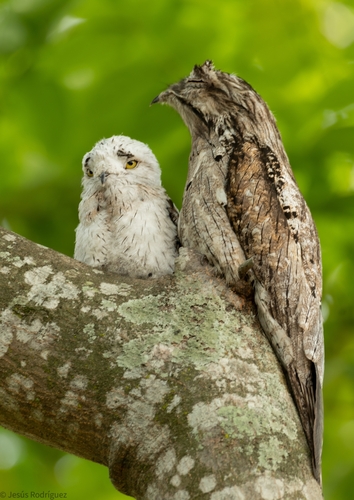
About Nyctibius jamaicensis (J.F.Gmelin, 1789)
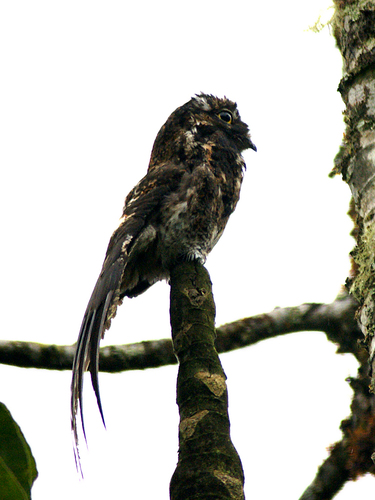
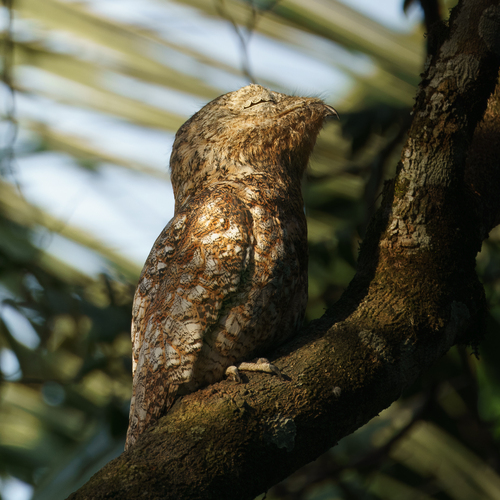
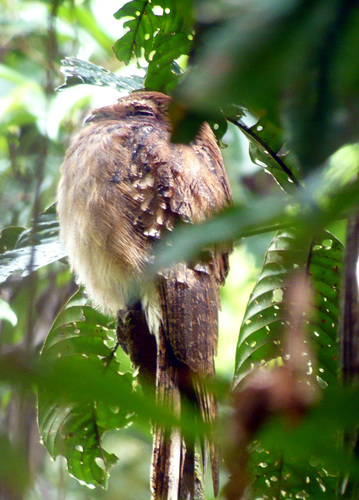
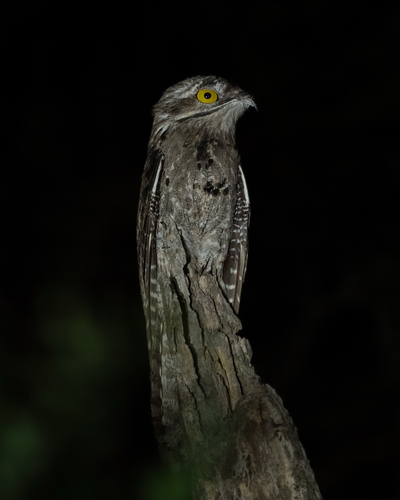
Nyctibius jamaicensis is a fairly large bird, measuring 38–46 centimetres in length. It has a long tail, long pointed wings, a large head, very short legs, and a small bill with a large gape. It is most commonly spotted perched motionless in an upright position on branches or posts. Its plumage is grey-brown, marked with an intricate pattern of black, grey and cream. It has pale cheeks, with a dark malar stripe below the cheeks, and large eyes with a yellow iris that can shine red in night light. Its calls are hoarse and guttural; its song is described as a "rough, squalling kwaaah, kwa-kwa-kwa", and it also makes "an abrupt, emphatic rrah!" and "a barking alarm call". The closely related common potoo is virtually identical in appearance to this species, but has a very different voice made up of a series of mournful, wailing whistles. The great potoo is larger and paler than Nyctibius jamaicensis, and lacks the dark malar stripe. Five subspecies of Nyctibius jamaicensis are distributed across Central America and the Caribbean. It mainly occurs in lowland areas, where it inhabits woodland, scrubland with clearings, and farmland with scattered trees. It is sometimes seen around golf courses and urban areas. It is an occasional visitor to Puerto Rico, particularly to its outlying islands in the Mona Passage. Permanent presence of the species in Cuba has been reported, but remains unconfirmed. Nyctibius jamaicensis feeds on large insects such as moths or beetles. It hunts from a perch, sitting and waiting for prey before sallying out to catch it in flight.