About Nyctibius grandis (J.F.Gmelin, 1789)
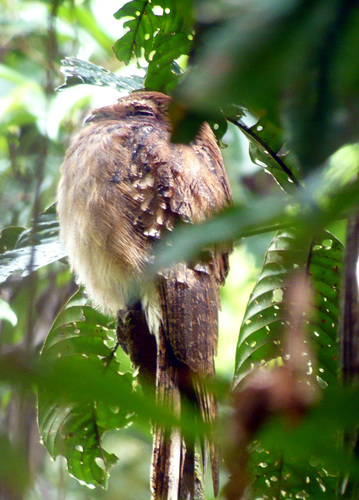
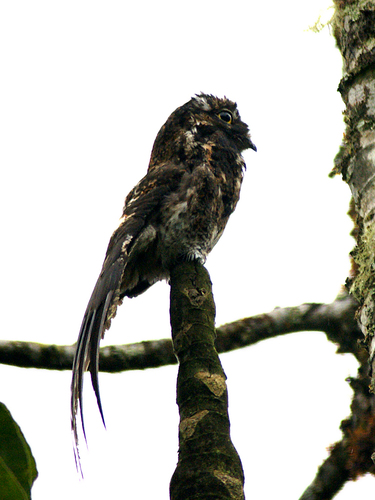
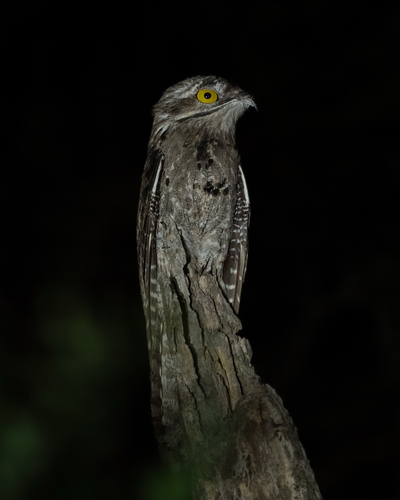
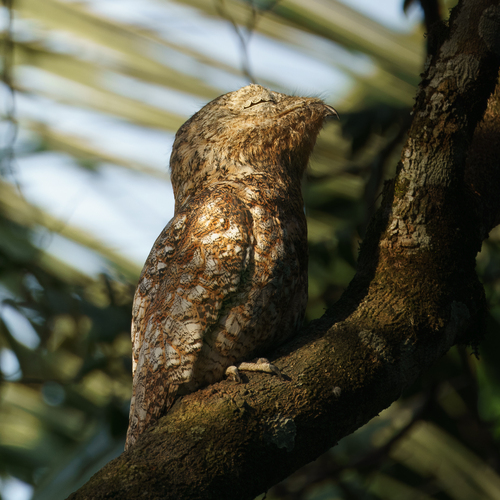
The great potoo (Nyctibius grandis) has a large head relative to its body size. It also has very large eyes with dark brown irises, unlike the yellow irises seen in many other potoo species, and a short but broad beak. Its wings are elliptical, and its tail is elongated. Feather coloration across the body includes white, gray, black, and burgundy. The tail shares the same base coloration as the rest of the body, but is marked with distinct white bars that run laterally across it. The species has a mass range of 360 to 650 g (13 to 23 oz), a total length range of 480 to 600 mm (19 to 24 in), a wingspan range of 700 to 804 mm (27.6 to 31.7 in), and an average wingspan of 734.8 mm (28.93 in).
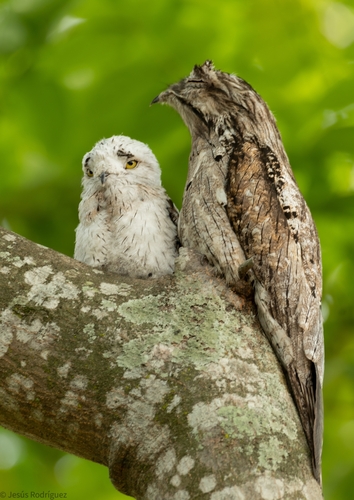
The great potoo's distribution extends from southern Mexico through northeastern Guatemala and most of Central America, south into South America as far as southeastern Brazil and Bolivia. It occupies habitats ranging from humid to semi-humid forested areas. Despite the species' broad geographic range, there is almost no variation in its physical traits such as size or plumage. The great potoo occurs most often in dense lowland forests, along forest edges, and in clearings. It can also be found in foothills up to approximately 1,500 m above sea level, second-growth vegetation, open woodlands including plantations, and is occasionally spotted around meadows, but it always requires trees or similar structures to use as camouflaged, imitative perches. During the day, the great potoo typically perches or nests at least 12 meters (39 ft) above ground in large trees, choosing branches that are usually 20 to 30 centimeters (7.9 to 11.8 in) in diameter. At night, it may move to lower perches that are 1.5 meters (4.9 ft) above ground to hunt.