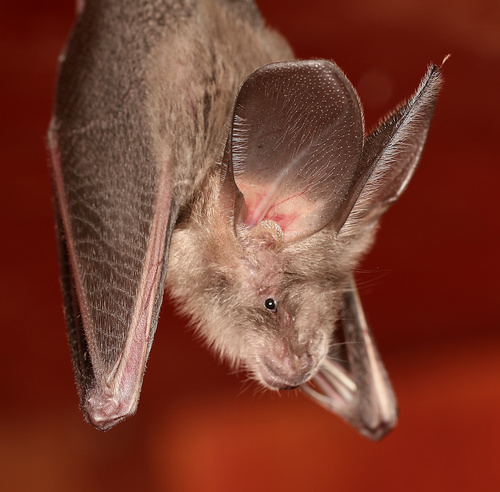
About Nycteris thebaica E.Geoffroy, 1818
The Egyptian slit-faced bat (Nycteris thebaica E.Geoffroy, 1818) gets its common name from a deep slit that runs from the base of the ears to the nostrils, between the nose leaves. These bats typically weigh 6.5–9.7 g (0.23–0.34 oz), and females can weigh up to 11.5 g (0.41 oz). They have broad wings with a wingspan of 283 mm (11.1 in) and a low aspect ratio, which allows for high maneuverability and the ability to hover close to the ground. Their dorsal fur is dusky to reddish brown, while their underside is white to whitish gray. Their fur is lighter than that of other members of the nycterid bat family. They have a long tail that can reach 61 mm (2.4 in) in length. This species thrives in a variety of tropical and temperate habitats across Africa and the Arabian Peninsula. One specimen was recorded on the Greek island of Corfu, marking the first known record of this animal in Europe. It can live in a wide range of diverse habitats, including forests, deserts, savannas, shrublands, and grasslands. For reproduction, the uterine horns of this species open into the vagina through separate vaginal canals, forming a uterus duplex. The placenta does not have a hemophagous area, a structure that aids in endocytosis and digestion of erythrocytes. The gestation period varies based on climate: it lasts 2–3 months in tropical areas, and up to 5 months in temperate climates. At birth, young of this species weigh about 50% of the mother's body weight. Females fly carrying their young between roosts to keep the young safe from predators.

