About Nyctalus noctula (Schreber, 1774)
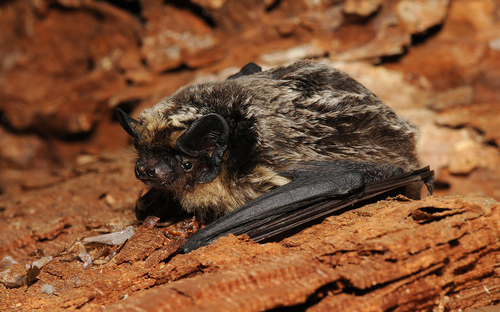
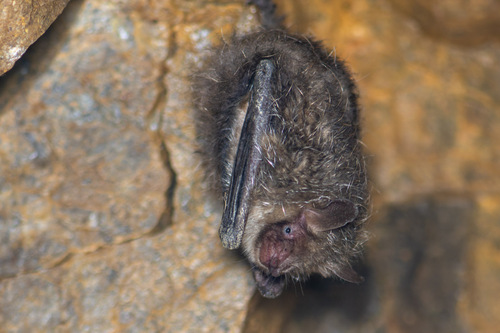
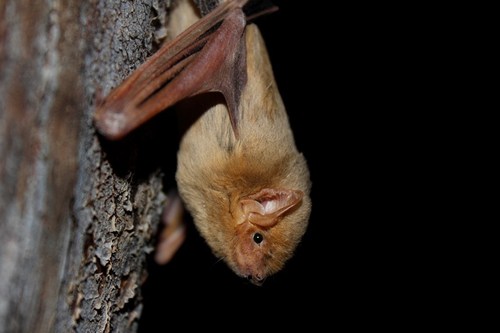
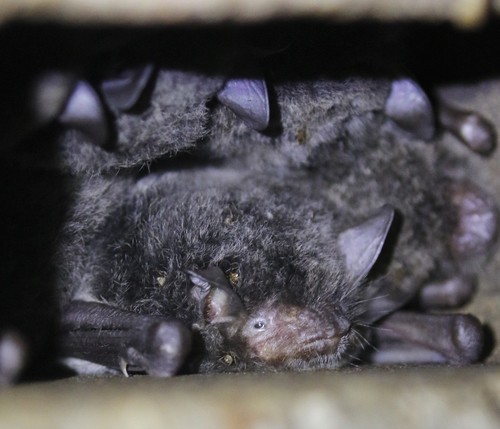
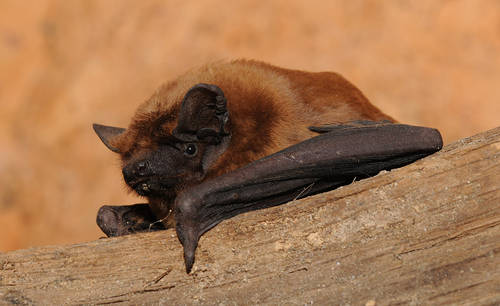
The common noctule (Nyctalus noctula) has short dark brown fur after moulting, which happens in June for males and July or August for females. Before winter sets in, its fur changes to red-brown. When awake, the species has a body temperature of 36.5 °C (97.7 °F), but temperature decreases sharply during inactivity. Adult common noctules have a body mass of 25–30 g (0.88–1.1 oz) and a wingspan of 37–40 cm (15–16 in). They forage while flying at a rapid speed of 20–40 km/h (12–25 mph), and can sometimes reach speeds up to 60 km/h (37 mph). Because insect prey is only available for a limited time each day, common noctules have short daily activity periods, all within the time after sunset and before sunrise, adding up to one hour or less in total. This means they must cope with up to 23 hours of fasting per day. The species has a robust body, long broad wings, a distinctive pointed snout, and large ears that are necessary for its echolocation abilities. Its distribution covers most of Europe, central Russia, across the Ural Mountains, Caucasus, Turkey, the Near East, to southwestern Siberia, the Himalayas, China, Malaysia, Taiwan and Japan. Its range stretches from western Europe to eastern European regions, including Germany, Poland, and the United Kingdom. In Bulgaria, it is widespread and prefers deciduous forests. It can usually be found at altitudes up to 2,000 meters, and lives in a variety of habitats from deciduous forests to agricultural landscapes. It prefers small to medium-sized woodlands, but will forage up to 20 km (12 mi) away from woodland at night. It commonly roosts in tree cavities and buildings, especially attics. For daytime roosting, it usually uses tree holes or bat boxes attached to tree trunks. It has adapted well to urban environments, and uses street lights to attract insects. While it generally occupies wooded habitats, some populations thrive in central European cities such as Hamburg, Vienna, Brno and others. The common noctule is a migrating species with female bias: females migrate, while males do not. Mating season occurs in late summer in the wintering areas. Females store sperm in the uterus during hibernation, and fertilization happens in spring. During early pregnancy in late April, females migrate north, as far as the Baltic region, to return to their natal maternity colonies. They give birth after a six to eight week pregnancy. Each female raises one or two young per year. At birth, offspring weigh about a third of the mother’s body weight. After three to four weeks of suckling, the young leave the roost almost fully developed, so females raise their offspring to full size entirely on milk. Males do not migrate, but instead scatter along the females’ migration routes to get a higher chance of attracting the first females migrating back to the wintering regions. The reproductive cycle of male common noctules corresponds directly to season and food availability, and spermatogenesis can be affected by body condition. In early autumn, males develop large testes and use singing calls to attract females. While in harem roosts, males often do not enter torpor, staying awake and mobile to defend their females from other males that try to copulate. Avoiding torpor in late summer and early autumn also prevents delayed spermatogenesis, which occurs when resting metabolic rate is depressed during torpor and hibernation. During summer, male noctules are solitary or form small bachelor groups. In Europe, young are mainly reared in the northern part of the distribution range, north of roughly 48°–49°N latitude. Outside this main breeding area, several smaller isolated breeding areas are recorded in Slovakia, Hungary, Bulgaria, Slovenia, the Iberian Peninsula and Italy.