About Nuttallia obscurata (Reeve, 1857)
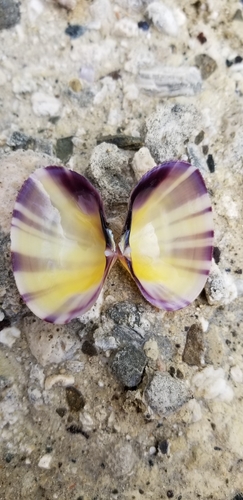
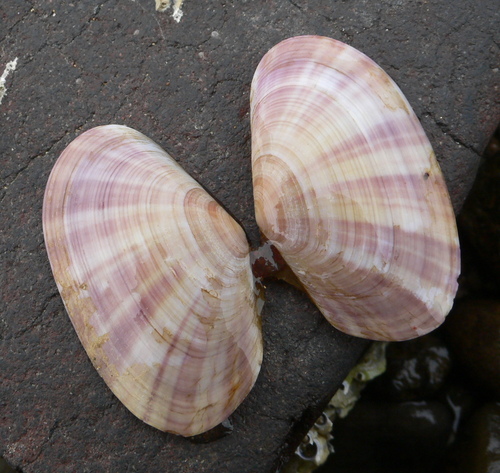
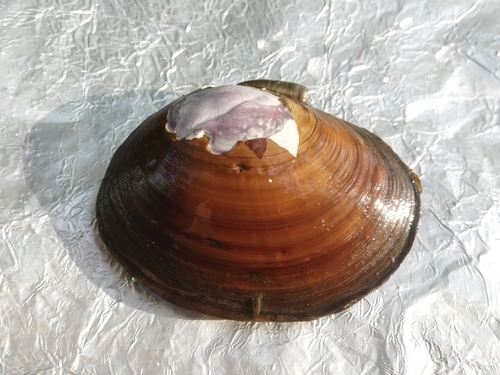
The valves of Nuttallia obscurata are thin, relatively shallow, and nearly oval in shape. They can grow up to 6.4 centimetres (2.5 inches) in length, and individual clams can reach a maximum weight of 45 grams (1.6 ounces). The exterior of the valves is covered by a shiny brown periostracum, which gives the species one of its common names: varnish clam. This periostracum is often worn away at the umbo. Where the periostracum has been removed, concentric rings are visible on the outer surface of the valves. The interior of the valves ranges from deep purple to almost white across different individuals. The prominent hinge ligament of this species sits external to the valves. Nuttallia obscurata has a large, white, muscular foot that it uses to dig into sand and for propulsion. The animal also has two long, separate white siphons. This clam species lives in the mid to high intertidal zone, buried in sand, gravel, or silt, from just below the surface down to 20 centimetres (7.9 inches) deep. It has a higher tolerance for varying salinity conditions than native clams, and is sometimes found in brackish waters near freshwater seeps. Nuttallia obscurata is native to Japan, Korea, and China. It has become naturalized in British Columbia, Washington, and Oregon. Its introduced range covers the coast of Vancouver Island, the Strait of Georgia, Puget Sound, and extends south along the coast to Coos Bay. It is classified as an invasive species in North America. The first recorded collection of Nuttallia obscurata in North America was made in 1991 near Vancouver. It is hypothesized that planktonic larvae of the species were released when a ship disposed of ballast water that had been pumped in Asia. A 2006 study of the species' reproductive ecology and dispersal potential concluded that a lengthy planktonic phase, combined with favorable oceanographic circulation patterns, contributed to the rapid dispersal and geographic range expansion of the varnish clam in the Northeast Pacific. By 1998, the species had reached Washington beaches. In suitable habitat, these clams can reach densities as high as 800 individuals per square meter.