About Nuphar polysepala Engelm.
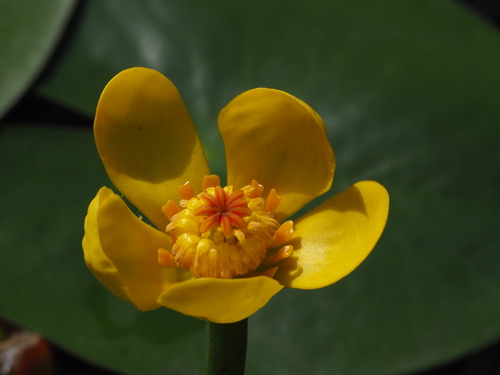
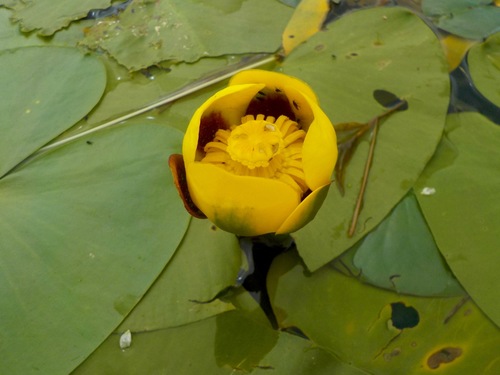
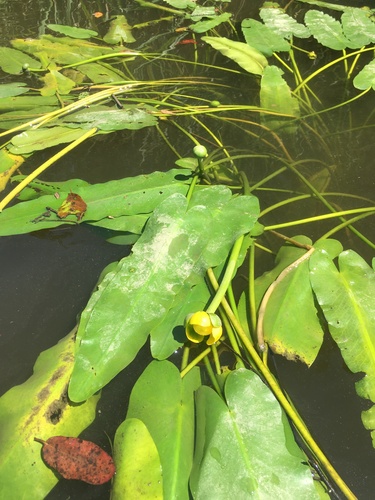
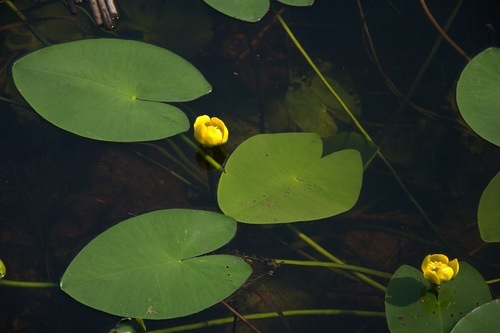
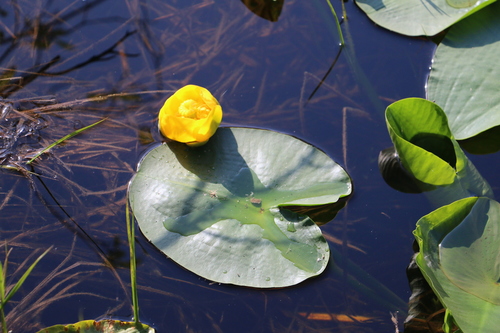
Nuphar polysepala Engelm. is a perennial, rhizomatous, aquatic herb with an extensive root system. Its rhizomes grow up to 5 metres (16 ft) long and 3–8 centimetres (1+1⁄4–3+1⁄4 in) wide; they are spongy, creeping, and branching. Leaves of this species may be submerged or floating on the water surface. Individual leaves are ovate to oblong, measuring 10–45 cm (4–17+1⁄2 in) long and 7–30 cm (3–12 in) wide. The terete leaf petiole can reach up to 2 m (6+1⁄2 ft) in length. Flowers are solitary, borne on stalks, and bisexual, with a width of 5–10 cm. Flowers either float on the water surface or extend above it. They have (6–)9(–12) green to bright yellow sepals, which occasionally develop a red base. The 10–20 thick green to yellow petals are hidden beneath the plant's stamens. The fruit is ovoid to cylindric, strongly ribbed, and measures 4–6(–9) cm long by 3.5–6 cm wide. It produces seeds that are 4 millimetres (1⁄8 in) in length. The documented chromosome count for this species is 2n = 34. This species is native to western North America. It is most commonly found in shallow muddy ponds, ranging from northern Alaska and Yukon southward to central California and northern New Mexico. It is easily recognizable by its large floating leaves and bright yellow blossoms. It grows in slowly flowing streams, ponds, and lakes, in water up to 2.4 meters deep. Ecologically, Nuphar polysepala is pollinated by flies and beetles, and provides shelter for fish. The seeds of Nuphar polysepala are edible; they pop like popcorn when heated, and can be steamed as a vegetable, dried and ground into flour, or cooked like oatmeal. Historically, the seeds were a significant source of carbohydrates for the Klamath and Modoc peoples who inhabit the area near Oregon's Upper Klamath Lake. Traditional uses also include applying leaves and rootstocks to treat ulcerous skin conditions and swelling. An infusion made from rootstock is used traditionally as a gargle for mouth irritation and sore throats, and as a douche for vaginal inflammation. The preparation uses one cup of boiling water to two tablespoons of chopped rhizome.