About Nuphar lutea (L.) Sibth. & Sm.
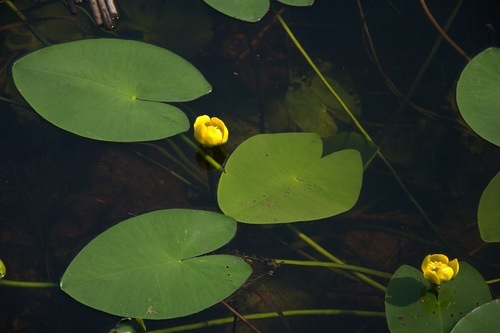
Nuphar lutea (L.) Sibth. & Sm. is an aquatic, rhizomatous perennial herb. It has stout, branching, spongy rhizomes that are 3–8 (up to 15) cm wide. It produces both floating and submerged leaves. Floating leaves are broadly elliptic to ovate, green, and leathery, with an entire margin, a deep sinus, spreading basal lobes, and measure 16–30 cm long by 11.5–22.1 cm wide. The upper (adaxial) leaf surface is glabrous, while the lower (abaxial) surface is either glabrous or pubescent. The petiole is trigonous and 3–10 mm wide. Submerged leaves are very thin with undulate margins and short petioles.
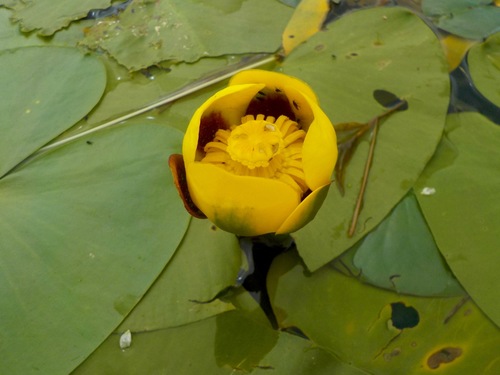
Flowers are fragrant, solitary, yellow, and subglobose, 30–65 mm wide, and are either floating on the water surface or emergent above it. Peduncles are 4–10 mm wide and range from glabrous to pubescent. There are typically 5 (rarely 6) yellow, broadly ovate to orbicular sepals with rounded apices, each 2–3 cm long. The 11–20 inconspicuous obovate petals also have rounded apices, and measure 7.5–23 mm long. The androecium is made up of numerous stamens with yellow anthers 4–7 mm long. Pollen grains are sulcate, spheroidal, and 26–50 μm long. The gynoecium contains 5 to 20 carpels. The stigmatic disk has an entire margin and is 7–19 mm wide.
The fruit is urceolate, green, 2.6–4.5 cm long and 1.9–3.4 cm wide, and is enclosed by persistent sepals. It bears up to 400 ovoid, olive green seeds that are 3.5–5 mm long and 3.5 mm wide.
Nuphar lutea grows in a wide range of aquatic habitats, occurring in both moving and stagnant waters including shallow lakes, ponds, swamps, river and stream margins, canals, ditches, and tidal reaches of freshwater streams. It tolerates waters from alkaline to acidic, and grows from sea level up to mountainous lakes at 3,000 metres in altitude. This species is less tolerant of water pollution than water-lilies in the genus Nymphaea. It grows in shallow water and wetlands, with roots anchored in sediment and leaves floating on the water surface, and can grow in water up to 5 metres deep. It is usually found in shallower water than the white water-lily, and often occurs in beaver ponds.
Because flooded soils are low in oxygen, aerenchyma in the leaves and rhizome transport oxygen from the atmosphere to the rhizome roots. Mass flow typically occurs from young leaves into the rhizome, and out through older leaves. This ventilation mechanism has been the subject of research, as the species provides a substantial benefit to surrounding ecosystems by exhaling methane gas from lake sediments.
Nuphar lutea is native to the region spanning from Europe to Siberia, Xinjiang (China), and northern Algeria. It is extinct in Sicily, Italy, and has been introduced to Bangladesh, New Zealand, and the Russian region of Primorye. This species is used as food.