About Numida meleagris (Linnaeus, 1758)
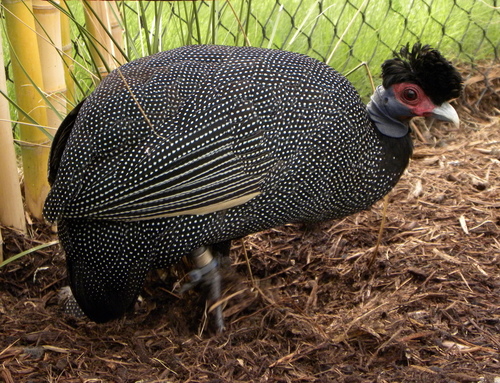
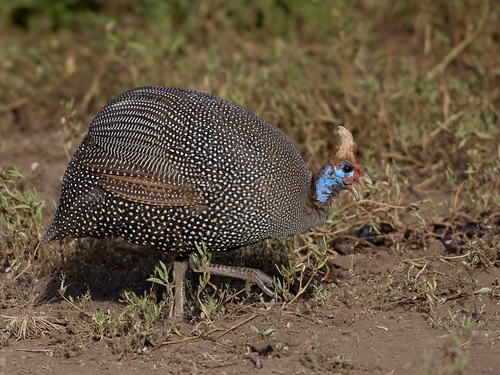
The helmeted guinea fowl (Numida meleagris) is a large bird, measuring 53 to 58 cm (21 to 23 in) in length with a round body and small head, and weighing approximately 1.3 kg (2.9 lb). Its body plumage is gray-black speckled with white. Like other guinea fowl, this species has an unfeathered head; this head features a dull yellow or reddish bony knob, and bare skin in red, blue, or black hues. Both the wings and tail are short and rounded, with the wings also rounded in shape. Multiple subspecies have been proposed, and their main differences in appearance stem from large variation in the shape, size, and colour of the casque and facial wattles.
This species breeds in warm, fairly dry, open habitats with scattered shrubs and trees, such as savanna or farmland. It is a gregarious species, and outside of the breeding season it forms flocks that typically contain around 25 birds, which also roost communally. Helmeted guinea fowl are particularly well-suited to eating large quantities of ticks, which could otherwise spread Lyme disease. These are terrestrial birds that prefer to run rather than fly when alarmed. Like most gallinaceous birds, they have short, explosive flight and rely on gliding to travel longer distances. They can walk 10 km or more in a single day. Their bodies are well adapted for running, and they are very successful at maintaining dynamic stability over rough terrain when moving at speed. They produce loud harsh calls when disturbed.
Their diet includes a variety of both animal and plant foods. During the nonbreeding season, N. meleagris eats grains, tubers, and seeds — especially seeds from agricultural weeds — as well as spilled agricultural crop material. During the breeding season, invertebrates, particularly arthropods like beetles, may make up more than 80% of their diet. Like domestic chickens, helmeted guinea fowl have strong claws and scratch in loose soil to find food, but they rarely uproot growing plants while doing this. As with all members of the Numididae family, they have no spurs. They can live up to 12 years in the wild.
Males often act aggressively toward one another, and engage in aggressive fights that can leave other males bloodied and injured. To make themselves appear more intimidating, males raise their wings upward from their sides, bristle their feathers across their entire bodies, and may rush toward opponents with an open beak. The nest is a well-hidden, usually unlined scrape in the ground, and a normal clutch holds 6 to 12 eggs. The female incubates the eggs for 26 to 28 days. Nests with larger numbers of eggs are generally thought to be the result of more than one female hen using the same nest; the eggs are large, so an incubating bird could not reasonably cover much more than a standard clutch.
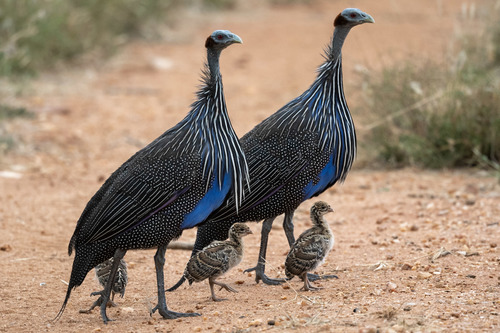
At least domesticated helmeted guinea fowl are known for producing very thick-shelled eggs; when the young birds (called keets by bird breeders) hatch, the egg breaks into fragments instead of leaving two large sections with small chips where the keet broke through the end of the egg. Domesticated guinea hens are not good mothers, and often abandon their nests. Keets have cryptic colouration, and rapid wing growth lets them flutter onto low branches barely a week after hatching.
Helmeted guinea fowl are seasonal breeders. Summer is the peak breeding season, when male testes can weigh up to 1.6 g, while no breeding activity occurs during winter. Serum testosterone levels can reach up to 5.37 ng/ml during the breeding season.